How to Open Your First Business Bank Account: 5 Things to Know First — How-To #005
Yesterday we filed the papers. Today we open the account the papers were for. The bank account is where the separation we have been talking about all week stops being an idea and starts being a balance.
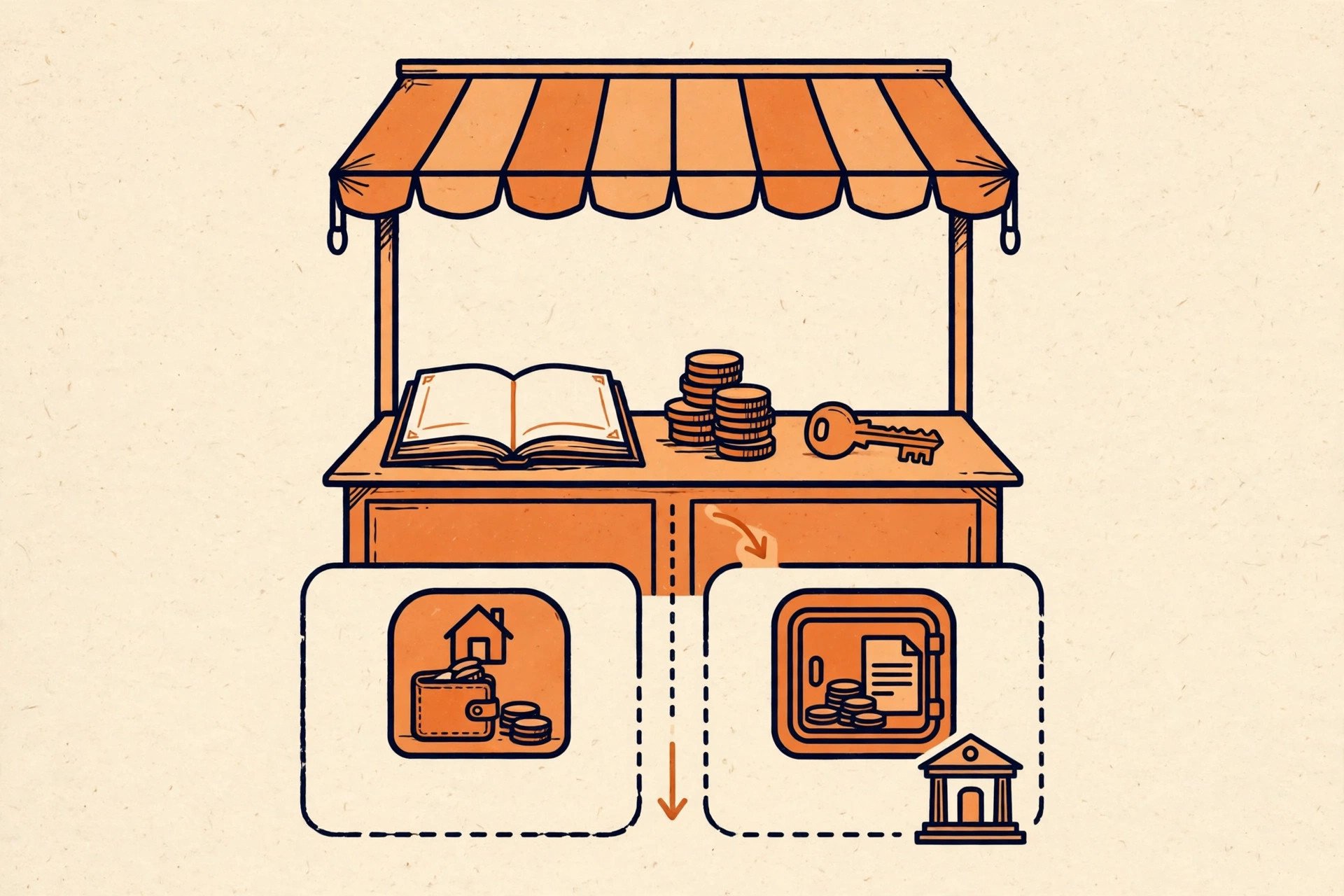
We have a rule for this one, and it fits in a sentence: the business's money lives in the business's account, from the first dollar. Not from the first big dollar. Not from the first tax return. From the first dollar.
Why so strict, so early? Because everything downstream gets easier when the money is separate. Taxes. Bookkeeping. The day a client asks for a refund and you need to show what came in and what went out. Even your own confidence — there is something about watching a business balance grow, apart from your rent money, that makes the business feel real in a way a logo never will.
Read this as general information, not financial advice. Banks differ, states differ, and your situation may call for a conversation with an accountant before you pick. The five things below are the questions to ask, whichever bank you walk into.
Bring the papers that prove the business is real
Banks do not open business accounts on a promise. They open them on paper. Before you go, gather the folder: the EIN letter from the IRS (free from irs.gov — #002 walked it screen by screen), the state formation document if the business is an LLC or corporation, any trade-name registration if you operate under a name that is not your own, and a photo ID.
In New Jersey, used here as an example of any state, the formation document is the certificate filed with the Division of Revenue and Enterprise Services. Readers elsewhere: your state has its own filing office and its own version of that paper, and the bank in your state will know it by sight. Bring the original or a certified copy, not a screenshot of a confirmation email, and keep a copy of everything you hand over.
One more paper, if it applies: the operating agreement or bylaws. Not every bank asks for it, and a single-owner business may not need one to open the account. But if there is more than one owner, bring it. The bank wants to see who is authorized to act for the business, and so will you, the first time a decision gets disputed.
Match the account name to the legal name, exactly
This sounds like fussiness. It is not. The account name should match the legal name on the formation papers, or the registered trade name, spelled exactly — every word, every punctuation mark.
Here is what goes wrong when it doesn't: checks arrive in a name the bank won't accept. A payment processor flags the mismatch. A tax form reports income under one name and the account shows another, and you spend a February afternoon explaining the difference to someone who does not care about your story. Get the name right on day one, and none of that happens.
If you trade under a name that is not your legal name, register that trade name first, then open the account in it. The order matters. The bank follows the paper, not the sign on the door.
Ask about fees before you fall for features
Banks compete on features. Cash-back cards, slick apps, a branch on every corner. Fine. But the number that decides whether an account is cheap or expensive is the fee schedule, and it is written in the small print for a reason.
Ask these four questions, and get the answers in writing: What is the monthly maintenance fee, and what minimum balance waives it? How many transactions are included, and what does each extra one cost? Is there a cash-deposit limit or fee, if your business takes cash? And what opening deposit is required?
We will not quote you a bank's numbers here, because they change, and because the right answer depends on how your business actually moves money. A business that takes mostly cash cares about deposit fees. A business that takes mostly cards cares about transaction limits. Match the account to the money you will really move, not the money you imagine moving someday.
One honest note: a free account that charges you for every deposit past a low limit can cost more than a $15-a-month account that doesn't. Read the schedule like a bill, because that is what it becomes.
Decide who can touch the money — and write it down
For a one-person business, this step is short: you are the signer, you hold the card, and nobody else moves money. Still write it down. Habits set now survive the day you hire help.
For a business with partners, this is the step that prevents the first real argument. Who can sign checks? Who can move money online? Who can only view the balance? Who approves a payment above a certain amount? Decide it while everyone is friendly, put it in the account paperwork, and keep a copy with the operating agreement.
And be careful with cards. Every debit card attached to the account is a door into it. Hand them out like keys, not like business cards. When someone leaves the business, the card gets cancelled the same day — not "when we get around to it." We have seen that movie. It does not end well.
Keep the first month boring on purpose
Here is our stance, plain: the first month of a business account should be boring. Every business dollar in, every business expense out, nothing personal in either direction. No "I'll pay myself back later." No groceries on the business card because it was closer to hand.
Reconcile weekly. Fifteen minutes, once a week, matching the account to your records. That is the whole system at this stage, and it is enough. The businesses that can show a stranger exactly where the money went are the businesses that get loans, survive audits, and settle partner disputes without a lawyer in the room.
The account is the wall, made visible. #003 built the wall on paper. #004 filed it with the state. Today you gave it a balance. Keep it clean, and it will hold.
Questions we get asked
Do I need a business account before my first sale? Not strictly — but the first sale is the easiest moment to start clean, and the hardest moment to recreate later. Open the account before the money arrives, and the first dollar lands in the right place by default.
Can I just use a second personal account? It is better than mixing everything in one account, and plenty of sole proprietors start there. But it is not the same thing: the account is still in your personal name, and the separation a bank account gives an LLC or corporation only fully works when the account belongs to the business. Upgrade when the structure does.
What if my bank asks for something not on this list? Bring it, or ask what it is for. Banks must verify the business and its owners — the exact list varies by bank and by state. A bank that cannot explain what it needs is a bank worth comparing against another one.
How much should I keep in the account? Enough to cover the minimum that waives the fee, plus a cushion for the expenses you already know are coming. Beyond that, the answer belongs to your budget — the money week later in this series covers the personal budget first, and the business budget follows it.
Is this financial advice? No. General information about a standard process. For your situation — taxes, ownership, the right account type — a licensed professional in your state beats any blog post, including ours.
What comes next
This is installment #005 of How to X, closing the "Start Something" formation run — umbrella, EIN, structure, incorporation, and now the account. This evening, #006 turns to the question every new account holder asks next: how do you start a side hustle that actually pays? Morning and evening, one step a day. Papers first, money second, habits always.
Liked this? Build with it.
Get a free ebook copy of Rebuilding Justice: An Employment-Based House Arrest Story of Redemption when you join the Changenaire Weekly Newsletter. Plus one email a week. Zero fluff.
Free forever. A free ebook copy of Rebuilding Justice: An Employment-Based House Arrest Story of Redemption, then one email a week. Unsubscribe anytime.
Building something?
Get a free ebook copy of Rebuilding Justice: An Employment-Based House Arrest Story of Redemption when you join the Changenaire Weekly Newsletter.
Get my free ebook