

Start with Why: Say the Belief Before You Sell the Thing — Book Deep-Dive #008
Disclosure: some links on this page are affiliate links. If you buy through one, Changenaire may earn a commission at no extra cost to you. As an Amazon Associate, Changenaire earns from qualifying purchases made through links on this page.
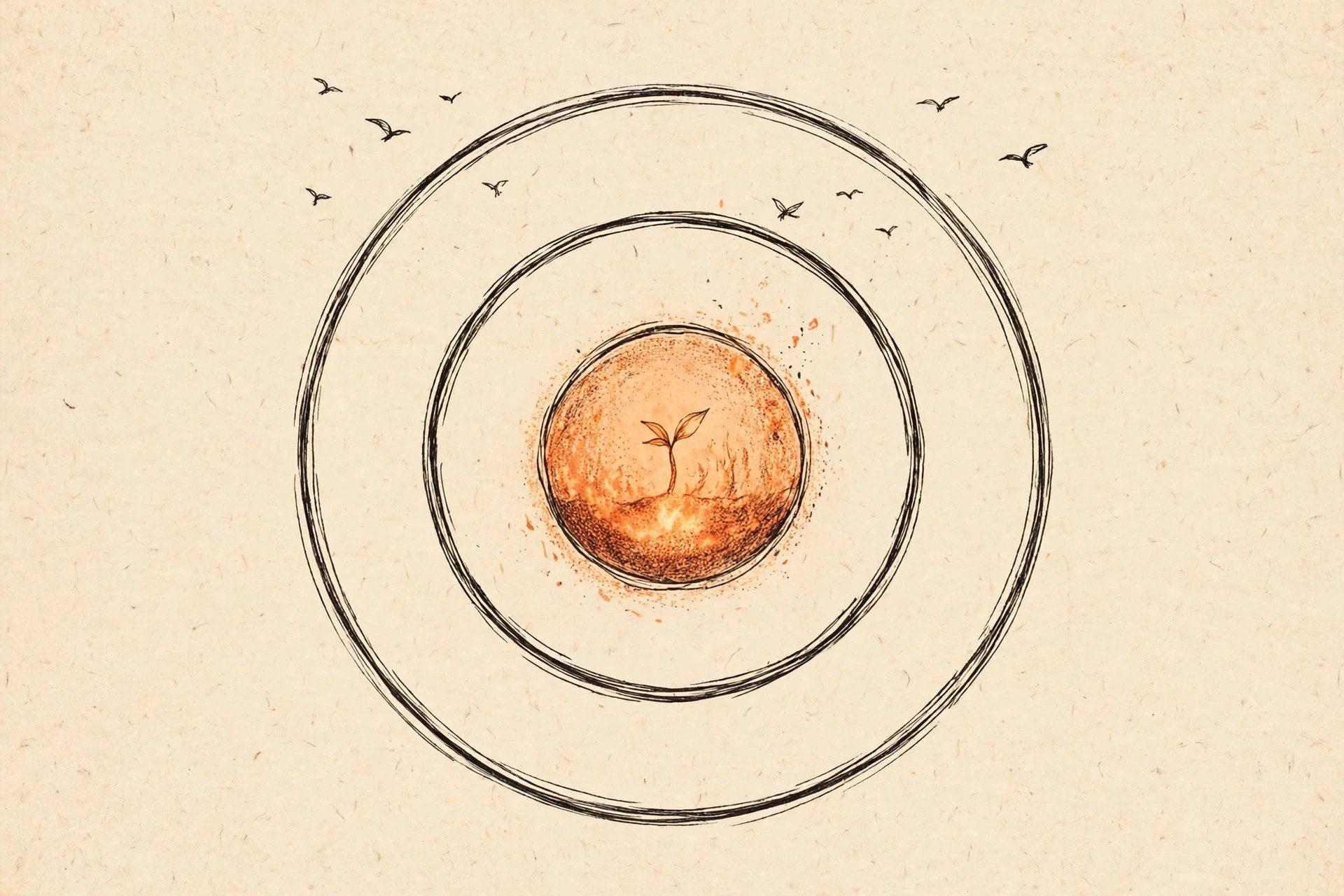
People don’t buy what you do. They buy why you do it. That is the whole book in one sentence, and if your business can’t say why it exists in a sentence a stranger can repeat, no feature list or discount will cover for it. Simon Sinek published Start with Why (Amazon Associates link — we may earn a commission) in October 2009 — a little over 250 pages, built from a TEDx talk he gave the month before that has since passed 70 million views on TED.com. Sinek wasn’t writing from a mountaintop. He was an ad man who had started his own consultancy and then lost his own spark for it, and the book is his answer to a question he was asking himself: why do some leaders and companies inspire loyalty that looks almost unreasonable, while others with better funding and better products can barely hold attention? His answer fits on a napkin. Three rings. Why at the center, How around it, What on the outside — and the order you talk about them changes everything.
Here’s the book in one line: say the belief before you sell the thing — because a customer who believes what you believe will stay, and a customer who only liked your price will leave the moment someone cheaper shows up.
We put this book eighth on the shelf for a reason. Rework (#007) told you to build less and skip the meeting. This one asks what the smaller thing you built is actually for. The two books rhyme on purpose: one trims the work down to what matters, the other names why any of it matters at all. If #007 was the discipline, #008 is the direction.
Key takeaways
- The Golden Circle: Why at the center, How around it, What on the outside — talk from the inside out, not the outside in.
- People buy why, not what: a customer who believes what you believe stays; a customer who only liked your price leaves when someone cheaper appears.
- Trust lives where language doesn’t: the part of the brain that decides loyalty runs on feeling, not features — so a spec sheet never inspires anyone.
- Movements tip at 15–18%: win the believers first, and the majority follows. Seek the majority first, and you stall.
- Manipulation works once; inspiration works for years: discounts, pressure, and fear buy a sale. A clear why buys a customer who brings friends.
The Golden Circle — three rings, one order
Every business can answer What. We sell candles. We do bookkeeping. We fix roofs. Most can answer How, too — the process, the quality, the thing that makes them a bit different. Almost nobody can answer Why clearly. Why does the business exist beyond making money? What belief made it worth starting?
Sinek’s Golden Circle is three rings, drawn like a target. Why at the center. How in the middle. What on the outside. The model isn’t the insight — the order is. Most companies communicate from the outside in: here’s what we sell, here’s how it’s better, here’s the price. The companies people love do the reverse. They start with the belief and let the product follow.
Apple is the book’s famous case, and it still holds up. Apple doesn’t open with a chip speed. It opens, in effect, with a belief — that the status quo should be challenged, that tools should be beautiful and simple — and then the computer, the phone, the watch all make sense as proof of the same belief. The what changes every year. The why doesn’t. That’s the point of the circle: products come and go, but a why you can say in one sentence outlives all of them. A why also makes decisions cheaper. Sinek calls it the celery test — if you know what you believe, you know what to buy at the store, what to charge, who to hire, and what to turn down, without a committee.
People buy why, not what
The line gets quoted so often it risks sounding like a poster. The book earns it with two stories that have nothing to do with business at all.
The first is Martin Luther King Jr. He didn’t gather a quarter of a million people in Washington with a plan. He gathered them with a dream — a sentence about the future that people could see themselves inside. Nobody marched because the logistics were good. They marched because the belief was clear, and the belief did the recruiting.
The second is the Wright brothers. They beat Samuel Langley, a man with a government grant, a Smithsonian post, and the best minds money could hire, to powered flight. The Wrights had a bicycle shop, a few hundred dollars of their own money, and a team that worked for a belief — that flight would change the world. Langley had funding and quit the day someone else flew first. The Wrights had a why and kept going. Money hires hands. Belief hires believers. That difference is the whole book, and it’s why the argument lands for a one-person business as hard as for a big one: your why is the cheapest marketing you will ever have, and it’s the only kind a competitor can’t copy by spending more.
Trust lives where language doesn’t
Sinek doesn’t just assert the Golden Circle — he ties it to how the brain is built, and the biology is the part that makes the book stick.
The outer brain, the neocortex, handles rational thought and language. It understands features, prices, and comparisons. The inner brain, the limbic system, handles feelings — trust, loyalty, gut calls — and it has no capacity for language. That’s the mismatch the book is built on: the part of the brain that decides whether to trust you can’t be argued with, because it doesn’t speak. It responds to feeling, not facts.
Read that again, because it explains most bad marketing. A list of specifications talks to the neocortex. It can win an argument and still lose the customer, because the part that decides never heard a word it understands. A clear why talks to the limbic brain first — here is what we believe, here is why it matters — and then the facts arrive as proof of a decision the gut already made. That’s also why people struggle to explain their own loyalty. Ask someone why they love a brand and they’ll talk about the product. They mean the feeling. The product was the receipt, not the reason.
Movements tip at 15–18% — win the believers first
The last big idea is the Law of Diffusion, borrowed from the sociologist Everett Rogers. Every new idea spreads through a population in the same order: a few innovators (about 2.5%), then early adopters (about 13.5%), then the early majority, the late majority, and finally the laggards who only move when everyone else already has.
The tipping point sits at 15 to 18% — the moment the innovators and early adopters together are enough that the majority starts to follow on its own. Sinek’s warning is about who you seek. Most businesses aim straight at the majority, because that’s where the money is, and they stall — because the majority doesn’t try new things. It waits. The early adopters are the ones who buy the belief, not the product. Win them, and the majority comes to you. Seek the majority first, and you’re shouting at people who are professionally good at waiting.
For a builder, this is the most practical chapter in the book. Your first ten customers are not a random sample of the market. They’re the believers — the people who share the why and want to be early. Serve them like they matter, because they’re the whole strategy: they’re the ones who tell the next hundred. A discount can buy a first sale from the majority. It can’t buy a believer, and believers are the only customers who recruit.
Use it this week
First, write your why in one sentence — no jargon, no “solutions,” no “world-class.” A stranger should be able to repeat it back after hearing it once. If you can’t, that’s the work, and it’s worth an honest hour. Second, rewrite the first line of your homepage, your bio, and your best-selling listing so the belief comes before the product. Read the old line and the new line out loud; the new one should sound like a person, not a catalog. Third, run the celery test on one real decision this week — a price, a hire, a feature, a partnership — and ask whether the choice proves what you believe or contradicts it. If it contradicts it, say no and watch nothing break. Fourth, find your first ten believers, not your first ten buyers: the people who already share the why, and ask them what they’d tell a friend. Their words are your next piece of marketing, and they’ll be better than anything you write alone. Fifth, watch one sales call or one pitch and count how many sentences start with what. Flip the order once, just once, and listen for the difference.
Who should skip this book
If you need a step-by-step plan for running a business, this isn’t it — there are no templates, no budgets, no hiring scripts. If you sell a commodity where price is the whole game and you’re fine with that, the book will feel like a luxury you can’t afford, and it won’t argue you out of it. If you’re already allergic to big-brand case studies, brace yourself: Apple and King return again and again, and Sinek has told these stories in every book since, so the examples will feel familiar fast. And if you want the biology held to lab standards, skip it — the brain argument is a simplified sketch, not neuroscience, and it does more persuading than proving.
One honest note before you buy: the book is one framework, repeated well. The Golden Circle is a strong lens, and Sinek looks at almost everything through it — Apple, King, the Wrights, the military, the civil rights movement. That’s the book’s strength and its limit: it makes one big claim and defends it from every angle, but it doesn’t test what happens when the why is clear and the product still isn’t good enough. A belief won’t save a business that can’t deliver. Read it as the first chapter of your strategy, not the whole book of it — pair the why with a product people will pay for twice, and the circle holds.
Questions people ask
What is the Golden Circle?
Three rings. Why sits at the center — your purpose, cause, or belief. How wraps around it — the values and actions that set you apart. What sits on the outside — the products or services you sell. Most businesses talk from the outside in, starting with what. The book argues the inspiring ones talk from the inside out, starting with why.
Is “start with why” just a slogan for your website?
No — it’s a test for every decision the business makes. Sinek’s “celery test” is the short version: if your why is real, it tells you what to do at the store, what to charge, who to hire, and what to turn down. A why that only lives on the homepage isn’t a why, it’s decoration.
Can a small business use this, or is it for big brands like Apple?
It’s written for the small builder first. Apple is the famous example, but the book’s other cases are a two-man bicycle shop that beat a government-funded rival and a preacher with a dream and no plan. A clear why costs nothing, and for a one-person business it’s the cheapest marketing there is.
Does the book say price and quality don’t matter?
No. A product still has to work and the price still has to make sense. The argument is that features and price are the wrong place to start the conversation — they explain a purchase after the fact, but they don’t inspire it. People choose with feeling first, then use the facts to justify the choice they already made.
See it on Amazon → (Amazon Associates link — we may earn a commission)
Read this next: The Infinite Game by Simon Sinek — what a purpose-led company does over decades, not quarters. (Amazon Associates link — we may earn a commission)
From the Book Club shelf: browse all fifteen picks.
Sources
Figures in this guide are as of November 2026 unless noted.
- Rework — Simon Sinek’s Leadership Philosophy: Start With Why — the TEDxPugetSound talk (September 2009, “How Great Leaders Inspire Action”, more than 70 million plays on TED.com as of September 2026); Portfolio published Start With Why in 2009, with a 15th-anniversary edition in May 2025; the Golden Circle, three rings with Why at the center.
- The Executive Insight — Simon Sinek Golden Circle — the TED talk logged 71,364,039 plays when checked on November 6, 2026; Sinek’s own definition of Why as “your purpose, cause, or belief.”
- LoveReading — Start With Why by Simon Sinek — published October 29, 2009 by Portfolio, an imprint of Penguin Publishing Group; basis for one of the most popular TED Talks of all time.
Subscribe for more free step-by-step how-to guides to help you get more things done to grow your business or project everyday.
Unsubscribe anytime.