
Ankle Mobility for Sitters: Move Freely — Fitness #020
Your ankles do not move much when you sit all day. They stay bent at one angle, hour after hour. Then you stand up, and they feel stiff and slow. Five minutes of ankle work can wake them up. This guide gives you three moves: a calf stretch, ankle circles, and heel raises.
Disclosure: some links on this page are affiliate links. As an Amazon Associate, Changenaire earns from qualifying purchases made through links on this page, at no extra cost to you.
Key takeaways
- Three moves: the wall calf stretch, ankle circles, and heel raises — all done at your desk or a wall.
- Hold each calf stretch for about 30 seconds, breathe freely, and never bounce — the Mayo Clinic rule.
- Ankle circles move the joint in every direction — 10 slow circles each way, each foot.
- Heel raises build the calf muscles that steady your step — 10 slow raises, twice a day to start.
- Pain, swelling, or an ankle that gives way is a sign to stop and call your doctor.
Health note: This guide is education, not medical advice. It describes general techniques for healthy adults. Talk to your doctor before starting a new exercise routine — especially if you have a health condition, an injury, or pain that keeps coming back. If a movement hurts, stop.
Who this is for: anyone who sits all day and stands up to stiff ankles — or anyone whose first steps of the day feel slow. Who should check first: anyone with a sprained or swollen ankle, pain that keeps coming back, or an ankle that gives way — talk to your clinician before starting, and skip any move that hurts.
Go deeper (affiliate link — we may earn a commission): you need nothing to buy for this routine — a wall and a chair do the job, and the moves below are the whole program. If you want a band to add gentle pull to the ankle moves, the Fit Simplify Resistance Loop Exercise Bands, Set of 5 is the set we would hand you: five color-coded bands with a carry bag and a guide, and the top seller in resistance bands. Skip it if you only want the routine — it is all below, free, and it is enough to start.
Your ankles are the base of every step. They bend, turn, and catch you all day — until you sit for hours, and they forget how. Stiff ankles make stiff steps. The fix is small: move them through their full range, a few minutes a day. Strong for the long build — five minutes, at your desk, every day. This guide is part of the Fitness hub, and it pairs with hip and hamstring mobility for sitters, which loosens the legs above the ankle, and with how to get 7,000 steps on a workday, which gives your fresh ankles somewhere to go.
Step 1: the wall calf stretch — 30 seconds per leg
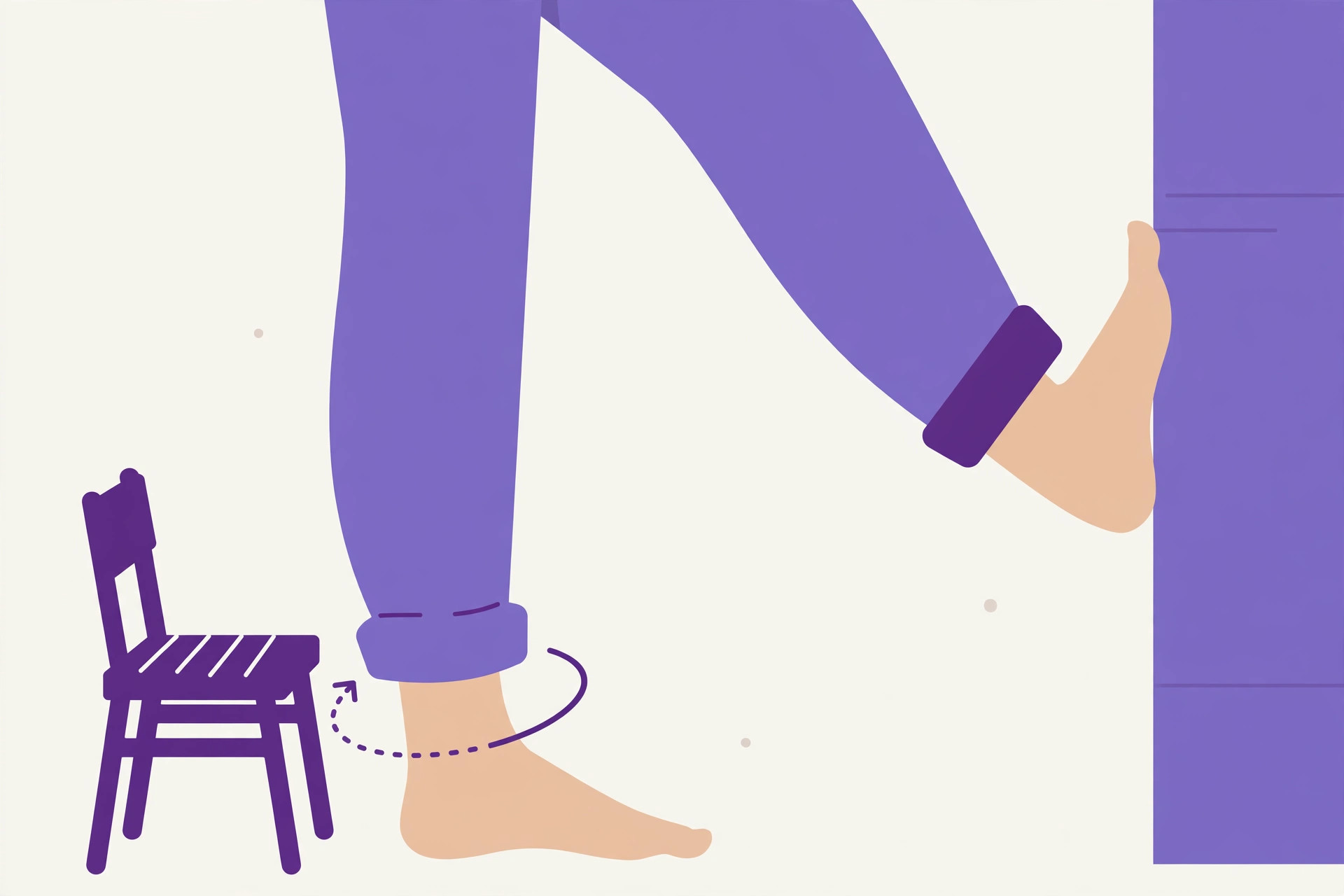
Stand facing a wall, hands on the wall, one arm’s length away. Step your right foot back, heel down on the floor, knee straight. Bend your front knee until you feel the pull in the back calf. Hold for 30 seconds. Breathe slow. Switch legs.
Keep the back heel down. The heel is the whole point — if it lifts, the stretch leaves the calf. The Mayo Clinic says to hold each stretch for about 30 seconds, breathe freely, and never bounce (checked November 2026). Push your hands into the wall for a little more pull, the way Mayo Clinic shows the calf stretch.
Easier: stand closer to the wall and bend the front knee less. Harder: hold for 45 seconds, or do a second round.
Step 2: ankle circles — 10 each way
Sit in a chair, feet flat on the floor. Lift your right foot a few inches. Draw slow circles with your big toe — 10 one way, then 10 the other way. Put the foot down. Switch feet. That is one set — do 2 sets per foot.
Make the circles big and slow. The ankle moves in every direction here — up, down, in, out, and around. Small, fast circles do nothing. Big, slow ones wake the joint up. If a spot feels tight, pause there and breathe.
Easier: rest the heel on the floor and circle from there. Harder: circle with the leg held out straight.
Step 3: heel raises — 10 slow lifts
Stand behind a chair, hands light on the chair back. Feet hip-width apart. Rise up on your toes, slow, for 2 counts. Hold for 1 second at the top. Lower down slow, for 3 counts. That is one rep — do 10 reps, rest, and repeat for 2 sets.
Slow down, not fast up. The lowering is the work — it asks the calf to hold you while it lets go. If you bounce at the top, slow down. The NIA lists heel raises with the one-leg stand and the heel-to-toe walk as moves that build steadier legs (checked November 2026).
Easier: do 5 reps per set, or hold the chair with both hands. Harder: do one leg at a time, with the other foot just off the floor.
Step 4: the band pull and the 5-minute desk routine
Loop the lightest band around the ball of one foot. Hold the ends in your hands. Point your toes away from you, slow, against the band. Hold for 2 seconds. Pull the toes back toward you, slow. That is one rep — do 10 reps per foot. Then turn the foot in, then out, against the band, 10 reps each way.
Put it together like this each day: calf stretch at the wall, 30 seconds per leg; ankle circles at your desk, 10 each way; heel raises at the chair, 10 reps. That is about 5 minutes. Do it once a day, or split it up — circles while you wait for a call, the stretch when you stand up.
Easier: skip the band and do the first three moves only. Harder: move to the next band up when 10 reps feel easy.
At a glance
| Step | The short version |
|---|---|
| The rule | Heel down in the stretch, slow circles, slow raises — stop if it hurts |
| Step 1: wall calf stretch | 30 seconds per leg, back heel down, hands on the wall |
| Step 2: ankle circles | 10 slow circles each way, each foot, 2 sets |
| Step 3: heel raises | 10 slow reps, 2 sets, lower for 3 counts |
| Step 4: band pull + daily plan | 10 band reps each way, then all three moves in 5 minutes |
Common mistakes
Bouncing in the stretch. You bounce at the wall to push deeper, and the calf tightens up instead. Fix: hold still and breathe — the depth comes on its own.
Letting the heel lift. Your back heel comes off the floor in the calf stretch, and the stretch leaves the calf. Fix: step back less, and keep the heel glued down.
Rushing the circles. Fast, small circles do nothing for the joint. Fix: make each circle big and slow, and count them out loud.
Skipping one side. You do the stiff ankle and skip the good one, and the gap grows. Fix: always do both sides, even when one feels fine.
Can't do today?
Do the 2-minute version at your desk: 10 ankle circles each way, each foot, seated in your chair. That is the whole fallback, and it counts. The missed-day rule is simple: let it go — do today’s moves today, never double up to catch yesterday. What counts as enough: circles and one calf stretch a day, with the full 5-minute routine most days.
Questions people ask
Why do my ankles feel stiff after sitting?
They stay in one spot for hours, bent at the same angle. Joints like to move — a few minutes of circles and stretches wakes them back up.
How often should I do ankle exercises?
Daily, in short bursts — this plan takes 5 minutes. The NIA asks for about three balance sessions a week, and ankle work fits well inside them.
Can ankle exercises help my balance?
Yes. Your ankles steady your step — when they move well, you stand well. Pair this routine with single-leg stands for the full effect.
What if my ankle hurts when I move it?
Stop. Pain, swelling, or an ankle that gives way is a sign to call your doctor before trying again — the health note at the top of this guide says the same.
What comes next
Keep the five minutes, and let the ankles loosen up. When the circles feel easy, add the band pull every day — and then hip and hamstring mobility loosens the legs above the ankle, while how to get 7,000 steps on a workday puts your fresh ankles to use.
Sources
Every fact in this post was checked against the sources below in November 2026.
- Mayo Clinic — Stretching and flexibility (checked November 2026) — hold each stretch for about 30 seconds; breathe freely; do not bounce.
- Mayo Clinic — What it takes to be flexible at any age (checked November 2026) — a calf stretch with the hands pushed into a wall, held for 10 to 15 seconds.
- National Institute on Aging — Three Types of Exercise Can Improve Your Health and Physical Ability (checked November 2026) — about three balance sessions a week; heel raises, one-leg stands, and heel-to-toe walks are on the list.
- Fit Simplify Resistance Loop Exercise Bands, Set of 5, ASIN B01AVDVHTI — the resistance bands recommended in this post.
Subscribe for more free step-by-step how-to guides to help you get more things done to grow your business or project everyday.
Email required. Unsubscribe anytime.
Read our Privacy Policy.