
Morning Yoga Flow for Stiff Beginners — Fitness #021
You wake up stiff. Your back is tight. Your hips feel locked. Your neck cracks when you turn it. Ten slow minutes of yoga can change how the whole morning feels. This flow uses six gentle poses, in order, with slow breath all the way through.
Disclosure: some links on this page are affiliate links. As an Amazon Associate, Changenaire earns from qualifying purchases made through links on this page, at no extra cost to you.
Key takeaways
- Six poses, ten minutes, one slow breath per move — cat-cow, forward fold, low lunge, chair pose, and a rest at the end.
- Move with your breath: breathe in as you open up, breathe out as you fold or sink down.
- Hold each pose for about 30 seconds, breathe freely, and never bounce — the Mayo Clinic rule.
- Yoga can build strength, stretch, and balance all at once, says Harvard Health Publishing.
- Pain means stop. A gentle pull is the target; sharp pain means you have gone too far.
Health note: This guide is education, not medical advice. It describes general techniques for healthy adults. Talk to your doctor before starting a new exercise routine — especially if you have a health condition, an injury, or pain that keeps coming back. If a movement hurts, stop.
Who this is for: anyone who wakes up stiff from sitting all day — neck tight, hips locked, back wound up. Who should check first: anyone with sharp, shooting, or worsening pain, or a recent injury or surgery — talk to your clinician before starting, and skip any pose that hurts.
Go deeper (affiliate link — we may earn a commission): you need nothing to buy for this flow — a rug and the floor do the job, and the poses below are the whole program. If you want to go deeper on how each pose works, the Yoga Anatomy by Leslie Kaminoff and Amy Matthews shows each pose with the muscles it uses, in plain pictures. Skip it if you only want the flow — it is all below, free, and it is enough to start.
Morning stiffness is normal after a night of stillness. Your joints have not moved for hours. Your muscles are cool and short. The fix is not a hard workout. It is slow, gentle motion that warms you up a little at a time. Strong for the long build — ten minutes, every morning, on the floor. This guide is part of the Fitness hub, and it pairs with yoga for absolute beginners, which teaches five first poses in the same slow pace, and with desk stretches for people who sit all day, the daytime version of this same idea.
Step 1: wake the spine — easy breath and cat-cow
Sit tall on your mat, legs crossed, hands on your knees. Breathe in slow through your nose for 4 counts. Breathe out slow through your mouth for 6 counts. Do that 3 times. Then get on hands and knees, hands under shoulders, knees under hips.
Breathe in, let your belly drop, and lift your head. Breathe out, round your back up, and tuck your chin. Move slow, one breath per shape, 5 rounds. Your spine wakes up a little with each round. If a shape feels stiff, stay in it for one more breath.
Easier: do 3 rounds instead of 5. Harder: hold each shape for 2 breaths instead of 1.
Step 2: the standing fold — forward fold and halfway lift
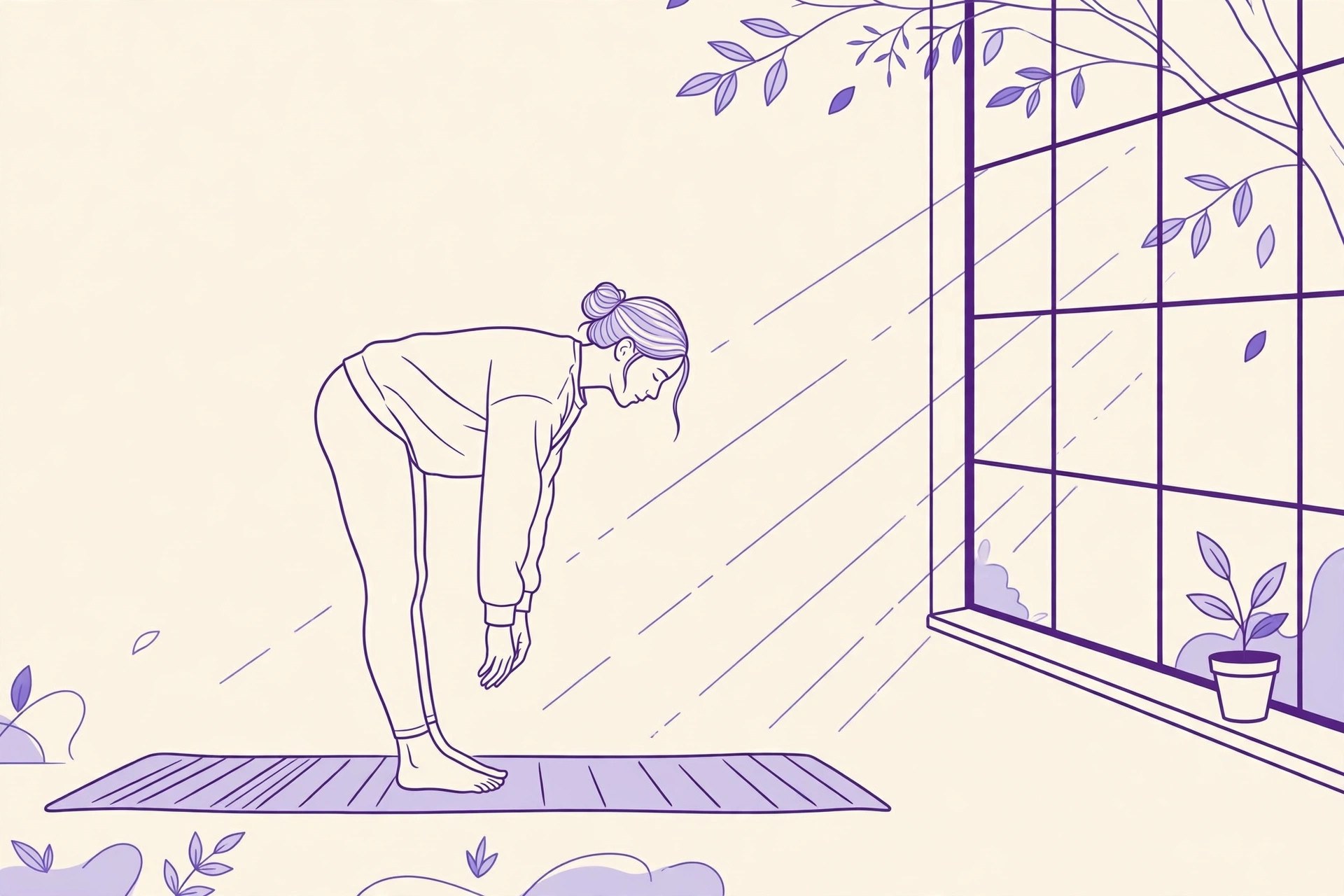
Stand up, feet hip-width apart, arms at your sides. Breathe in, reach your arms up high. Breathe out, fold forward from the hips, knees soft, hands toward the floor. Let your head hang heavy. Hold for 30 seconds.
Put your hands on your shins and lift your chest halfway up. Keep your back flat, like a table top. Hold for 5 slow breaths. Then fold forward again for 30 seconds. The Mayo Clinic says to hold each stretch for about 30 seconds, breathe freely, and never bounce (checked November 2026).
Easier: bend your knees a lot in the fold. Harder: hold the fold for 45 seconds.
Step 3: the low lunge and the chair pose — legs wake up
Step your right foot back into a low lunge. Left knee bent over the left ankle, right knee on the floor. Hands on the floor or on your front knee. Hold for 30 seconds. Breathe slow. Switch legs. Then stand up, feet together, and sit back like you are sitting in a chair, arms up.
Hold the chair pose for 5 slow breaths. Your thighs will work hard here — that is the point. Keep your chest up and your weight in your heels. The Harvard Health Publishing notes that yoga can build strength, stretch, and balance all at once (checked November 2026), and this step is where the strength part lives.
Easier: put your hands on your thighs in the chair pose. Harder: hold the chair pose for 8 breaths.
Step 4: rest and the 10-minute morning plan
Sit back on your heels, arms out long in front of you. Rest your forehead on the mat. Breathe in for 4 counts, out for 6 counts, for one minute. That is the end of the flow. You are warm, loose, and awake — and you did not rush once.
Put it together like this each morning: 3 slow breaths, 5 rounds of cat-cow, the standing fold twice, a low lunge per side, the chair pose, and one minute of rest. That is about 10 minutes. The CDC asks adults for muscle work on at least 2 days a week (checked November 2026), and this flow counts as a gentle start on those days.
Easier: do steps 1 and 4 only, for 5 minutes. Harder: run the whole flow twice.
At a glance
| Step | The short version |
|---|---|
| The rule | Slow breath, 30 seconds a pose, never bounce — stop if it hurts |
| Step 1: wake the spine | 3 slow breaths, then cat-cow for 5 rounds |
| Step 2: the standing fold | Forward fold 30 seconds, halfway lift 5 breaths, fold again |
| Step 3: lunge and chair pose | Low lunge 30 seconds per side, chair pose 5 breaths |
| Step 4: rest and the plan | One minute of rest, then the whole flow in 10 minutes |
| Weekly rhythm | Every morning, or at least a few times a week |
Common mistakes
Rushing the breath. You move fast and forget to breathe, and the flow turns into a race. Fix: one breath per move — if the breath is short, slow down.
Forcing the fold. You push to touch the floor, and your back complains. Fix: bend the knees as much as you need — the fold is for your back, not your toes.
Holding your breath in the chair pose. Your thighs burn, so you hold your breath with it. Fix: breathe out slow through the whole hold, and come up early if you need to.
Skipping the rest. You finish the chair pose and jump straight into your day. Fix: take the one minute of rest — it is part of the flow, not a bonus.
Can't do today?
Do the 2-minute version on the floor: 3 slow breaths and 3 rounds of cat-cow. That is the whole fallback, and it counts. The missed-day rule is simple: let it go — do this morning’s flow this morning, never double up to catch yesterday. What counts as enough: a few mornings a week, with the 2-minute version on the other mornings.
Questions people ask
Do I need to be flexible to start yoga?
No. Stiff is the starting point, not a problem. Bend your knees, use a chair for balance, and let the poses meet you where you are.
Should I do yoga before or after breakfast?
Before is fine on an empty stomach, or wait an hour after eating. A full stomach makes folds and twists feel tight.
How long should I hold each yoga pose?
About 30 seconds, says the Mayo Clinic. Breathe freely the whole time, and do not bounce.
What if a pose hurts?
Come out of it. A gentle pull is the target; sharp pain means you have gone too far. If pain keeps coming back, talk to your clinician before trying again.
What comes next
Keep the ten minutes, and let the mornings get easier. When the flow feels easy, hold each pose a little longer — and then yoga for absolute beginners gives you five first poses to add to the flow, while hip and hamstring mobility for sitters goes deeper on the hips that wake up last.
Sources
Every fact in this post was checked against the sources below in November 2026.
- Harvard Health Publishing — Yoga: Benefits Beyond the Mat (checked November 2026) — all types of yoga can build strength, flexibility, and balance; slow, deep breathing helps lower blood pressure and heart rate.
- Mayo Clinic — Stretching and flexibility (checked November 2026) — hold each stretch for about 30 seconds; breathe freely; do not bounce; stretch after muscles are warm.
- CDC — What You Can Do to Meet Physical Activity Recommendations (checked November 2026) — adults need muscle-strengthening activity on at least 2 days a week.
- Yoga Anatomy by Leslie Kaminoff and Amy Matthews, ASIN 1492596477 — the yoga book recommended in this post.
Subscribe for more free step-by-step how-to guides to help you get more things done to grow your business or project everyday.
Email required. Unsubscribe anytime.
Read our Privacy Policy.