
A 5-Move Desk Workout: Strength at Work — Fitness #023
You do not need a gym to get stronger. You need a desk, a wall, and ten minutes. These five moves work your legs, chest, arms, and calves — the muscles that go quiet when you sit all day. Do them between calls, and get back to work a little stronger.
Disclosure: some links on this page are affiliate links. As an Amazon Associate, Changenaire earns from qualifying purchases made through links on this page, at no extra cost to you.
Key takeaways
- Five moves, all at your desk: sit-to-stand, desk push-up, seated march, wall sit, and calf raises.
- Do 10 reps of each move, rest a minute, and repeat for 2 rounds — about 10 minutes total.
- Rest a day between hard sessions for the same muscles — the Mayo Clinic rule.
- Adults need muscle work on at least 2 days a week, says the CDC.
- Pain means stop. A dull burn in the muscle is normal; sharp pain in a joint is not.
Health note: This guide is education, not medical advice. It describes general techniques for healthy adults. Talk to your doctor before starting a new exercise routine — especially if you have a health condition, an injury, or pain that keeps coming back. If a movement hurts, stop.
Who this is for: anyone who sits all day and wants to get stronger without a gym. Who should check first: anyone with sharp joint pain, a recent injury or surgery, or a health condition that limits exercise — talk to your clinician before starting, and skip any move that hurts.
Go deeper (affiliate link — we may earn a commission): you need nothing to buy for this workout — your desk and a wall do the job, and the moves below are the whole program. If you want a little weight for later, once your own weight feels easy, the Amazon Basics Neoprene Dumbbell Hand Weights, 3 Pounds, Pair is the pair we would hand you: light, easy to grip, and small enough to keep by your desk. Skip it if you only want the routine — it is all below, free, and it is enough to start.
Your body weight is enough weight. You carry it all day. These five moves use it on purpose — slow, with good shape, and with rest between rounds. No jump. No rush. No gear. Strong for the long build — ten minutes, twice a week, at your own desk. This guide is part of the Fitness hub, and it pairs with the bodyweight strength starter, the 20-minute home version of this same idea, and with the push-up progression from zero, which takes the desk push-up all the way to the floor.
Step 1: sit-to-stand — legs, 10 reps
Sit in your chair, feet flat, hip-width apart. Lean forward a little. Stand up slow, without using your hands. Stand tall. Then sit back down slow, and do not plop. That is one rep — do 10 reps.
Push through your heels as you stand. Keep your knees over your toes, not caving in. If standing without hands is hard, put one hand on the desk for help. The NIA lists strength work with aerobic and balance work, and asks for about three sessions a week (checked November 2026).
Easier: use both hands on the desk and do 5 reps. Harder: stand up slow for 3 counts, and sit down slow for 3 counts.
Step 2: desk push-up — chest and arms, 10 reps
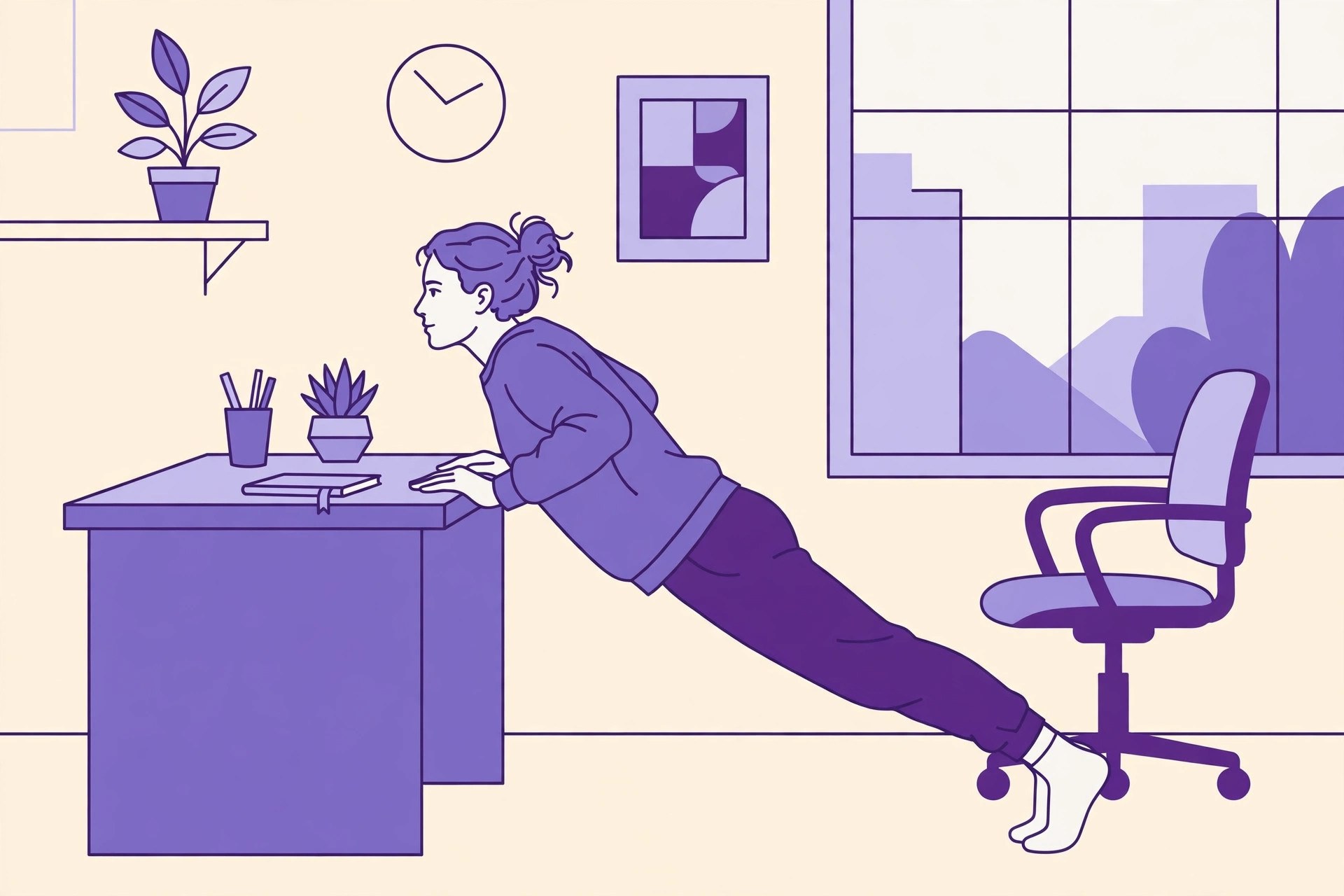
Stand an arm’s length from your desk, hands on the desk edge, shoulder-width apart. Walk your feet back until your body makes a straight line from head to heels. Bend your elbows and lower your chest toward the desk. Push back up. That is one rep — do 10 reps.
Keep your body in one straight line. Do not let your hips sag or your back arch. If the desk moves, brace it against a wall first. The Mayo Clinic says to start light and build up slow, and to rest a day between sessions for the same muscles (checked November 2026).
Easier: stand closer to the desk, so your body is more upright. Harder: step your feet farther back for a longer line.
Step 3: seated march and wall sit — hips and thighs
Sit tall in your chair, feet flat. Lift your right knee up high, then set it down. Lift your left knee up high, then set it down. That is one march per leg — do 10 marches per leg. Then stand with your back flat against a wall, feet a step out, and slide down until your thighs are near level with the floor.
Hold the wall sit for 10 seconds. Breathe slow. Slide back up. Rest, and repeat for 3 holds. Your thighs will burn — that dull burn is the muscle working. Sharp pain in a knee is not the muscle working. Stop if a joint hurts.
Easier: march 5 times per leg, and hold the wall sit for 5 seconds. Harder: hold the wall sit for 20 seconds.
Step 4: calf raises and the 10-minute circuit
Stand behind your chair, hands light on the chair back. Rise up on your toes, slow, for 2 counts. Hold for 1 second at the top. Lower down slow, for 3 counts. That is one rep — do 10 reps.
Put it together like this: 10 sit-to-stands, 10 desk push-ups, 10 marches per leg, 3 wall sits, and 10 calf raises. Rest a minute. Do the whole round again. That is about 10 minutes. The CDC asks adults for muscle work on at least 2 days a week (checked November 2026) — two desk workouts a week already meets the ask.
Easier: do one round only. Harder: add a third round, or hold a dumbbell in each hand for the marches.
At a glance
| Step | The short version |
|---|---|
| The rule | Slow reps, straight lines, rest a day between hard days — stop if a joint hurts |
| Step 1: sit-to-stand | 10 slow reps, push through your heels |
| Step 2: desk push-up | 10 reps, body in one straight line, hands on the desk edge |
| Step 3: march and wall sit | 10 marches per leg, then 3 wall sits of 10 seconds |
| Step 4: calf raises + circuit | 10 slow raises, then 2 rounds of all five moves |
| Weekly rhythm | Twice a week, with a rest day between |
Common mistakes
Rushing the reps. You rush through 10 reps in 10 seconds, and the muscles do nothing. Fix: count slow — up for 2, down for 3.
Letting the hips sag in the push-up. Your back arches, and your low back takes the load. Fix: squeeze your belly tight and keep one straight line from head to heels.
Using a wobbly desk. The desk slides as you push, and you catch yourself. Fix: brace the desk against a wall, or use a counter that does not move.
Skipping the rest day. You do the workout every day, sure that more is better. Fix: put rest days on the calendar first — muscles get stronger while you rest, not while you push.
Can't do today?
Do the 2-minute version at your desk: 5 sit-to-stands and 5 desk push-ups. That is the whole fallback, and it counts. The missed-day rule is simple: let it go — do today’s workout today, never double up to catch yesterday. What counts as enough: two full workouts a week, with the 2-minute version on the other days.
Questions people ask
Can I build strength without weights?
Yes, to start. Your body weight is real weight — slow reps with good shape build strength. Add dumbbells later, once your own weight feels easy.
How many days a week should I do this workout?
Twice a week, with a rest day between. The CDC asks adults for muscle work on at least 2 days a week.
Is muscle burn normal?
A dull burn in the muscle is normal. Sharp pain in a joint is not — stop if a joint hurts, and talk to your clinician if it keeps coming back.
What if I cannot do a desk push-up?
Stand closer to the desk so your body is more upright. The move gets easier as you stand taller — work the height you can do, and step back a little each week.
What comes next
Keep the two days a week, and let the reps get easy. When 10 reps feel easy, add a third round — and then the bodyweight strength starter gives you the 20-minute home version, while the push-up progression from zero takes your desk push-up all the way to the floor.
Sources
Every fact in this post was checked against the sources below in November 2026.
- Mayo Clinic — Strength training: Get stronger, leaner, healthier (checked November 2026) — start light and build up slow; do not work the same muscle group two days in a row.
- CDC — What You Can Do to Meet Physical Activity Recommendations (checked November 2026) — adults need muscle-strengthening activity on at least 2 days a week.
- National Institute on Aging — Three Types of Exercise Can Improve Your Health and Physical Ability (checked November 2026) — strength work, with aerobic and balance work, about three times a week.
- Amazon Basics Neoprene Dumbbell Hand Weights, 3 Pounds, Pair, ASIN B01LR5RG08 — the dumbbells recommended in this post.
Subscribe for more free step-by-step how-to guides to help you get more things done to grow your business or project everyday.
Email required. Unsubscribe anytime.
Read our Privacy Policy.