
Lower-Back Stretches for Sitters: Ease Up — Fitness #024
Your low back holds you up all day. Then you sit for hours, and it stiffens up. It aches when you stand. It complains when you bend. Five gentle moves on the floor can ease it. No force. No bounce. Just slow stretches and slow breath.
Disclosure: some links on this page are affiliate links. As an Amazon Associate, Changenaire earns from qualifying purchases made through links on this page, at no extra cost to you.
Key takeaways
- Five moves: pelvic tilt, knees-to-chest, cat-cow, child’s pose, and seated twist — all gentle, all on the floor.
- Hold each stretch for about 30 seconds, breathe freely, and never bounce — the Mayo Clinic rule.
- Staying active helps a sore back more than bed rest — gentle movement is the whole point, says the NHS.
- Most back pain gets better with time and gentle movement, says Mayo Clinic — but some signs need a doctor fast.
- Pain that shoots down a leg, numbness, or weakness is a sign to stop and call your doctor.
Health note: This guide is education, not medical advice. It describes general techniques for healthy adults. Talk to your doctor before starting a new exercise routine — especially if you have a health condition, an injury, or pain that keeps coming back. If a movement hurts, stop.
Who this is for: anyone whose low back aches after sitting all day. Who should check first: anyone with pain that shoots down a leg, numbness or weakness, a recent fall or injury, or pain that keeps getting worse — talk to your clinician before starting, and skip any move that hurts.
Go deeper (affiliate link — we may earn a commission): you need nothing to buy for this routine — a rug and the floor do the job, and the moves below are the whole program. If you want a book that walks you through finding what sets your own back off, the Back Mechanic by Dr. Stuart McGill shows a step-by-step self-check for back pain triggers. Skip it if you only want the routine — it is all below, free, and it is enough to start.
A stiff back wants motion, not stillness. Lying still all day lets the muscles tighten more. Gentle movement lets them let go. These five moves are slow, small, and kind — nothing here should hurt. Strong for the long build — five minutes, every day, on the floor. This guide is part of the Fitness hub, and it pairs with core strength for sitters, which builds the muscles that hold your back up, and with hip and hamstring mobility for sitters, which loosens the legs that pull on your low back.
Step 1: pelvic tilt and knees-to-chest — wake the low back
Lie on your back, knees bent, feet flat on the floor. Press your low back gently into the floor, and tighten your belly a little. Hold for 5 seconds. Let go. That is one pelvic tilt — do 10 tilts.
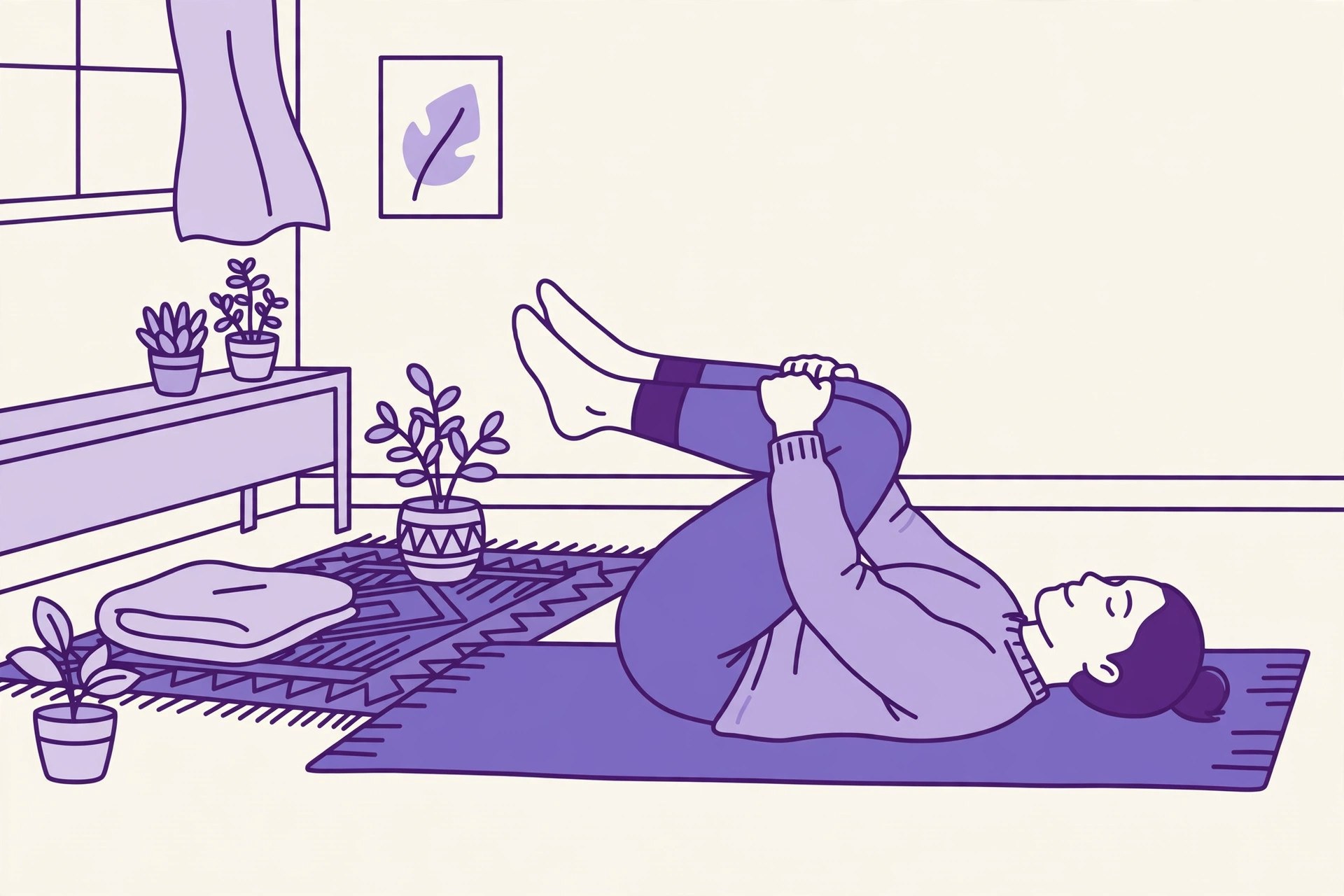
Now pull both knees up to your chest. Hold them there with your hands. Hold for 30 seconds. Breathe slow. The Mayo Clinic says to hold each stretch for about 30 seconds, breathe freely, and never bounce (checked November 2026).
Easier: pull one knee up at a time. Harder: hold the knees-to-chest for 45 seconds.
Step 2: cat-cow and child’s pose — move the spine
Get on hands and knees, hands under shoulders, knees under hips. Breathe in, let your belly drop, and lift your head. Breathe out, round your back up, and tuck your chin. Move slow, one breath per shape, 5 rounds.
Then sit back on your heels, arms out long in front of you. Rest your forehead on the mat. Hold for 30 seconds. Breathe in for 4 counts, out for 6 counts. Your back lets go a little with each breath.
Easier: do 3 rounds instead of 5. Harder: hold the child’s pose for a full minute.
Step 3: the seated twist — one side, then the other
Sit on the floor, legs out long. Bend your right knee and put your right foot flat on the floor, outside your left knee. Put your right hand on the floor behind you. Twist gently to the right. Hold for 30 seconds. Breathe slow. Switch sides.
Keep the twist gentle. You are turning your spine, not wringing it. If the twist pinches, turn less far. The NHS back pain guidance says the most important thing is to stay active — staying still lets the back muscles stiffen and ache more (checked November 2026).
Easier: sit in a chair and twist there instead. Harder: hold the twist for 45 seconds.
Step 4: the 5-minute daily plan and the warning signs
Do it like this each day: 10 pelvic tilts, knees-to-chest for 30 seconds, 5 rounds of cat-cow, child’s pose for 30 seconds, and a seated twist per side. That is about 5 minutes. Do it once a day, or split it up — two moves in the morning, three at night.
Most back pain gets better with time and gentle movement. Mayo Clinic says most back pain improves with self-care within a few weeks (checked November 2026). The CDC asks adults for muscle work on at least 2 days a week (checked November 2026), and this gentle routine fits well on the days between.
Know the warning signs. Stop and call your doctor if pain shoots down a leg, if a leg feels numb or weak, or if you lose control of your bladder or bowels. Those signs need care fast — do not stretch through them.
At a glance
| Step | The short version |
|---|---|
| The rule | Gentle motion, 30 seconds a stretch, never bounce — stop if it hurts |
| Step 1: tilt and knees-to-chest | 10 pelvic tilts, then knees-to-chest for 30 seconds |
| Step 2: cat-cow and child’s pose | 5 slow rounds, then rest for 30 seconds |
| Step 3: seated twist | 30 seconds per side, gentle turn, no wringing |
| Step 4: daily plan + warning signs | All five moves in 5 minutes; leg pain or numbness means call a doctor |
Common mistakes
Forcing the stretch. You push until it hurts, sure that more is better. Fix: stop at a gentle pull — pain means you have gone too far.
Bouncing to go deeper. You bounce in the stretch to push further, and the back tightens up instead. Fix: hold still and breathe — the depth comes on its own.
Lying still all day. Your back aches, so you lie down and stay down. Fix: gentle movement beats bed rest — walk a little, stretch a little, and keep moving.
Stretching through shooting pain. Pain runs down your leg, and you stretch harder. Fix: stop. Shooting pain, numbness, or weakness means call your doctor, not more stretching.
Can't do today?
Do the 2-minute version on the floor: 5 pelvic tilts and knees-to-chest for 30 seconds. That is the whole fallback, and it counts. The missed-day rule is simple: let it go — do today’s moves today, never double up to catch yesterday. What counts as enough: the full five moves most days, with the 2-minute version on the other days.
Questions people ask
Should I rest in bed when my back hurts?
No, not all day. Gentle movement helps more than bed rest — the NHS says staying active is the most important thing. Walk a little, stretch a little, and rest only in short breaks.
How long does back pain usually last?
Most back pain gets better with self-care within a few weeks, says the Mayo Clinic. If it keeps getting worse, or it does not ease up, talk to your clinician.
Can stretching make back pain worse?
Forcing a stretch can. Gentle stretches, held still with slow breath, should not hurt. If a move hurts, stop — and do not stretch through shooting pain.
When should I see a doctor for back pain?
See your clinician if pain shoots down a leg, a leg feels numb or weak, or you lose bladder or bowel control. The health note at the top of this guide says the same.
What comes next
Keep the five minutes, and let the back loosen up. When the moves feel easy, hold each stretch a little longer — and then core strength for sitters builds the muscles that hold your back up, while hip and hamstring mobility loosens the legs that pull on your low back.
Sources
Every fact in this post was checked against the sources below in November 2026.
- Mayo Clinic — Stretching and flexibility (checked November 2026) — hold each stretch for about 30 seconds; breathe freely; do not bounce.
- Mayo Clinic — Back pain (checked November 2026) — most back pain improves with self-care within a few weeks; see a doctor for pain that shoots down a leg, numbness, weakness, or loss of bladder or bowel control.
- NHS — Back pain (checked November 2026) — the most important thing is to stay active; staying still lets the back muscles stiffen and ache more.
- CDC — What You Can Do to Meet Physical Activity Recommendations (checked November 2026) — adults need muscle-strengthening activity on at least 2 days a week.
- Back Mechanic by Dr. Stuart McGill, ASIN B01FKSGJYC — the back pain book recommended in this post.
Subscribe for more free step-by-step how-to guides to help you get more things done to grow your business or project everyday.
Email required. Unsubscribe anytime.
Read our Privacy Policy.