
How to Price Your Product or Service — How-To #018
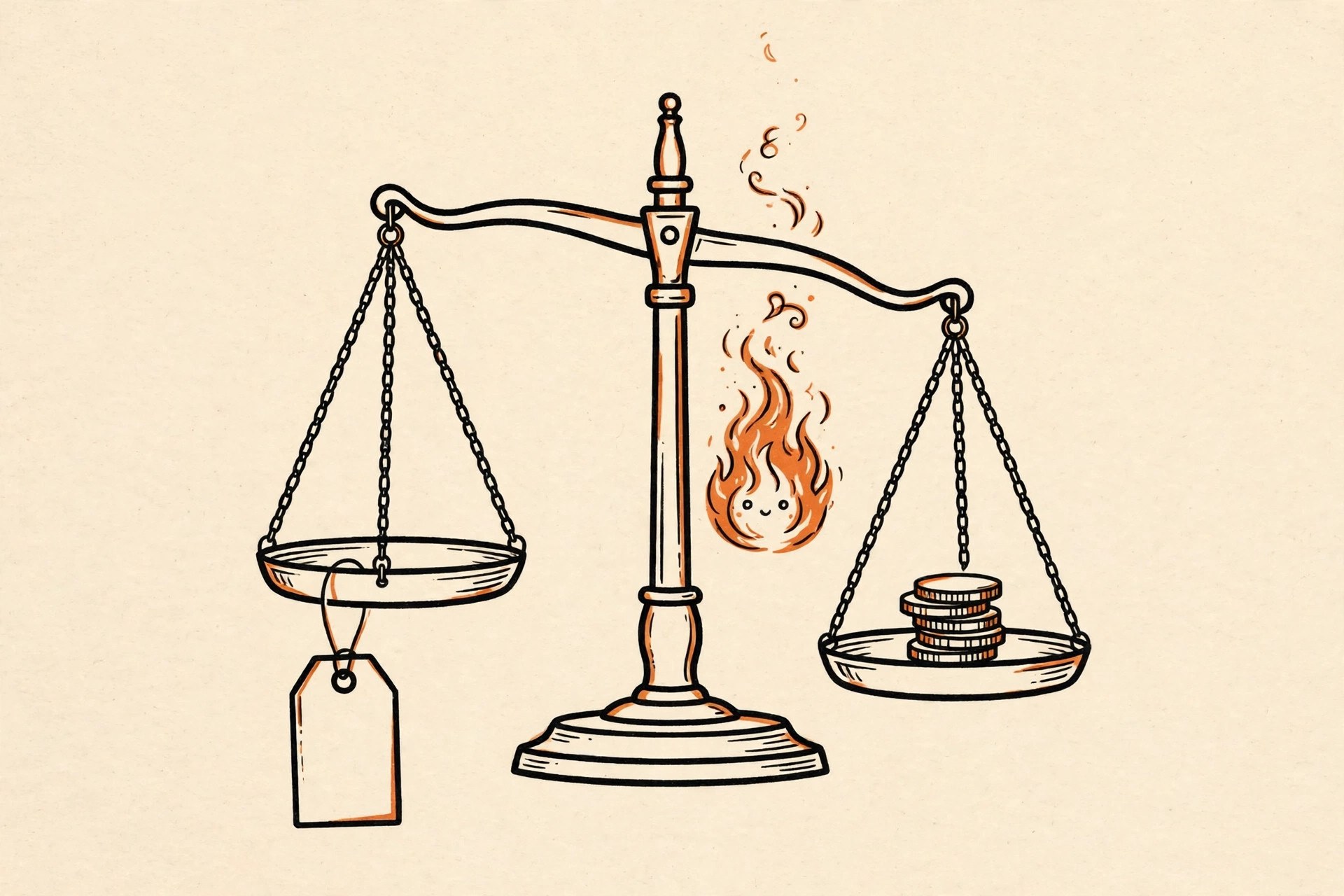
To price a product or service, count the true cost of one unit — materials, your labor, packaging, overhead and fees — then set that cost as your floor and pick a lane in the market. The $28 candle in this guide shows the whole calculation, step by step.
Disclosure: some links on this page are affiliate links. As an Amazon Associate, Changenaire earns from qualifying purchases made through links on this page, at no extra cost to you.
Key takeaways
- Your true cost is your floor: materials, your labor, packaging, overhead and fees — never sell below it.
- The worked example lands at $28: $5.90 materials, $6.00 labor, $1.10 packaging, plus overhead and fees.
- A common rule of thumb is 2× to 4× true cost at retail.
- The market has three honest lanes — cheapest, best, or in-between — and you get exactly one.
- Price the outcome, not the part: the buyer pays to stop worrying, not for the part itself.
- Raise 5–10% a year as a habit; change one thing at a time and watch units and revenue for two weeks.
Go deeper (affiliate link — we may earn a commission): The Pumpkin Plan by Mike Michalowicz — the book behind picking your spot — fewer, better customers you serve well, and a price that holds.
If pricing still makes your stomach drop a little, welcome. You're in the majority.
Most new sellers set prices by feeling. A guess. A glance at a competitor. A number that sounds nice. Feeling is a terrible accountant — it undercharges out of fear, overcharges out of hope, and keeps no records either way. This installment replaces the feeling with math, then puts judgment back on top in the right order.
How-To #016 found the money. How-To #017 taught you to win it. Now: price what you sell. Here's the whole post in one line — your price is a story told in numbers, and the numbers have to be true before the story can be good.
Count what it costs you — all of it
Before a single dollar of price, there is a number most beginners never actually compute: the true cost of one unit. Not the materials — everything:
Materials. Every input, down to the label and the tissue paper. Price them per unit, not per bulk bag.
Your labor. The one everyone skips. Pick an hourly number you'd accept as a wage — be honest, not heroic — and multiply by the time one unit takes. If a candle takes you 15 minutes and your time is worth $24 an hour, that's $6.00 of labor sitting inside every candle. It counts whether you pay yourself today or not.
Packaging and delivery. The box, the mailer, the trip to the post office averaged across units.
Fees. Card processing (~3%), marketplace cuts (Etsy takes 6.5% plus payment fees), the monthly cost of whatever platform you're on — divided by the units you realistically sell.
Overhead share. The unglamorous slice: insurance, the market-stall fee, the software subscriptions, the portion of your phone bill that's really business. Total it monthly, divide by monthly units.
Add it up and you have the true cost. Write it down. Everything below starts here, and almost nobody does this step — which is exactly why almost nobody prices well.
Build one price, start to finish: the $28 candle
Theory is cheap. Let's build one price, all the way through, so you can see the machinery.
Take a hypothetical candle-maker — she doesn't exist, but her math does. She hand-pours 8 oz soy candles and sells at a weekend market:
Materials per candle: wax $2.20, jar $1.80, fragrance oil $1.40, wick $0.15, label $0.35 — $5.90. Labor: 15 minutes at $24/hour — $6.00. Packaging: box and tissue — $1.10. Overhead and fees, averaged across a hundred candles a month — $1.50. True cost: $14.50 per candle.
She prices at $28 — roughly double her cost, a 48% margin. After card processing on each sale, about $12.60 of every $28 stays as gross profit. Then she checks the market: In this example, artisan soy candles in her city sell between $24 and $38. At $28 she sits in the middle — not the cheapest, not the priciest. The story she tells at the stall is small-batch and hand-poured, and the price matches the story.
Notice the direction: the number came from the math up, not the market down. And the math also hands her a brutal, useful verdict on wholesaling — a boutique offering the usual wholesale split of 50% of retail would pay $14 a candle, which is below her $14.50 true cost. So she doesn't wholesale. Or she redesigns the candle to cost $9. The math makes the decision, not her pride.
Set your floor and guard it
Your true cost is your floor — the number you never go below. Not on sale days, not for friends, not because a big order "makes up for it in volume." Every sale below the floor is you paying the customer to take your work.
The floor is not the price. It's the line under the price. A common rule of thumb: most healthy small businesses price at 2× to 4× true cost at retail (the old "keystone" rule is 2× wholesale, which is 4× cost — a fine starting point for physical goods; services often run higher). Where you land inside that range is judgment. That the range starts at your floor is math.
Two deliberate exceptions, both rare: a loss leader you chose on purpose, with the loss budgeted and the upsell real — and a founding offer with a written end date. "Accidentally below cost because I didn't do the math" is not a strategy. It's the most common one, and it has a name: going out of business slowly.
Check the market, then pick your spot in it
Now — and only now — look at what comparable things actually sell for. Not list prices on abandoned Etsy shops; sold listings, competitor menus, the going rate in your city. You're mapping the neighborhood, not copying a neighbor.
Then pick your lane on purpose. There are three honest positions, and you get exactly one:
Cheapest. You win on price and you mean it — which means your costs must be structurally lower, not just your courage. This lane is a treadmill; someone is always willing to go lower.
Fastest or easiest. You win on convenience — same-day, done-for-you, no hassle. Buyers pay a premium to skip the line.
Best. You win on quality, craft, or outcome — and you charge like it. This is the lane most small builders belong in, because it's the only one where being small is an advantage.
What kills sellers is the mushy middle: priced like the premium option, delivering the budget experience — or priced like the budget option while doing premium work. The candle-maker at $28 with a hand-poured story is in the "best" lane and priced to match. Alignment is the whole game.
Go deeper (affiliate link — we may earn a commission): The Pumpkin Plan by Mike Michalowicz is the book behind picking your spot — fewer, better customers you serve well, and a price that holds. Optional reading; the steps above stand on their own.
Price the value, not just the cost
Cost sets the floor. The market sets the neighborhood. But the ceiling is set by something else entirely: what the outcome is worth to the buyer.
The plumber who charges $495 to fix a leak used a $5 part and twenty minutes. Nobody sane pays $495 for a part and twenty minutes — they pay $495 to stop worrying about the ceiling caving in at 2 AM. The price was never about the part. It was about the outcome: dry ceiling, sleep, done.
Ask the value question for your own thing: what does the buyer get that they couldn't get — or couldn't get without pain — otherwise? A resume writer isn't selling two pages; she's selling the interview. A bookkeeper isn't selling spreadsheets; he's selling the end of tax-season dread. When the outcome is worth far more than your cost, price toward the outcome. That's not greed. That's the buyer telling you, with their wallet, what it was actually worth.
One honest guardrail: value pricing has to be true. If the outcome doesn't actually materialize for the buyer, the price was a story with false numbers — and false numbers always get found out. Cost-plus keeps you honest; value-based lets you thrive; the two together are the whole discipline.
Go deeper (affiliate link — we may earn a commission): Priceless by William Poundstone is the book on how customers actually judge a price — why the same number can feel cheap or expensive depending on what sits next to it. Optional reading; the steps above stand on their own.
Raise it on purpose — and test like you mean it
Prices are not tattoos. They're thermostats — set, watched, adjusted. Here's the discipline:
Change one thing at a time. New price, same everything else, for two weeks. Watch units sold and total revenue, not just vibes. If revenue holds or rises, the market just told you the old price was wrong.
Raise 5–10% a year as a habit. Costs rise; pretending yours don't is a slow pay cut you give yourself. Customers expect annual movement — what shocks them is a 40% jump after three years of silence, not a steady 7%.
Grandfather with notice. For services with ongoing clients: 30 days' written notice, existing clients keep the old rate for a defined period (say, 90 days), then everyone moves together. Respectful, predictable, drama-free.
And the fear every beginner has — "if I raise it, everyone leaves" — is almost always wrong. The customers who leave over two dollars were buying the price, not the thing; they were never yours. The ones who stay just funded your next year. Price like you intend to be here in five years, because the math only works if you are.
At a glance
| Step | The short version |
|---|---|
| Count the true cost | Materials + labor + packaging + overhead and fees = the floor |
| Build one price | The $28 candle: $5.90 + $6.00 + $1.10 + overhead and fees |
| Set the floor | Never go below true cost; 2×–4× true cost is the common rule of thumb |
| Check the market | Sold listings and real rates, then pick one of three lanes |
| Price the value | The buyer pays for the outcome, not the part |
| Raise on purpose | 5–10% a year; one change at a time, two weeks of watching |
Common mistakes
Mistake: Skipping your own labor from the true cost.
Fix: Pick an honest hourly number and multiply by the time one unit takes — the candle example counts 15 minutes at $24 an hour as $6.00.
Mistake: Pricing from feeling or copying a competitor.
Fix: Build the price from the math first, then check the market and pick your lane on purpose.
Mistake: Selling below the floor for friends, sale days, or a big order.
Fix: The floor is the line under the price — every sale below it is you paying the customer to take your work.
Mistake: Starting low to win customers, then trying to raise.
Fix: Start where the math says; low prices attract price-loyal buyers who leave when the price rises.
Mistake: Discounting the item to move slow stock.
Fix: Discount the bundle instead, so the single-unit price stays intact.
Questions people ask
What if a competitor charges half what I do?
Then you are not competing with them — say so, out loud, in your marketing. Different lane, different buyer. Competing on price with someone whose costs you cannot see is a race to a cliff. Hold your lane and let the bargain hunters go.
Should I start low to win customers, then raise?
Almost never. Low prices attract price-loyal customers, not you-loyal ones — and when you raise, they leave, because the price was the whole relationship. Start where the math says, and win customers with the work instead.
Hourly or flat rate for services?
Flat, whenever you can scope the work. Hourly punishes efficiency — the faster you get, the less you earn — and it makes the buyer watch the clock instead of the outcome. Price the project, the month, or the result.
Do discounts work?
Rarely the way people hope. A discount trains buyers to wait for the next one. If you must move slow inventory, discount the bundle rather than the item — it protects the single-unit price in everyone's mind, including yours.
What comes next
You can price it perfectly and still starve if nobody buys. Pricing was the math; selling is the motion. Next, the series gets gloriously unglamorous: How to Get Your First 10 Customers — How-To #019. No ads, no hacks — a hundred names, thirty conversations, one script, and the ask that turns a yes into ten. Price it right, then sell it by hand.
Sources
The steps, timelines, and targets in this guide are our own method, stated as our experience or as a rule of thumb where noted. Where a figure comes from an outside source, it is linked in the text and listed below.
Figures in this guide are as of November 2026.
- Etsy — Fees & Payments Policy — the 6.5% transaction fee plus payment processing cited in the true-cost math.
Subscribe for more free step-by-step how-to guides to help you get more things done to grow your business or project everyday.
Email required. Unsubscribe anytime.
Read our Privacy Policy.