
Multiple Sources of Income, Built in Order
The "seven streams" idea is all over TikTok and finance feeds: build seven income streams, all at once, as fast as you can. We think that's the wrong order — and the wrong number. You don't need seven. You need two, built in the right order, and then a third when the second can pay for it.
This post contains an affiliate link. If you buy through it, Changenaire may earn a commission at no extra cost to you. As an Amazon Associate, Changenaire earns from qualifying purchases made through links on this page.
Go deeper (affiliate link — we may earn a commission): Profit First by Mike Michalowicz — the book on the money habit underneath it all — pay yourself first, then build the next stream from what is left.
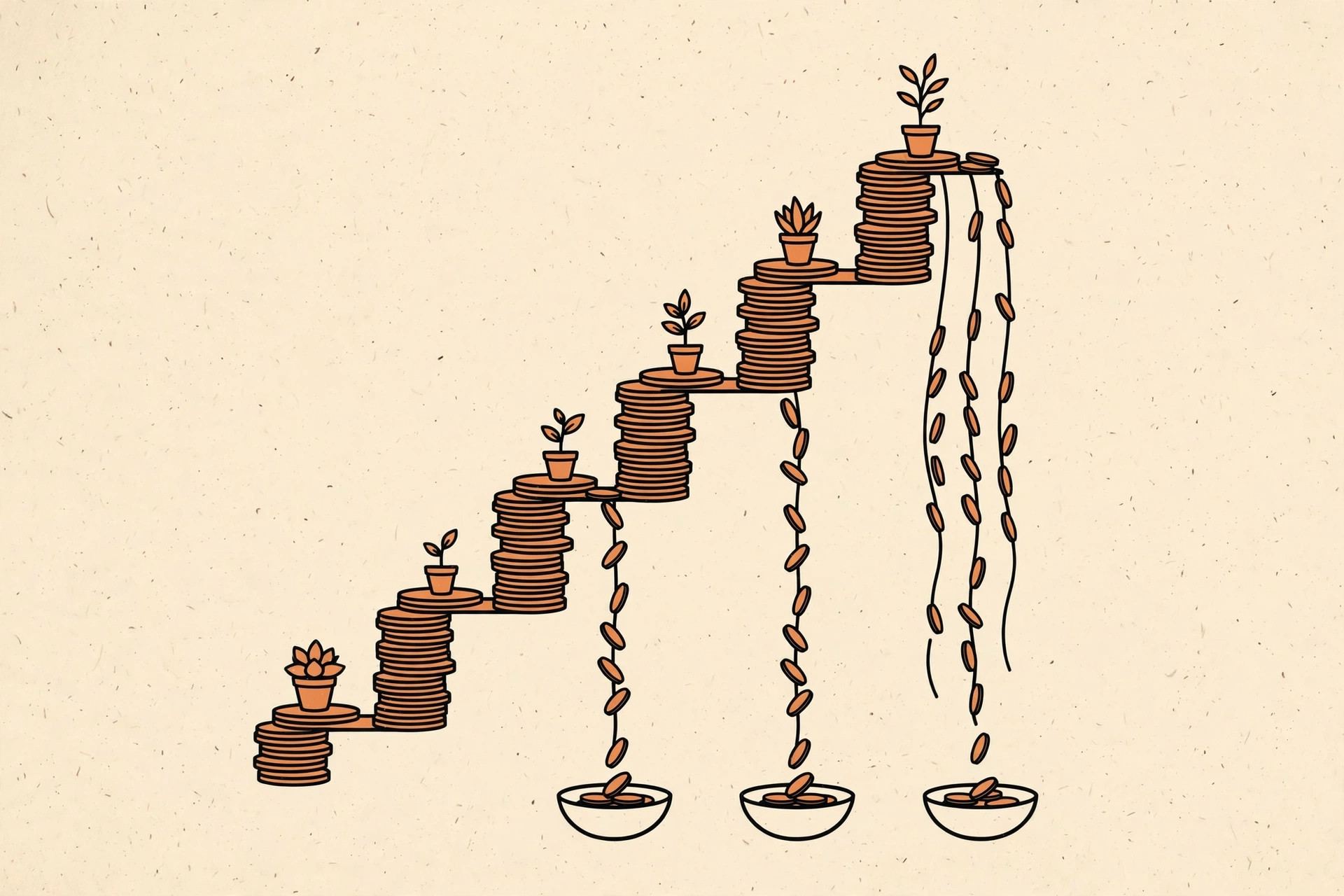
Here's our stance, plain: income streams are a ladder, not a lottery ticket. The first stream funds the second. The second funds the third. Skip the order and you end up with five half-built things, none of them paying, all of them asking for your evenings.
This post is the ladder. What counts as a stream, the order to add them in, and what each one actually costs you — in hours, in attention, in money up front. No shortcuts promised. Just the sequence that holds up.
What counts as a stream?
A stream is money that arrives on a schedule you can roughly count on, from a source that keeps working when you step back for a week. Your paycheck counts. A freelance client who books you every month counts. A product that sells while you sleep counts — once it actually sells.
What doesn't count: a one-time payout, a lucky month, a side project you've been "about to launch" since spring. A stream is a pipe, not a puddle. If the money stops the week you stop pushing, it's a job you gave yourself, not a stream — and that's fine, as long as you call it what it is.
Five kinds cover almost everything a builder will touch: a job, freelance work, a product, rent from something you own, and dividends from something you invested in. Same five for everyone. The difference is the order you pick them up in — and the order is where most people go wrong.
Stream one: the job that pays for everything else
Stream one is almost always a job. Not because jobs are the dream — because jobs are the funder. A steady paycheck buys the two things every later stream needs: time to build without panic, and a small pile of money to build with.
This is the part the seven-streams advice skips. It tells you to quit the job and build streams full-time, as if rent pauses while you figure out a product. It doesn't. Keep the job until a second stream covers a real bill — not a coffee, a bill. Rent, or the car payment, or the phone. That's the line that tells you stream two is real.
If the job is the only stream you have right now, you are not behind. You are on rung one, and rung one is load-bearing. Everything after it stands on this.
Stream two: sell a skill by the hour
The second stream should be the fastest one to start: freelance work — selling a skill you already have, by the hour or by the project. Writing, design, repairs, tutoring, bookkeeping, driving, fixing things people will pay to have fixed. The skill matters less than the fact that you already own it.
Freelance is the best second stream for a simple reason: it needs no money up front, only evenings. A product needs building before it earns. Rent needs property. Dividends need a pile of cash. Freelance needs a first client, and a first client can come from a conversation this week.
The cost is honest and it's mostly time. Two or three evenings a week, plus the admin nobody counts — quotes, invoices, following up on late payments. Keep it inside a boundary: if freelance starts eating the job that funds it, you've climbed the ladder sideways. We wrote a full walkthrough on starting one that actually pays — How to Start a Side Hustle That Actually Pays — and the first step there is the same as here: pick one skill, one offer, one price.
Stream three: build it once, sell it many times
Freelance trades hours for money. A product breaks that trade: you build it once, and it sells while you're doing something else. A digital guide, a template, a course, a physical item in a small shop — the form changes, the math doesn't. The build is the cost, the repeat sales are the payoff.
This is the rung where most people jump too early. A product built on a shaky stream one — no steady income behind it — has to pay rent from week one, and products almost never do. That's why it sits at three, not two. The job and the freelance money buy the product its slow first months.
Start small and real. One product, one page, one buyer. Our walkthrough on opening a shop covers the groundwork — How to Start an Online Store — and the rule there holds here too: the store is the easy part. The hard part is making one thing somebody wants, then telling the right people it exists.
Streams four and five: rent and dividends — the slow ones
Rent and dividends are the streams everyone wants first and should build last. Both of them need capital — money already saved — before they pay anything worth counting.
Run the dividend math once and it sticks. Investor.gov explains that dividends are payments a company distributes to its stockholders. At a 4% yield — an example, not today's rate — $100 a month in dividends takes about $30,000 invested. That's not a criticism of dividends; it's the price tag, out in the open. The same honesty applies to rent: a room or a property pays monthly, but only after the deposit, the repairs, the months between tenants, and the work of being a landlord. The income is real. The runway is long.
So these two sit at the end of the ladder on purpose. Streams one through three are how you build the pile. Streams four and five are what the pile does once it exists. Reversing that order — seeking rent or dividends before you have income to invest — is how people end up leveraged, stressed, and no richer.
The costs nobody lists on the poster
Every stream costs three things: time, attention, and money up front. The posters only show the money coming in. Here's the other side of the ledger.
Time is the one you can count. A full-time job is typically around forty hours. Freelance is your evenings. A product is weekends for a month or three. Rent is the occasional crisis at the worst hour. Dividends are the cheapest on time — a few hours a year — and the most expensive on money up front.
Attention is the one you can't count, and it's the scarcer of the two. Each stream is a thing you think about, check on, and fix when it breaks. Two streams fit in one head comfortably. Three takes a system — a weekly check, a separate account, a notebook that knows where everything stands. Five streams with no system is just five worries wearing a money costume.
Our rule of thumb: never add a stream until the last one runs without you thinking about it daily. If stream two still needs you every evening, stream three can wait. The ladder holds because each rung is solid before the next one goes on.
One book that shaped how we think about the money side of this is Profit First by Mike Michalowicz — a simple system for splitting income into separate pots so each stream's money has a job before it gets spent. (Find it on Amazon — we earn a small commission if you buy through that link; it costs you nothing extra.) The system matters more than the book: separate the money, or the streams blur into one pile and the ladder disappears.
The ladder, on one page
Here it is, start to finish. One: a job — steady pay, funds everything after it. Two: freelance — a skill you already have, sold by the hour, no money up front. Three: a product — built once, sold many times, funded by streams one and two. Four: rent — something you own, paying monthly, after the pile exists. Five: dividends — the pile itself, paying you back a little every quarter.
That's the whole sequence. No step is optional and no step is skippable — you can move fast through a rung, but you can't stand on air where a rung should be.
And the number? Two streams is a strong place to be. Three is a strong place to stay for a long while. Seven is a poster, not a plan. Build the ladder one rung at a time, and let each rung pay for the next.
Questions we get asked
How many streams should I aim for? Start with two — the job and one more. Add a third when the second covers a real bill every month without you pushing it. The count matters less than the order.
Can a side hustle be stream one? It can be the stream that matters most to you, but it rarely funds the ladder at the start. Until it covers your bills on its own, the job is still stream one — it's the one paying for the build.
What if I have no money to invest? Then streams four and five wait, and that's the correct call. Streams two and three need time and skill, not cash. The pile comes later; the work comes now.
Is this financial advice? No. General information about a common way people sequence income. Your debts, your taxes, your situation — those can change the details, and a licensed professional in your state is the right call when they do.
Go deeper on Changenaire: the side-hustle walkthrough shows how to pick and price your first freelance offer, and the online-store walkthrough shows how to turn one product into stream three — How to Start a Side Hustle That Actually Pays and How to Start an Online Store.
Sources
The outside sources behind this post are listed here. The dividend figures are our own illustration, labelled as an example in the text.
- Penguin Random House: Profit First by Mike Michalowicz (Portfolio) — the publisher page for the book behind the money-splitting system in this post; the Amazon link in the text is the buy link. Accessed November 6, 2026.
- Investor.gov (U.S. Securities and Exchange Commission): Stocks — FAQs — dividends are payments a company distributes to its stockholders, and income stocks pay dividends consistently. Accessed November 6, 2026.
Subscribe for more free step-by-step how-to guides to help you get more things done to grow your business or project everyday.
Email required. Unsubscribe anytime.
Read our Privacy Policy.