
The Second Career: Life After the Last Game — Sports #012
Here is the number that frames everything else in this piece: a professional playing career lasts about three to five years. You retire in your early thirties, and you still have forty working years ahead of you. The first contract pays you for playing. The second career is everything after — and the athletes who handle it best treat it as a second build, not a landing. Tom Brady sells his knowledge from a broadcast booth. Kobe Bryant built a studio and won an Oscar. Roger Staubach started his company while he was still taking snaps. George Foreman licensed his name and out-earned his boxing career many times over. None of them waited for the last game to start thinking about it. This piece lays out the clock, the money cliff, and the four patterns that repeat — in plain English, so you can start your own second build on time.
Disclosure: some links on this page are affiliate links. As an Amazon Associate, Changenaire earns from qualifying purchases made through links on this page, at no extra cost to you.
Key takeaways
- A playing career is short: the NFL Players Association puts the average NFL career at about 3.3 years; Basketball-Reference data puts the average NBA career at about 4.5 years.
- The money cliff is real but often overstated: a National Bureau of Economic Research paper found 1.9 percent of drafted NFL players had filed for bankruptcy within two years of retirement — 15.7 percent within twelve.
- Three credited seasons vest an NFL pension: $836 a month per credited season for seasons played from 2020 to 2030, payable at age 55.
- Four second-career patterns repeat: sell your knowledge (Brady), build a studio (Kobe), start the company while you still play (Staubach), license your name (Foreman).
- Start before the last game. The second career grows slowly — give it years, not months.
One honest note before you start: Sports For Entrepreneurs is education, not financial, legal, or tax advice. Changenaire is not your financial advisor, your lawyer, or your agent. Talk to a licensed professional before you make money decisions.
Who this is for: athletes who know the last game is coming — and every builder whose first career has an expiry date, which is most of them. If you have ever wondered what your skills are worth once the job that made you known goes away, this piece is written for you. Who should adjust: if you are still early in your playing career, read this as a planning piece, not a warning — the clock is the point, and the clock is on your side while you still have seasons left.
This piece sits in the Sports For Entrepreneurs hub, in the Second Contract pillar. It pairs with three neighbors: Shaq's Newark blueprint, the archetype of a second career built on franchises, media, and ownership; LeBron's path from player to owner. That shows the ownership endgame a second career can reach; and the First Check, on what to do when the money arrives. That teaches you the team to hire and the order to hire them in. Read the four together and you have the full arc. The first check, the second contract, and the life after the last game.
Go deeper (affiliate link — we may earn a commission): the five moves below are the whole lesson, and you need nothing to buy to use them. If you want a method for designing the next chapter instead of just worrying about it, Designing Your Life by Bill Burnett and Dave Evans teaches you to prototype a life the way a designer prototypes a product — three five-year plans side by side, tested small before you commit. Skip it if you only want the patterns — the four below are enough to start.
Why it matters to entrepreneurs™:
Every builder faces a version of this. Your first business, your first job title, your first big client — none of them last forever, and the skills that made you valuable in one setting are worthless until you translate them into the next one. Athletes just face it earlier and more publicly: a career that ends at thirty-five, in front of millions of people, with the money arriving in a spike and then stopping. Study how they handle the transition and you learn the general rule. The second career is not a fallback. It is a second build, and the builders who start it early — while the first one still pays — are the ones who get to choose what comes next instead of taking whatever is left.
The clock: how short a career really is
Start with the honest numbers, because the plan only makes sense once you see the shape of the problem. The NFL Players Association puts the average NFL career at about 3.3 years, a figure traced back to a union study of rosters from 1987 to 1996 (checked November 2026). That number is widely quoted and worth one honest caveat. It counts every player who ever signs, including the ones cut in training camp before they play a down. The league's own response, in 2011, put the average at 6.0 years for a player who makes his club's opening-day roster as a rookie, the same analysis reports (checked November 2026). Either way, the shape is the same: a short spike of earning years, then decades of ordinary working life.
The other leagues tell the same story in slightly longer numbers. Data compiled from Basketball-Reference puts the average NBA career at about 4.5 years, with most players leaving the league in their early-to-mid thirties, one review of the data reports (checked November 2026). A career-coaching review puts baseball at about 5.6 years and hockey at about 5.5, the same review reports (figures as compiled, checked November 2026). The position matters too: running backs average about 2.57 years, the shortest of any NFL position, while kickers and punters last nearly twice as long at 4.87, Zip Football reports, citing the union figures (checked November 2026). A first-round draft pick averages about 9 years. The lesson is not that every career is short — it is that the average is short. And the average is the number you should plan around, because nobody gets to choose which side of it they land on.
Copy this: write down your own number. How many earning years does your first career have left — three, five, ten? Then write down how many working years you have after that. The gap between those two numbers is the size of the second career you need to build, and seeing it written down is what turns a vague worry into a plan.
The money cliff: what the research actually says
Now the part everyone has heard, and most people have heard wrong. You have probably seen the claim that 78 percent of NFL players go broke within two years of retirement. That number comes from a 2009 Sports Illustrated article. And it counted players who were bankrupt or under financial stress — two very different things folded into one scary figure. When researchers at the National Bureau of Economic Research tested the claim against actual bankruptcy filings, the picture changed: among players drafted from 1996 to 2003, only 1.9 percent had filed for bankruptcy within two years of retirement, rising to 15.7 percent within twelve years, Plan Sponsor reports, summarizing the NBER working paper (checked November 2026). Fifteen-point-seven percent is still a serious number — roughly one in six — but it is a different problem from the one the headline describes. It is a slow leak over a decade, not a cliff in year two. And the researchers found something striking: a player's total earnings and career length had surprisingly little effect on the risk, FiveThirtyEight's reading of the paper reports (checked November 2026). The money coming in was not the problem. The money going out — and the absence of a next income — was.
That is where the benefits math comes in, and it is more generous than most players realize. Three credited seasons vest a player in the Bert Bell/Pete Rozelle NFL Player Retirement Plan, and each credited season played from 2020 to 2030 is worth $836 a month at the normal retirement age of 55, LegalClarity reports, citing the NFLPA's benefit materials (figures as published under the 2020 CBA, checked November 2026). Five credited seasons in that window pay $4,180 a month. The pension starts at 55, not at 35 — so it does not solve the twenty-year gap between the last game and the first pension check. But it is a floor, and a floor changes how you plan. The league also runs a 401(k) with employer matching, severance pay, and a health reimbursement account, and the NFLPA's Trust. Open to former players with two or more credited seasons, launched in 2013 — offers transition coaching, degree completion, and career programs, The Trust's own FAQ explains (checked November 2026). None of this replaces a second career. All of it buys you time to build one.
Copy this: find out your vesting number before you need it. How many credited seasons do you have? Are you vested? What does The Trust offer you right now? Those are three questions with written answers, and the answers are free. A builder who knows the floor can plan the climb.
Pattern one: sell your knowledge — Tom Brady
Tom Brady played 23 NFL seasons and won seven Super Bowls, then retired for good in February 2023 — and his earning years never stopped. While he was still playing, Fox Sports signed him in May 2022 to a 10-year, $375 million contract to become its lead NFL analyst once he retired, Pro Football Network reports (checked November 2026). He began calling games in September 2024, alongside Kevin Burkhardt, and he has said he intends to fulfill the full ten-year deal, Sportscasting reports (checked November 2026). At $37.5 million a year, the broadcasting contract is worth more than any single playing contract he ever signed. He also bought a minority stake in the Las Vegas Raiders, approved by owners in October 2024, with limits on his access to other teams' practices and facilities, the same report notes (checked November 2026).
The pattern is the cleanest one in this piece: sell the knowledge, not the body. Brady's value in the booth is twenty-three seasons of reading defenses in real time — knowledge no one else in the room has. Michael Strahan ran the same pattern a generation earlier. He retired in June 2008, weeks after winning Super Bowl XLII with the New York Giants, and joined Fox NFL Sunday the same year, WebMD reports (checked November 2026). He went on to co-host Live! with Kelly and Michael from 2012 to 2016, then became a full-time co-anchor of Good Morning America in 2016, TV Insider reports (checked November 2026) — and he built SMAC Entertainment, his own production company, with his business partner Constance Schwartz-Morini in 2011, Yardbarker reports (checked November 2026). Nearly two decades after his last game, he is still on television every week. The knowledge was the product. The camera was just the shelf it sat on.
Copy this: ask what you know that a room full of smart people would pay to hear. Not what you did — what you know. The answer is usually one sentence, and it is usually the first line of your second career.
Pattern two: build a studio around your story — Kobe Bryant
Kobe Bryant played twenty seasons with one team and won five championships, then did the harder thing: he started over as a beginner. He founded Granity Studios in 2013 to tell stories around sports, and in 2017 the studio produced Dear Basketball. A five-minute animated film based on the retirement poem he wrote for The Players' Tribune, directed by Disney veteran Glen Keane with music by John Williams, Wikipedia reports (checked November 2026). On March 4, 2018, it won the Academy Award for Best Animated Short Film. The first Oscar win for any former professional athlete, the same record notes (checked November 2026). Granity went on to produce bestselling children's books and the ESPN series Detail, in which Bryant broke down film the way only a twenty-year veteran could.
The pattern is different from Brady's, and worth seeing clearly. Brady sold his knowledge to an existing network. Kobe built the network — a studio that owned the stories, the books, and the format. Peyton Manning ran a version of the same play. He co-founded Omaha Productions with media executive Jamie Horowitz in December 2020, and the company's ManningCast — an alternate Monday Night Football telecast with Peyton and his brother Eli talking over the game from their couches — debuted on September 13, 2021, Wikipedia reports (checked November 2026). ESPN extended its partnership with Omaha through 2034, USC reports (checked November 2026). The studio pattern costs more to start and takes longer to pay — but what you build is yours. And it keeps working after you stop showing up.
Copy this: ask whether your second career needs a stage or a studio. A stage pays you to appear. A studio pays you because you own the thing people watch. Both are honest work. Only one of them compounds.
Pattern three: start the company while you still play — Roger Staubach
The most instructive second career in this piece started before the first one ended. Roger Staubach founded his commercial real estate firm in 1977, while he was still the Dallas Cowboys' starting quarterback, Business Facilities reports (checked November 2026). He built it in the off-seasons and the margins of a football career, representing tenants looking for office, retail, and industrial space. By 2008 the firm had more than 70 offices and about 1,600 employees — and in July 2008, Jones Lang LaSalle bought it for $613 million, paying $123 million in cash and $100 million in stock at closing, with the balance spread over five years, the same account reports (checked November 2026). Staubach stayed on as executive chairman of the Americas until his retirement in 2018. He had distributed equity to employees over the years. So the sale rewarded hundreds of the people who built the firm with him.
That is the Staubach rule, and it is the single most useful line in this piece. Start the second career while the first one still pays. The firm grew for thirty-one years because it had thirty-one years to grow. Most athletes wait until retirement to ask what comes next, and then they are starting a business with no income, no runway, and no patience — the three conditions under which most new businesses fail. Staubach's version had income, runway, and patience, because the football salary covered the early years and the real estate business could grow at its own speed. You do not need a real estate empire. You need something started early enough that it can be small for a long time.
Copy this: pick one thing you could start this month, in the hours your first career does not use, that would still be worth having in five years. Then start it. The size does not matter yet. The start date does.
Pattern four: license the name — George Foreman
George Foreman won the heavyweight title twice, twenty years apart, and then built a second career that out-earned his boxing career many times over — without throwing another punch. In 1994, the same year he regained the title. A small company called Salton signed him to endorse a countertop grill invented by Michael Boehm, the Smithsonian's Lemelson Center reports (checked November 2026). The deal paid Foreman about 40 percent of the profits on each grill sold, and at its peak he was earning $4.5 million a month from it, Wikipedia reports (checked November 2026). In 1999, Salton paid him $137.5 million to buy out the perpetual rights to use his name on food preparation appliances — and his total earnings from the grill are estimated at over $200 million, with more than 100 million grills sold worldwide, the same record notes (checked November 2026). Foreman, who died in March 2025 at 76, later said he signed the deal partly because it came with free grills for his family, he wrote in his 2009 book Knockout Entrepreneur (checked November 2026).
The pattern is licensing: your name does the work while you do something else. It is the lightest of the four patterns — no studio to run, no company to manage — and the most dangerous, because the name is the whole asset. Foreman's grill worked because the product was real. The royalty was a share of profits rather than a flat fee, and his name meant something specific to the people buying it: a big, warm, trustworthy champion in the kitchen. The same pattern, attached to a bad product or a flat fee, is just a paycheck with your name on it. The lesson is not "license your name." It is "know what your name is worth, and take a share of what it builds, not a fee for lending it."
Copy this: before you lend your name to anything, ask two questions: what percentage do I get, and what happens to my name if the product fails? If the answers are a flat fee and "nothing," walk away. Your name is the one asset you cannot rebuild.
The five moves
Pull it together into the moves that matter. First: start before the last game — Staubach founded his firm while he was still playing. And the second career grows slowly, so give it years, not months. Second: audit what the game taught you — write down the transferable skills before you shop for a next job. Third: get the benefits math on paper — three credited seasons vest the pension. The Trust opens after two, and the numbers are free to find out. Fourth: test the next thing small — a few broadcasts, a small investment, a short course, a side project with a friend — before you bet on it. Fifth: aim to own something — a company, a studio, a license on your own name — not just another salary for showing up.
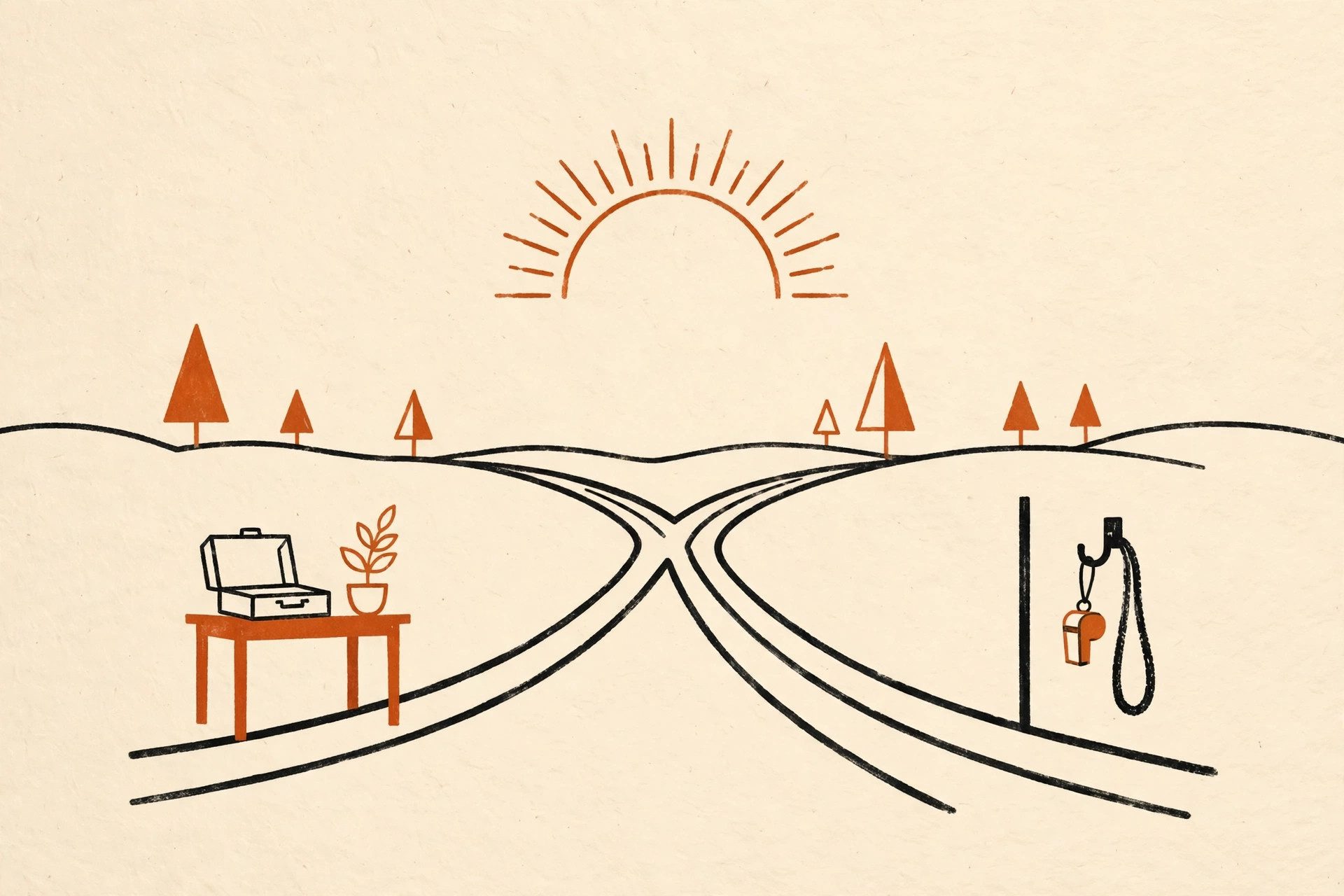
Run those five in order and you have done the real work of this piece. The athletes in it did not share a single career path. They shared a habit: they treated the end of the first career as the start of a second build. And they started building before they had to. You can do the same from wherever you stand — on a roster, on a bench, or in a business whose first chapter is closing. The road forks whether you plan for it or not. Pick your direction before you get there.
Copy this: take the five moves, write them on one page, and put a date next to the first one. A plan without a date is a wish. A wish does not pay rent.
At a glance
| Athlete | Second career | The pattern |
|---|---|---|
| Tom Brady | Fox lead NFL analyst, 10 years, $375 million; Raiders minority owner | Sell your knowledge |
| Kobe Bryant | Granity Studios; Dear Basketball won the 2018 Academy Award | Build a studio |
| Peyton Manning | Omaha Productions, co-founded 2020; ManningCast on ESPN | Own the production company |
| Roger Staubach | The Staubach Company, founded 1977; sold to JLL for $613 million in 2008 | Start while you still play |
| George Foreman | Grill license, 1994; $137.5 million buyout in 1999; est. $200 million+ total | License your name |
| Michael Strahan | Fox NFL Sunday from 2008; Good Morning America co-anchor from 2016 | Sell your knowledge |
Common mistakes
Waiting until retirement to start. A second career started at retirement has no runway and no patience. Fix: start one small thing while the first career still pays, and let it grow slowly.
Confusing fame with a business. Being known is not the same as owning something that earns. Fix: ask what you will own when the work ends — a company, a studio, a license — not just what you will be paid to show up.
Ignoring the benefits you already earned. The pension, the 401(k), the severance, The Trust — all of it exists, and most of it is free to find out about. Fix: get your vesting number and your Trust eligibility on paper before you need either.
Believing the scariest headline. The 78 percent figure counted financial stress, not bankruptcy filings — the measured filing rate within two years of retirement was 1.9 percent. Fix: plan from the measured numbers, not the loudest ones, and talk to a licensed professional about your own situation.
Copying someone else's second career. Brady's booth, Kobe's studio, Staubach's firm, Foreman's grill — each one fit the person who built it. Fix: test your own version small first, and let the test tell you whether it fits.
Questions people ask
How long does the average pro sports career last?
Shorter than fans think. The NFL Players Association puts the average NFL career at about 3.3 years, a figure traced back to a union study of rosters from 1987 to 1996 (checked November 2026), and Basketball-Reference data puts the average NBA career at about 4.5 years, one review of the data reports (checked November 2026). Baseball averages about 5.6 years and hockey about 5.5, a career-coaching review reports (checked November 2026). The average hides a wide spread: players who make an opening-day roster average about 6 years, and first-round picks average about 9, the same analysis reports (checked November 2026).
How many retired NFL players go bankrupt?
A National Bureau of Economic Research working paper (April 2015, players drafted 1996 to 2003) found 1.9 percent had filed for bankruptcy within two years of retirement, rising to 15.7 percent within twelve years, Plan Sponsor reports, summarizing the paper (checked November 2026). The famous 2009 Sports Illustrated claim of 78 percent counted players bankrupt or under financial stress, not bankruptcy filings — the NBER researchers found the two-year filing rate far lower, FiveThirtyEight's reading of the paper reports (checked November 2026).
What is the NFL pension, and when does a player qualify?
Three credited seasons vest a player in the Bert Bell/Pete Rozelle NFL Player Retirement Plan, LegalClarity reports, citing the NFLPA's benefit materials (checked November 2026). Each credited season played from 2020 to 2030 is worth $836 a month at age 55, so five credited seasons in that window pay $4,180 a month, the same source reports (figures as published under the 2020 CBA, checked November 2026). The NFLPA's Trust, open to former players with two or more credited seasons, helps with the transition to what comes next, The Trust's own FAQ explains (checked November 2026).
What is the best second career for a retired athlete?
There is no single best one. The patterns that repeat are broadcasting and media, building a company while still playing, licensing your name, and owning a production company. The right one depends on what you already know, who you already know, and what you can test cheaply before you commit. This is education, not advice — talk to a licensed professional before you make money decisions.
What comes next
Take the five moves and put a date next to the first one — the thing you start this month, in the hours your first career does not use. Then read the neighbors: Shaq's Newark blueprint for the fullest version of a second career built on franchises, media, and ownership; LeBron's path from player to owner for where a second career can end up. And the First Check for the team to hire while the money is still arriving. The Sports For Entrepreneurs hub collects every piece in this engine as it publishes. Your first career ends on someone else's schedule. Your second one starts on yours.
Sources
Every fact in this post was checked against the sources below in November 2026.
- Lexology — Stop saying the average NFL career is about three years (March 2026, checked November 2026) — the NFLPA's 3.3-year figure traced to its study of 1987–1996 rosters; the league's 2011 response of 6.0 years for opening-day rookies; Sharp Football Analysis's 5.0-year mean for players drafted 2002–2007.
- 911 Alloys — When do basketball players retire (checked November 2026) — average NBA career about 4.5 years, per Basketball-Reference data; most players retire in their early-to-mid thirties.
- Ecoslip — Post Playing Career Options for Athletes (checked November 2026) — average careers as compiled: NFL 3.5 years, MLB 5.6, NBA 4.8, NHL 5.5.
- Zip Football — The average NFL career is 3.3 years (checked November 2026) — running backs 2.57 years, kickers and punters 4.87 years; first-round picks about 9 years.
- Plan Sponsor — Even NFL Players Could Use Retirement Planning Help (April 2015, checked November 2026) — NBER Working Paper No. 21085: 1.9 percent of drafted NFL players filed for bankruptcy by year two of retirement, 15.7 percent by year twelve; median earnings about $3.2 million in year-2000 dollars.
- FiveThirtyEight via My Sport Analysis — There's A Difference Between Broke And Bankrupt For Ex-NFL Players (checked November 2026) — the NBER paper against the 2009 Sports Illustrated 78 percent claim; earnings and career length had surprisingly little effect on bankruptcy risk.
- LegalClarity — Do NFL Players Get a Pension? (checked November 2026) — three credited seasons to vest in the Bert Bell/Pete Rozelle NFL Player Retirement Plan; $836 a month per credited season for 2020–2030 seasons at age 55; 401(k), disability, severance, and health reimbursement account.
- The Trust (Powered by the NFLPA) — Frequently Asked Questions (checked November 2026) — earned benefit for former NFL players with two or more credited seasons; established under the 2011 CBA; personalized support for health, career, education, and finance.
- Pro Football Network — Kevin Burkhardt on working with Tom Brady (checked November 2026) — Brady's reported 10-year, $375 million Fox deal agreed in 2022; broadcasting debut September 2024; retired for good February 2023; seven Super Bowls in 23 seasons.
- Sportscasting — Tom Brady Commits To Full 10-Year, $375M Fox Contract (September 2026, checked November 2026) — Brady intends to fulfill the full contract; minority owner of the Las Vegas Raiders with limits on access to players and coaches.
- Wikipedia — Dear Basketball (checked November 2026) — Granity Studios, Believe Entertainment Group, and Glen Keane Productions; won the Academy Award for Best Animated Short Film at the 90th Academy Awards on March 4, 2018; first Oscar win for any professional athlete.
- Wikipedia — Omaha Productions (checked November 2026) — co-founded 2020 by Peyton Manning and Jamie Horowitz; ManningCast debuted September 13, 2021, on ESPN2 and ESPN+.
- USC Today — Peyton Manning talks with students (October 2025, checked November 2026) — Omaha Productions' nine-year ESPN extension in 2024 securing ManningCast and the Places franchise through 2034.
- Business Facilities — Occupying a New Space in a Changing Real Estate Industry (checked November 2026) — Staubach founded his firm in 1977; $613 million Jones Lang LaSalle purchase in 2008 ($123 million cash, $100 million stock at closing, balance over five years); Staubach as executive chairman, Americas.
- Smithsonian Lemelson Center — Who Invented the George Foreman Grill? (checked November 2026) — invented by Michael Boehm; debuted 1994; over 100 million units sold; Foreman earned an estimated $200 million from the endorsement.
- Wikipedia — George Foreman Grill (checked November 2026) — Salton paid $138 million in 1999 to buy out the name rights; about 40 percent of profits per grill; $4.5 million a month at peak; total estimated over $200 million.
- Umphen — George Foreman's famous grill wasn't always a knockout (checked November 2026) — Foreman signed partly for 16 free grills, per his 2009 book Knockout Entrepreneur; second royalty check paid $2,500.
- WebMD — Michael Strahan Tackles Life After the NFL (checked November 2026) — retired in 2008 after 15 seasons with the Giants; joined Fox NFL Sunday; co-hosted Live! from 2012; joined Good Morning America part-time.
- TV Insider — GMA's Michael Strahan Teases Retirement (January 2026, checked November 2026) — full-time Good Morning America co-anchor since 2016; co-hosted Live! with Kelly and Michael 2012–2016.
- Yardbarker — Good Morning America Host Michael Strahan Announces Next Big Project (November 2026, checked November 2026) — SMAC Productions, established 2011 with Constance Schwartz-Morini; Fox NFL Sunday since 2008; Good Morning America full-time since 2016.
- Designing Your Life: How to Build a Well-Lived, Joyful Life by Bill Burnett and Dave Evans (Knopf, September 20, 2016), ASIN 1101875321 — the book recommended in this post. ASIN verified by web search only, never by fetching amazon.com, and not claimed as Amazon-live-verified.
Subscribe for more free step-by-step how-to guides to help you get more things done to grow your business or project everyday.
Email required. Unsubscribe anytime.
Read our Privacy Policy.