
Self Improvement #060: How to Make Your Knees Stronger for the Stairs
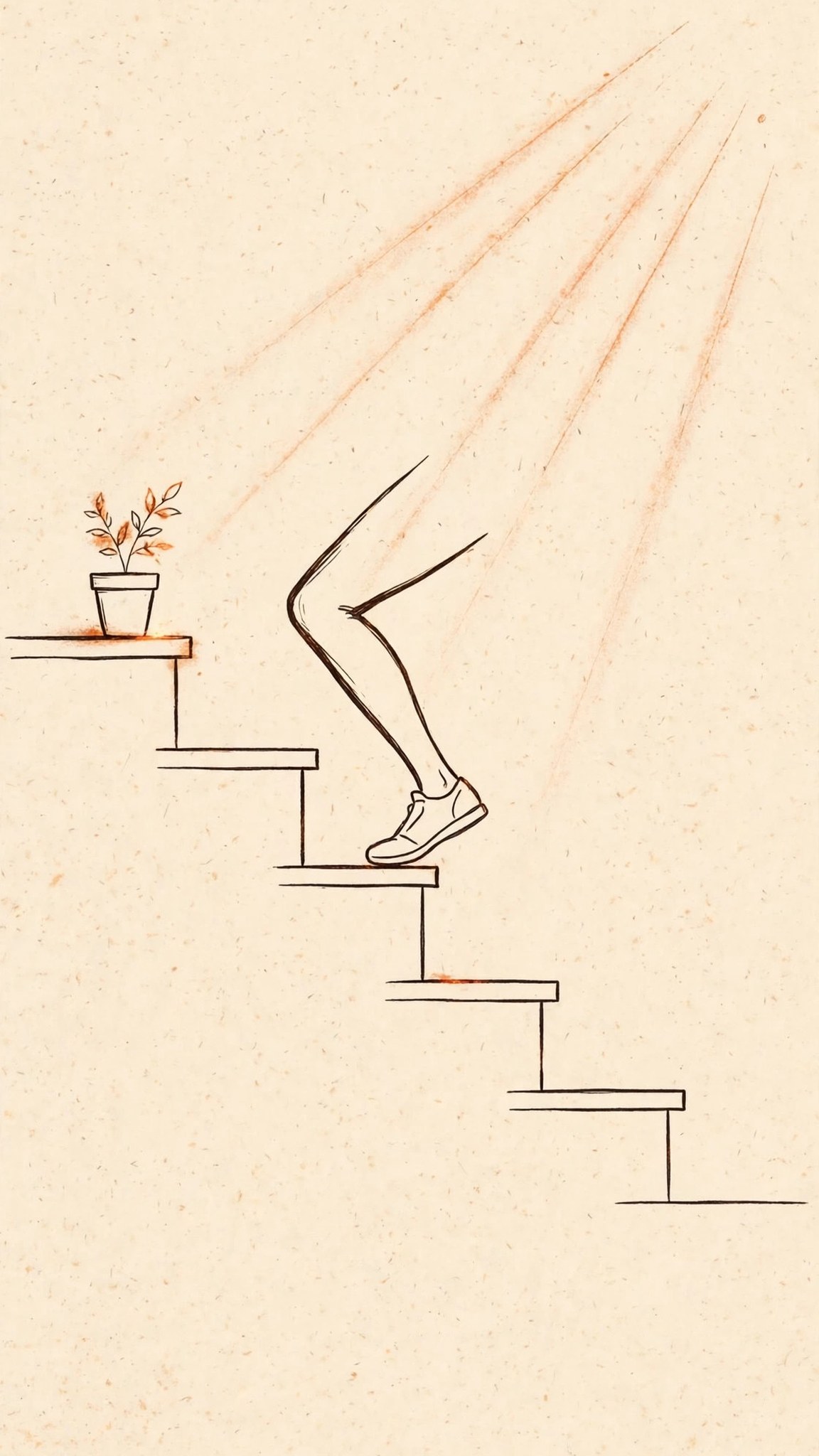
Stairs are the most honest test in the house. They ask your knees to lift your whole weight, one step at a time, and they never let you fake it. If the stairs have started to hurt, the answer is not to avoid them — it is to build the muscles that carry you up them, a few minutes a day.
Disclosure: This post contains one affiliate link. If you buy through it, Changenaire may earn a commission at no extra cost to you. We only link books we would hand to a friend.
One book worth your money
You don’t need it to start — nothing here replaces the practice itself. But if you want the case made properly, Born to Run by Christopher McDougall is the one: McDougall makes the case that our bodies were built to move on foot — and that strong legs are the point, not the problem. Read it and the stairs start to look like training, not a test. (Referral link — we may earn a commission.)
Your thigh does the lifting
Your knee is a hinge, and the muscles around it do the steadying. When a knee hurts, the thigh muscles — the quadriceps at the front — weaken fast, and a weaker thigh means the joint takes more of the load on every step. The Living With Arthritis knee exercise guide, built on the NICE osteoarthritis guideline, puts it plainly: stronger quadriceps, hamstrings, hip and calf muscles share the work the joint would otherwise do on its own. That is the whole plan. You are not fixing a broken knee. You are giving it a stronger team.
Three moves, one stair
Three moves, a few minutes, most days. First, the thigh tighten: sit with your leg straight, a small rolled towel under your knee, and press the back of your knee down into the towel by tightening the front of your thigh. Hold five seconds, relax, and build toward ten holds — the York and Scarborough NHS knee exercise leaflet lists it first for a reason. Second, the straight-leg raise: lying down, tighten the thigh and lift the straight leg a few inches, lower it slowly. Third, the step-up: hold the banister, step onto the bottom stair with one foot, bring the other up, step back down, and switch the leading leg. If any move makes the knee worse the next morning, ease off and keep the ones that feel fine. A little soreness that settles by the next day is normal; pain that grows is a sign to slow down, not to push through.
What not to buy
No knee brace, no supplement, no machine. A rolled towel, a bottom stair, and a banister are the whole kit.
What comes next
This is Self Improvement #060. The series continues the inner work: stillness, movement, time outdoors, and faith without the fine print. Next, we move — how to loosen your shoulders after a day at a desk, and why your neck will thank you.
One step. One stair. Stronger knees.
Sources
- Living With Arthritis, “Knee Exercises for Osteoarthritis” (updated November 11, 2026) — based on NICE guideline NG226 (2022): the quadriceps weaken quickly when the knee hurts, and stronger quadriceps, hamstrings, hip and calf muscles share the work the joint would otherwise do on its own.
- York and Scarborough Teaching Hospitals NHS Foundation Trust, “Knee Exercises” (November 2022) — when the knee is painful the thigh muscles may become weak; the exercises strengthen the thigh (quadriceps and hamstring) muscles, including thigh tightening with the knee pressed into a supporting surface and step-ups on the bottom stair holding the banister.
Subscribe for more free step-by-step how-to guides to help you get more things done to grow your business or project everyday.
Email required. Unsubscribe anytime.