

The Lean Startup: Your Business Plan Is a Guess — Test It Before You Build It — Book Deep-Dive #002
Eric Ries wrote the book that killed the business plan — not because planning is useless, but because most plans are guesses dressed up as certainty. The fix isn't a better plan. It's a smaller first step, and a real customer on the other end of it.
Disclosure: some links on this page are affiliate links. As an Amazon Associate, Changenaire earns from qualifying purchases made through links on this page, at no extra cost to you.
Go deeper (affiliate link — we may earn a commission): The Lean Startup by Eric Ries — the book itself — the build-measure-learn loop this piece walks through.
Here's the number that should haunt every founder: most startups don't fail because the product was bad. They fail because they spent months — sometimes years — building something nobody wanted, and only found out at the launch party. Ries watched it happen at his own company, IMVU, where a team burned through time and money on features customers never asked for. The book is his answer, and it's blunt: stop building in the dark.
We put this book second on the shelf because it pairs with the first one. Atomic Habits is about the daily machinery of a person. This one is about the daily machinery of a business. Same idea, bigger stage: small moves, real feedback, repeat.
Key takeaways
- Your business plan is a set of untested guesses — write down what you believe, what you are least sure about, and the cheapest way to find out.
- An MVP is the smallest thing that answers one question — will anyone actually use this? A landing page, a paper sketch, a single service sold by hand can all be an MVP.
- Watch what people do, not what they say: vanity metrics (page views, signups, compliments) flatter you; purchases, repeat visits, and referrals are the numbers that count.
- Pivot or persevere — and decide on purpose: a pivot is a change in direction based on what you learned, decided out loud on a date you set in advance.
- Small batches beat big launches: a bad guess costs you a week, not a year — and the product grows up in public, shaped by the people who will actually pay for it.
Your plan is a guess. Treat it like one.
A business plan reads like a promise. Five-year projections, market size, revenue curves — all of it typed up neatly, all of it invented. Ries's first move is to call that what it is: a set of untested assumptions. Not lies. Guesses. The honest version of a plan isn't "here's what will happen." It's "here's what we believe, here's what we're least sure about, and here's the cheapest way to find out." That shift changes everything downstream. You stop defending the plan and start testing it.
Build the smallest thing that tests the riskiest guess.
This is the minimum viable product — the MVP — and most people get it wrong. It's not a cheap version of your dream product. It's the smallest thing that answers one question: will anyone actually use this? A landing page with a signup button can be an MVP. A paper sketch shown to ten strangers can be an MVP. A single service sold by hand before any app exists can be an MVP. The point is speed to a real answer. Every week you spend polishing something untested is a week of rent on an idea that might be wrong.
Watch what people do, not what they say.
Ask ten people if they'd buy your idea and nine will say yes. They mean it, too — in the moment, to your face, for free. Then the price tag appears and the nine vanish. Ries calls the numbers that flatter you "vanity metrics": page views, signups, compliments. The numbers that count are the ones with a cost attached — a purchase, a repeat visit, a referral to a friend. Real learning only comes from behavior. If nobody pays, nobody clicks twice, nobody comes back, that's your answer. It's not the answer you wanted. It's the one that saves you.
Pivot or persevere — and decide on purpose.
Every founder hits the moment where the data says the idea isn't working. The temptation is to keep pushing — a little more time, a little more money, one more feature — because quitting feels like failure. Ries gives that moment a name and a process: the pivot. A pivot isn't giving up. It's a change in direction based on what you learned — same mission, different route. A food truck that becomes a catering company pivoted. A founder who keeps building the same product for the same shrinking audience isn't persevering. They're stalling. The discipline is deciding which one you're doing, out loud, on a date you set in advance.
Small batches beat big launches.
The old way: build for a year, launch, pray. The lean way: build a little, show it to real people, learn, build a little more. Small batches mean small mistakes. A bad guess costs you a week, not a year. It also means the product grows up in public, shaped by the people who'll actually pay for it — which is the opposite of the launch-day surprise where you discover you've been building for an audience of one: yourself.
Use it this week
Write down your three riskiest assumptions — the three things that have to be true for your idea to work. Pick the riskiest one. Then build the smallest test for it: a one-page description and a signup form, a phone call to five people in your target market, a single product sold before it exists. Put a price on the test, even a small one, so you measure real intent and not politeness. Set a decision date: by Friday, you will either keep going, change direction, or stop — and you'll write down why. That's one loop. The book is really just that loop, run again and again until the guesses are gone.
Who should skip this book
If you already test before you build — you talk to customers first, you ship small, you change course when the numbers say so — you'll recognize most of this and skim the rest. If what you want is a step-by-step playbook for your specific industry, this isn't that; it's a way of thinking, and it leaves the details to you. And if you're building something where you legally can't ship small — a medical device, a regulated financial product — the loop still applies to the idea, but the timelines won't match the book's. No shame in any of that. The shelf has ten more.
Questions people ask
Does "lean" mean cheap?
No. Lean means no waste — no wasted months building the wrong thing. Some lean startups spend plenty; they just spend it after the evidence arrives, not before.
Is an MVP just a rough first version?
Close, but the test matters more than the roughness. An MVP is defined by what it teaches you, not by how little it cost. If it doesn't answer a real question, it's not an MVP — it's just unfinished.
Does this only work for tech startups?
The examples are mostly software, but the loop is the same anywhere: a food stall tests a new dish on ten customers before printing a menu. A nonprofit tests a program on one block before a whole neighborhood. The tools change; the discipline doesn't.
What's the one idea to steal if I read nothing else?
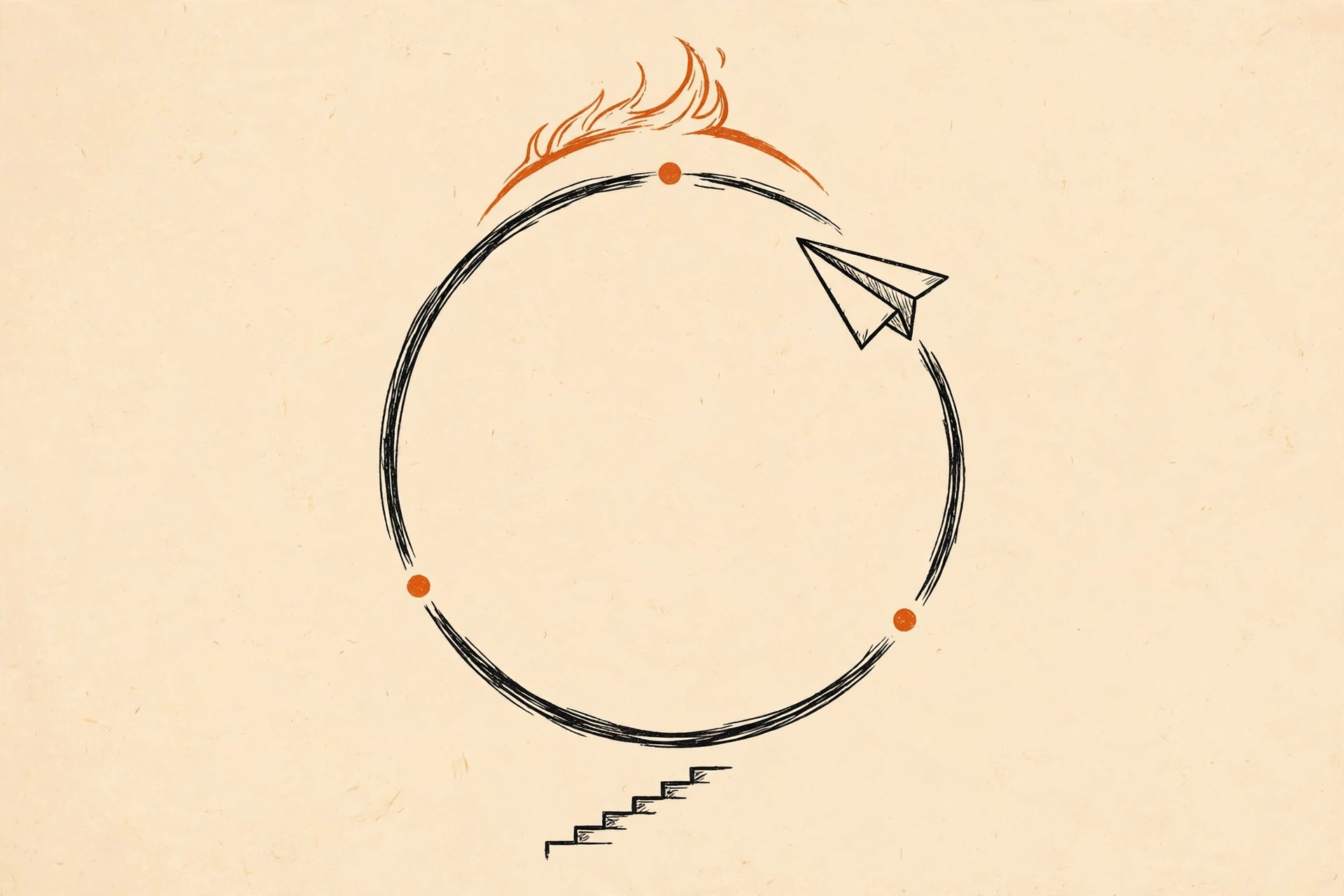
The build-measure-learn loop: build the smallest thing, measure what real people do with it, learn, and go around again. One loop a week beats one launch a year.
See it on Amazon (Amazon Associates link — we may earn a commission)
Read this next: The Mom Test by Rob Fitzpatrick — the short book on talking to customers without fooling yourself. It teaches the exact conversations this book's "measure" step depends on: questions even your mother couldn't lie to you about. (Amazon Associates link — we may earn a commission)
From the Book Club shelf: browse all twelve picks.
Sources
Figures in this guide are as of November 2026 unless noted.
- Penguin Random House — The Lean Startup by Eric Ries — published 2011 (Crown Business); the book this guide summarizes.
- The Lean Startup — Eric Ries's site — the home of the lean startup method; the source of the build-measure-learn loop and Ries's experience at IMVU.
- Wikipedia — The Lean Startup — publication details and a summary of the book's argument, including the minimum viable product.
Subscribe for more free step-by-step how-to guides to help you get more things done to grow your business or project everyday.
Email required. Unsubscribe anytime.
Read our Privacy Policy.