

Deep Work: Your Attention Is the Business — Book Deep-Dive #012
Disclosure: some links on this page are affiliate links. If you buy through one, Changenaire may earn a commission at no extra cost to you. As an Amazon Associate, Changenaire earns from qualifying purchases made through links on this page.
Cal Newport is a computer science professor at Georgetown — MIT PhD, five books in by the time this one landed — and he wrote it because he kept watching smart people lose their days to nothing. Deep Work (Amazon Associates link — we may earn a commission) came out in January 2016 from Grand Central Publishing — 304 pages, per the publisher's page — and it has sold past 1.5 million copies, per Newport's own site. That's a lot of readers for a book whose whole argument is: close the tabs, shut the door, and do one hard thing at a time. It reads like it was written for a founder who ends every day exhausted and can't name a single thing that actually moved forward — because the book says that founder isn't lazy. They're interrupted.
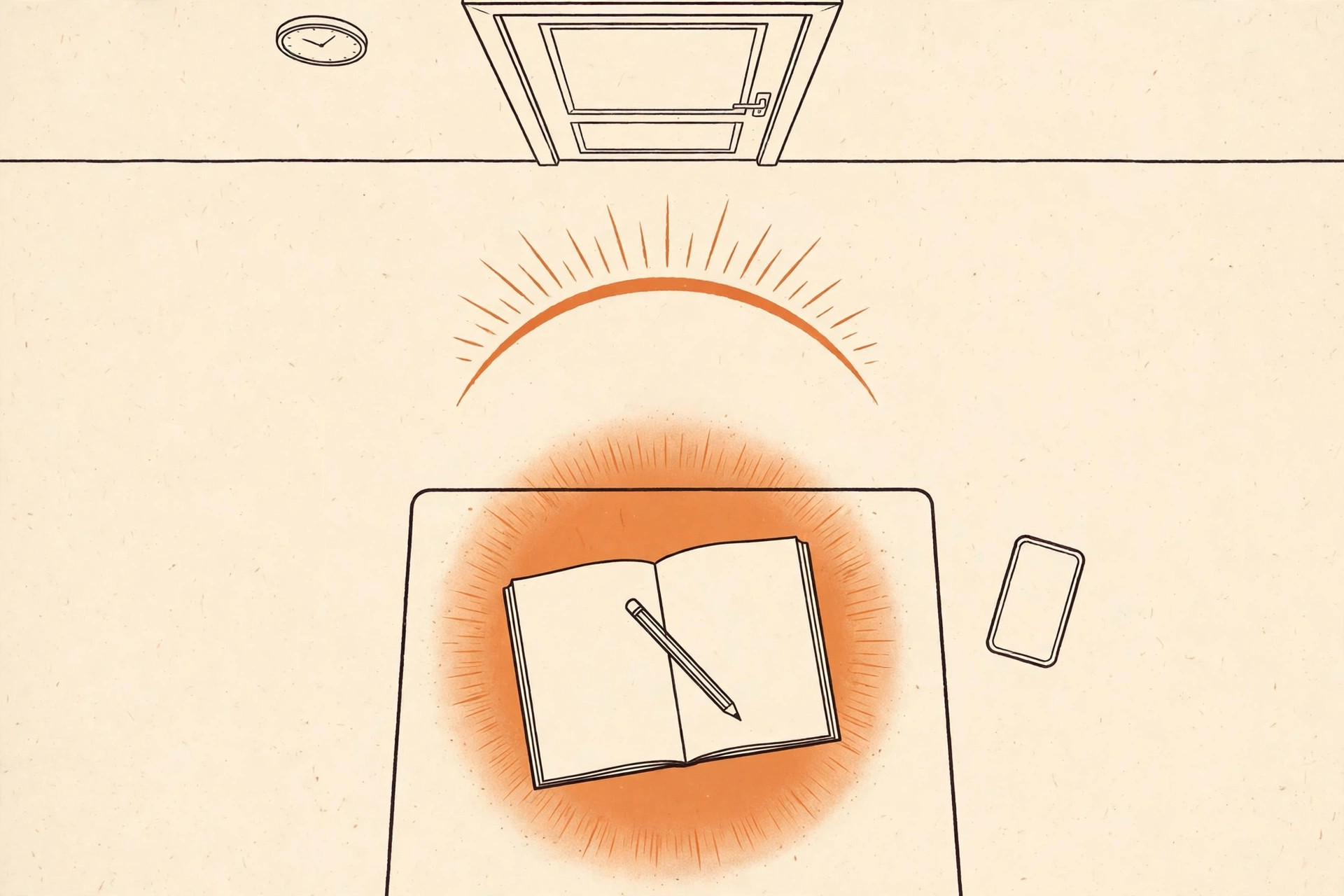
Here’s the book in one line: the ability to focus without distraction on hard work is getting rarer by the year — and rare is what gets paid.
This is the twelfth deep-dive, and it sits next to the last two on purpose. The Psychology of Money (#011) asked what you do with money once it starts coming in. Company of One (#010) asked how small a business can stay and still win. This one asks the question underneath both of them: where does the work that makes any of it happen actually get done? Not in the inbox. Not in the meeting. In the quiet hours nobody sees — the same hours the other two books quietly assume you have.
Key takeaways
- Deep work is professional work done in distraction-free concentration that pushes your mind to its limit; shallow work is logistical, easy to copy, and done while distracted — and it eats the day because it feels busy.
- Focus is a skill you train, not a trait you were born with: every glance at your phone in a spare minute teaches your brain to expect something new every few seconds.
- A tool earns its place only if it clearly serves your most important goals — otherwise it goes, at least for a 30-day test.
- Schedule every minute of the day: time blocking turns intention into a plan, and a shutdown ritual at day’s end is what lets you stop without the work following you home.
- The work that builds a business — the product, the hard problem, the skill — only happens in the deep hours. The shallow hours keep the lights on. They never move anything forward.
Busy is not the same as valuable
The book turns on two definitions, and they're worth getting straight before anything else. Deep work is professional work performed in a state of distraction-free concentration that pushes your cognitive capabilities to their limit. Shallow work is logistical-style work, done while distracted, that doesn't create much new value and is easy to replicate. Email. Admin. Most meetings. Scheduling. The stuff that fills a calendar and leaves nothing behind.
Here's the trap, and every founder knows it by feel: shallow work feels busy. You answer forty emails, sit through three calls, clear the inbox to zero — and the day feels full. But nothing got built. No product improved, no hard problem got solved, no skill got sharper. The book's blunt claim is that in a world of noise, the ability to do deep work is becoming rare at exactly the moment it becomes valuable — because the work that can't be copied is the work that needs your full mind on it.
So the first move isn't a new app or a new routine. It's an honest count. Look at yesterday and sort it: how many hours were deep, how many were shallow? Most builders who do this for the first time get a shock — the deep number is small, sometimes zero, and the day still felt exhausting. That's the point. Exhaustion isn't evidence of depth. It's usually evidence of switching: a mind yanked from task to task all day, never settling long enough to do the one thing only you can do.
Focus is a muscle, and boredom is the gym
The second idea is the one people argue with, because it sounds backwards. Newport says you can't train focus only during work hours. You train it in the gaps — the line at the store, the walk to the car, the minutes waiting for a meeting to start. Every time you reach for your phone in a spare minute, you teach your brain that boredom gets fixed by novelty, right now. Then you sit down to do hard work and wonder why your attention won't stay put for ten minutes.
There's research behind this, and the book leans on it honestly: a 2009 study by Sophie Leroy showed that when you switch tasks, part of your attention stays stuck on the unfinished one — attention residue, she called it. You can feel it. You close the email tab, open the spreadsheet, and for ten minutes your mind is still answering the email. Deep work is the attempt to pay that tax once, up front, instead of all day long.
Newport's fix is plain and a little uncomfortable: schedule your distraction time the same way you schedule your work time, and outside those blocks, let yourself be bored. Use the walk to think through one problem — he calls it productive meditation — instead of filling it with a podcast. Memorize something, a short speech or a string of cards, just to give your attention a weight to lift. None of this is fun. That's the tell. If your attention never has to work against resistance, it never gets stronger, and the deep hours stay out of reach.
Make every tool earn its keep
The third rule is the famous one, and it's the one most often quoted wrong. Newport doesn't say delete your accounts and move to the woods. He says stop keeping a tool just because it offers some benefit. That's the any-benefit approach, and by that standard you'd keep everything — every app helps somebody, somehow. His replacement is the craftsman approach: does this tool clearly serve the goals that matter most to me? If the answer is no, or "sort of," it goes.
His test for it is the part worth stealing. Quit the tool for 30 days. Then ask two questions: did anyone notice you were gone, and did you miss anything that actually mattered? Most people who run the test find the answer to both is no — the important messages found another way in, and the hours came back. The test works because it replaces an argument about principles with a fact about your own life. You don't have to decide whether social media is good or bad. You just have to notice what 30 days without it cost you.
For a builder, this one cuts close to home, because the tools in question are often the same ones that bring in customers. Newport's answer is that the question isn't whether the tool can help — it's whether it helps more than the deep work it displaces. A channel that eats two hours a day to produce one lead is a bad trade, and no amount of "but it's free marketing" changes the math. Keep the tools that earn their keep. The rest are rent on your attention, and the rent keeps going up.
Give every minute a job
The last rule is the most practical, and it's the one that makes the other three possible. Drain the shallows: cut the low-value work, batch what remains, and put a hard cap on how much of your week it gets. Newport's method for doing that is time blocking — at the start of the day, draw the day as a column of hours and write one job into each block before the day starts. No to-do list floating in the air. Every hour has an assignment, including the shallow ones.
He gives four ways to fit the deep blocks into a real life, and the honest one for most founders is the rhythmic philosophy: the same hour, every day, turned into a habit. Not a heroic week locked in a cabin — that's the monastic version, and most builders can't afford it. A fixed block, same time, same place, defended like a meeting with your best client. Newport runs his own life on three to four hours a day, five days a week, of uninterrupted concentration, and says even practiced deep workers rarely pass four. A beginner, he says, hits the wall at about an hour. Start there. An hour a day that actually belongs to you beats eight hours that belong to everyone else.
And then — the part the book refuses to skip — stop. The shutdown ritual is a short end-of-day routine: capture anything unfinished, check tomorrow's blocks, say the day is done, and mean it. Newport has kept one since 2009, and his reason is simple: without a clear end, the work follows you home and hums in the background all evening, which means you never rest and never really work either. Fixed-schedule productivity, he calls it: fix the hours, then get the work done inside them, instead of letting the work set the hours. The ritual is what makes the schedule honest.
Use it this week
First, count yesterday: sort every hour into deep or shallow, and write the two numbers down. If the deep number is zero, that's not a failure — it's the first honest measurement you've got. Second, pick one fixed hour tomorrow — the same hour you can protect every day — and put one hard job in it, phone in another room, door shut. Third, run the 30-day test on one tool that eats your attention: quit it, and at the end ask whether anyone noticed and whether you missed anything that mattered. Fourth, time-block tomorrow morning before the day starts: every hour gets one job, including the shallow ones, so the shallow work has a fence around it instead of the run of the place. Fifth, build a five-minute shutdown ritual for the end of the day — capture what's unfinished, glance at tomorrow's blocks, and stop. If you can't name the moment the workday ends, the workday never ends.
Who should skip this book
If your work genuinely is mostly shallow — front desk, dispatch, customer support by the hour — the book's advice bends more than it fits, because your job is being interruptible, and no philosophy changes that. If you want a list of productivity apps, this isn't it — Newport's tools are a notebook, a calendar, and a door that shuts. If you're looking for a book about social media marketing, look elsewhere; the chapter that bears that name is about quitting the stuff, not using it better. And if you already read it once and you're hunting for new tactics, the second read won't hand you any — the value the second time is noticing how much of your week is still shallow after you swore it wouldn't be.
One honest note before you buy: the book is a book about attention, and attention books have a limit. You can finish it nodding at every page and change nothing by Monday, because knowing that focus matters and protecting an hour a day are two different skills. The ideas are simple enough to explain to a teenager, which is exactly why they're hard — there's nothing to hide behind, no jargon to blame, just the question of whether you'll shut the door and do the hard thing for one hour. Treat it the way Newport wrote it: not as a plan, but as a dare. The hour is the whole point.
Questions people ask
What is the difference between deep work and shallow work?
Deep work is professional work done in a state of distraction-free concentration that pushes your mind to its limit — the new product, the hard problem solved, the skill mastered. Shallow work is logistical, easy to copy, and done while distracted: email, admin, most meetings. The trap is that shallow work feels busy, so a full day of it can feel productive while nothing that matters moved.
How much deep work can you actually do in a day?
Less than most people guess. Newport puts a beginner's limit at somewhere around an hour a day of intense concentration, and says even practiced deep workers rarely pass four hours. He runs his own working life on three to four hours a day, five days a week, of uninterrupted and carefully directed concentration — and treats that as plenty, not a warm-up.
Does Cal Newport really want you to quit social media?
Not exactly — he wants you to stop keeping a tool just because it offers some benefit. His craftsman approach asks whether the tool clearly serves your most important goals, and if the answer is no, it goes. His test is practical: quit for 30 days, then ask whether anyone noticed you were gone, and whether you missed anything that actually mattered.
What is time blocking, and do I have to schedule every minute?
Time blocking means drawing your working day as a column of hours and writing one job into each block before the day starts, instead of keeping a to-do list and reacting to whatever shows up. Newport's version is strict — schedule every minute — because an unscheduled hour gets eaten by shallow work by default. The block is the plan; the shutdown ritual at day's end is what lets you stop and leave the work behind.
See it on Amazon → (Amazon Associates link — we may earn a commission)
Read this next: Digital Minimalism by Cal Newport — the companion read from our shelf: choosing a focused life in a noisy world, from the same author. (Amazon Associates link — we may earn a commission)
From the Book Club shelf: browse all nineteen picks.
Sources
Figures in this guide are as of November 2026 unless noted.
- Hachette Book Group — Deep Work — the publisher's page: Grand Central Publishing, on sale January 5, 2016, 304 pages, ISBN-13 9781455586691, and the four rules for transforming daily habits.
- Cal Newport — calnewport.com — the author's site: professor of computer science at Georgetown University, and Deep Work at 1,500,000+ copies sold.
- Amazon — Deep Work — Grand Central Publishing, January 5, 2016, hardcover, ISBN-10 1455586692; the book's definitions of deep work and shallow work and its four rules.
- Changenaire Book Club — Deep Work — our shelf note on the book: focus without distraction is becoming rare, and therefore valuable, with the four rules in plain English.
Subscribe for more free step-by-step how-to guides to help you get more things done to grow your business or project everyday.
Unsubscribe anytime.