
Fix Forward Head and Rounded Shoulders — Fitness #004
Learning how to fix posture starts with the desk, not with willpower. Raise the screen to eye level, sit with your feet flat and your back supported, and run four short exercises a day — chin tucks, shoulder blade squeezes, wall angels, and a doorway chest stretch. That is the whole program. Ten minutes once you know it, no gear, and a setup that holds the position for you instead of asking your spine to remember all day.
Disclosure: some links on this page are affiliate links. As an Amazon Associate, Changenaire earns from qualifying purchases made through links on this page, at no extra cost to you.
Key takeaways
- The desk setup comes first: screen at eye level, feet flat, back supported, wrists straight.
- Four moves, 10 minutes a day: chin tucks (2 sets of 10), shoulder blade squeezes (2 sets of 12), wall angels (2 sets of 8), and a doorway chest stretch (2 rounds of 30 seconds).
- Hold times matter more than speed: 3 seconds per chin tuck, 5 per squeeze, 3 seconds up and 3 down per wall angel.
- Stand and move briefly every hour. No setup, however good, replaces moving.
- Stop if a move hurts sharply. Gentle effort is the target; pain is the signal to stop and check with your doctor.
Health note: This guide is education, not medical advice. It describes general techniques for healthy adults. Talk to your doctor before starting a new exercise routine — especially if you have a health condition, an injury, or pain that keeps coming back. If a movement hurts, stop.
Who this is for: anyone who sits at a desk, a laptop, or a phone for hours a day and ends the day with their head drifting forward and their shoulders rounded. Complete beginners are welcome — every move here uses a chair, a wall, or a doorway, and none of them needs strength you do not already have.
We wrote the first draft of this one hunched over a laptop, shoulders up around our ears. That is the joke of desk work: the fix is simple, and the chair still wins by noon. So we stopped treating posture as a character trait and started treating it as furniture plus four moves. Furniture first, because furniture never forgets. The moves second, because muscles learn slowly and only by repetition. This guide is part of the Fitness hub, and it pairs with desk stretches for people who sit all day — the stretches loosen what the four moves below retrain.
Go deeper (affiliate link — we may earn a commission): you need nothing to buy for this routine — a wall, a doorway, and a chair do the job, and the four exercises below are the whole program. If you want the full desk system behind them — how to set up a sitting and standing desk, how to sit, stand, and move through a whole workday — Deskbound: Standing Up to a Sitting World is the book we would hand you: 368 pages of desk setup, movement breaks, and mobility work written for people who sit for a living. Skip it if you only want the exercises — they are all below, free, and they are enough to start.
Set the desk so good posture is the easy option
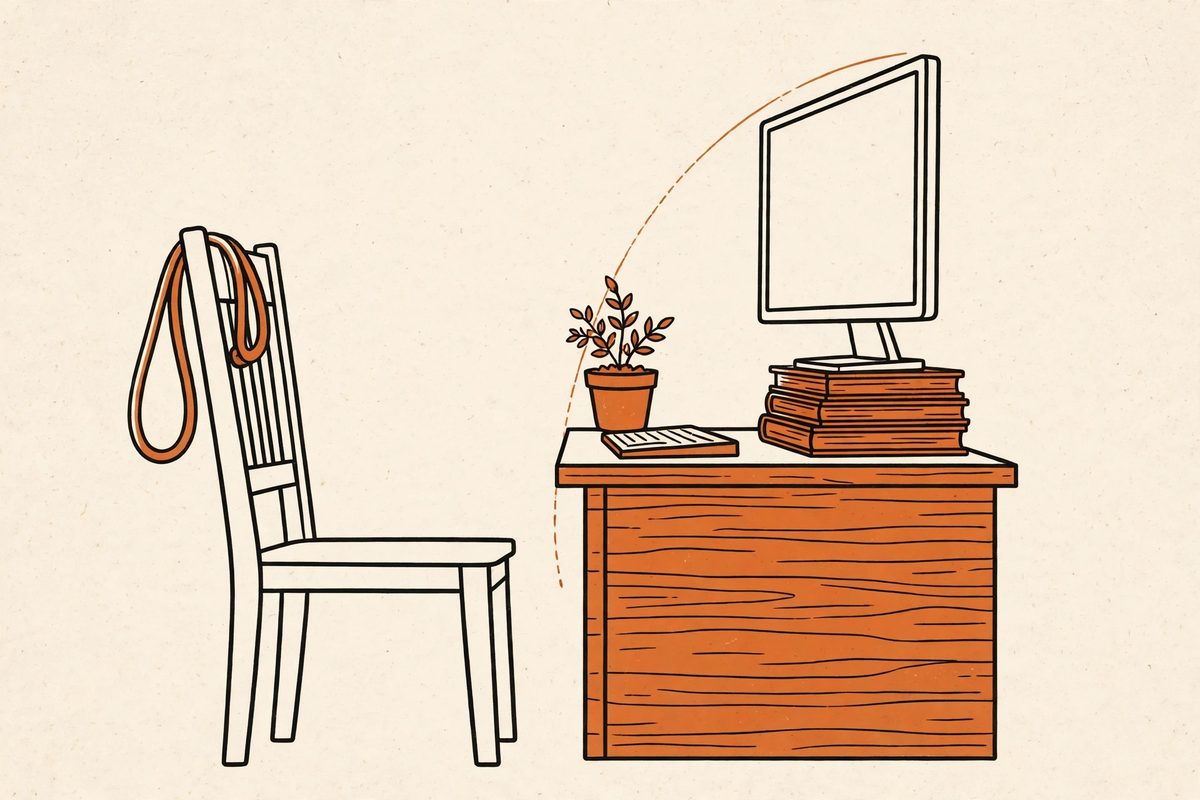
Start with the screen. The CDC's home-office guidance (2020, checked November 2026) puts an external monitor about an arm's length away, with the top of the monitor at or below eye level — and says to use a book or a box to raise it if needed. That one change does more for a forward head than any exercise, because the head follows the eyes. If the screen sits low, the head goes down to meet it, all day, every day. Raise it with what you have: CDC/NIOSH, Working from Home.
Then the chair. The same CDC guidance asks for feet flat on the floor (a box or a book works as a footrest), hips and knees at or slightly more than a 90-degree angle, and the lower back supported in its natural inward curve. Avoid the couch if you can; if you cannot, use pillows to support your back and sit upright. Vary your posture regularly through the day, and stand up at a countertop now and then as a break from sitting. The chair is not a prison. It is a perch you leave often. CDC/NIOSH, Working from Home (2020).
Then the keyboard and mouse. Wrists stay as close to straight — neutral — as possible, and elbows sit at a 90- to 120-degree angle, per the CDC guidance linked above. Shoulders stay down and relaxed, not hitched up toward the ears. If your shoulders creep up while you type, the keyboard is too high or the chair is too low; fix the furniture, not the shoulders.
Check the result with the wall test. Mayo Clinic's posture Q&A describes it this way (checked November 2026): stand so the back of your head, your shoulder blades, and your buttocks touch the wall, with your heels 2 to 4 inches from it. That shape — head over shoulders, shoulders over hips — is what the desk setup is trying to give you while you sit. Our shorter companion piece, Self Improvement #023: How to Fix Your Posture at a Desk, covers the same idea in reflective form; this guide is the full working version, with the numbers.
Easier: raise the monitor today and leave the rest for the weekend — screen height alone changes where the head sits. Harder: no harder version here; a good setup is a good setup. Spend the effort on the exercises below.
Chin tucks: 2 sets of 10, hold 3 seconds
Sit tall in your chair, feet flat, looking straight ahead. Glide your chin straight back, as if you were making a double chin on purpose. Eyes stay level — the head does not tilt up or down, and the movement is small, maybe an inch. Hold for 3 seconds, release, and repeat 10 times. Rest 30 seconds, then do a second set of 10. A rep is one repetition of a move; a set is a group of reps done before you rest. You will see that language all through this guide.
The point is plain: the head belongs above the shoulders. MedlinePlus, Guide to Good Posture, describes good posture as keeping the head above the shoulders with the spine's three natural curves held, not increased (checked November 2026). The chin tuck trains exactly that position, a few seconds at a time, until the body remembers it without being told.
Easier: lie on your back on the floor and tuck the chin there — gravity helps, and the floor tells you when the head is level. Harder: hold 5 seconds per rep instead of 3.
Shoulder blade squeezes: 2 sets of 12, hold 5 seconds
Sit or stand tall. Pull your shoulder blades down and together, as if you were tucking them into your back pockets. Hold for 5 seconds, breathing normally, then release. Repeat 12 times, rest 30 seconds, and do a second set of 12. The cue that matters: down first, then together. Most people pull the blades together and shrug at the same time, which loads the neck instead of the upper back. Ribs stay down, shoulders stay away from the ears, and the squeeze stays at a comfortable effort — firm, not forced.
This is the counterweight to a day of reaching forward. Arms forward, shoulders rounded, chest closed: that is the desk shape, and the squeeze is the opposite shape, held long enough for the body to notice. Do it slowly. A fast squeeze teaches nothing; a held squeeze teaches the position.
Easier: hold 2 seconds and do 8 reps per set. Harder: hold 8 seconds, and pause at the end of every third rep for a slow breath before releasing.
Wall angels: 2 sets of 8, slow on the way down
Stand with your back to a wall: head, shoulder blades, and hips touching it, heels 2 to 4 inches out — the same wall-test shape from step one. Raise your arms into goalposts, elbows bent, backs of the hands toward the wall. Slide the arms slowly up for 3 seconds, then slowly down for 3 seconds, going only as far as you can while keeping contact with the wall. Do 8 reps, rest 30 seconds, and do a second set of 8. If the hands lift off the wall, you have gone too far; bring the range back until contact holds.
Pair this one with a longer warm-up on the days you have it. Self Improvement #019: The 5-Minute Morning Stretch is a five-minute stretch routine that sits well before the wall angels, especially first thing in the morning when everything feels stiff. Wall angels are the stricter cousin: the wall removes the cheating, which is exactly why they work.
Easier: step a few inches away from the wall and let the arms travel a shorter distance. Harder: slow the lowering to 5 seconds per rep.
Doorway chest stretch: 2 rounds, hold 30 seconds
Stand in a doorway. Place one forearm flat on the doorframe at shoulder height, elbow bent at a right angle. Step gently through the doorway with the same-side foot until you feel a stretch across the chest — gentle, not sharp. Hold for 30 seconds, breathing normally. Switch sides, hold 30 seconds, and then do a second round on each side. No bouncing. A stretch held still teaches the muscle to lengthen; a bouncing stretch teaches it to guard.
Staying active is part of the picture too. MedlinePlus notes that any kind of exercise may help improve posture, and names strengthening the core — the muscles around the back, abdomen, and pelvis — as especially helpful (checked November 2026). The doorway stretch and the three moves above are general conditioning, not treatment for any named condition: they build the habit of an open chest and a head over the shoulders, one round at a time.
Easier: hold 15 seconds and keep the step small. Harder: raise the forearm a hand's width higher on the frame for the second round.
Run it daily: the 10-minute round and the hourly reset
Put it together: all four moves, once a day, about 10 minutes in total. Morning works, lunch works, the end of the workday works — the best time is the one you will actually keep. The desk setup is a one-time job you check once a month. The round is the daily habit, and the habit is the program.
Between rounds, stand up and move briefly every hour. The CDC guidance linked in step one recommends varying your posture regularly, and a short break — stand, walk to the window, roll the shoulders — is enough. On long sitting days, add Self Improvement #015: Stretching for People Who Sit All Day for a fuller stretching break. The round builds the position; the hourly reset stops the chair from quietly rebuilding the slouch.
Easier: two moves a day beats none — chin tucks and shoulder squeezes first, the rest when you have them. Harder: run the full round twice a day, morning and late afternoon.
At a glance
| Step | The short version |
|---|---|
| Desk setup | Screen at eye level, arm's length; feet flat; back supported; wrists straight |
| Chin tucks | 2 sets of 10, hold 3 seconds each |
| Shoulder blade squeezes | 2 sets of 12, hold 5 seconds each |
| Wall angels | 2 sets of 8, 3 seconds up, 3 seconds down |
| Doorway chest stretch | 2 rounds, 30 seconds each side |
| Daily round | All four moves, about 10 minutes, plus an hourly stand-and-move |
Common mistakes
Forcing yourself upright all day. Willpower runs out by lunch, and the slouch comes back with interest. Fix: let the furniture hold the position — screen height first, then the chair, then the exercises.
Tilting the head back during chin tucks. Looking at the ceiling is not a chin tuck; it loads the neck the wrong way. Fix: glide the chin straight back, eyes level, movement small.
Shrugging during shoulder squeezes. Shoulders up by the ears turns a back exercise into a neck exercise. Fix: blades go down first, then together, and the ribs stay down.
Bouncing the doorway stretch. Bouncing makes the muscle guard instead of lengthen. Fix: hold still for the full 30 seconds, at a gentle stretch, and breathe normally.
Can't do today?
Do the 2-minute version at your desk: 10 chin tucks and 10 shoulder blade squeezes, sitting tall, with the screen raised on books. That is the whole fallback, and it counts. The missed-day rule is simple: let it go — do today's session today, never double up to catch yesterday. What counts as enough: the full 10-minute round five days out of seven, with the 2-minute version on the other days, and the desk setup holding its shape all week.
Questions people ask
How long does it take to fix forward head posture?
The desk setup changes how you sit from the first day you use it. The exercises take longer — run the 10-minute round daily for a month before you judge it, and keep the setup either way. There is no fixed timeline, and anyone selling one is guessing.
Can you fix rounded shoulders without any equipment?
Yes. Every move in this guide uses a chair, a wall, or a doorway, and the desk setup needs nothing fancier than a stack of books under the monitor. If you buy one thing later, make it a chair that supports your lower back — but it is not required to start.
How often should I do posture exercises?
Once a day, for about 10 minutes, plus a short stand-and-move break every hour. The CDC's home-office guidance recommends varying your posture regularly through the workday, and the daily round is how that habit sticks.
Should posture exercises hurt?
No. Gentle effort and a mild stretch are normal; sharp pain is not. If a move hurts, stop, and talk to your doctor before trying it again — the health note at the top of this guide says the same.
What comes next
Keep the setup, run the round, and let the chair stop winning. Check the screen height once a month — monitors drift down, chairs sink, and good furniture quietly becomes bad furniture. The round stays at 10 minutes; the habit is the upgrade. Two more guides share the same desk: the 20-20-20 rule for eye strain for screen height and eye breaks, and hip and hamstring mobility for sitters for the lower half the chair folds all day.
Sources
Every fact in this post was checked against the sources below in November 2026.
- MedlinePlus (U.S. National Library of Medicine) — Guide to Good Posture (checked November 2026) — the spine's three natural curves, the head above the shoulders, and staying active and strengthening the core as habits that may help posture.
- CDC/NIOSH — Working from Home: How to Optimize Your Work Environment and Stay Healthy (2020, checked November 2026) — monitor at arm's length with the top at or below eye level, feet flat with hips and knees at or beyond 90 degrees, wrists straight with elbows at 90 to 120 degrees, and varying posture regularly.
- Mayo Clinic News Network — Q and A: Proper posture and body alignment (checked November 2026) — the wall test: head, shoulder blades, and buttocks touching the wall, heels 2 to 4 inches out.
- Deskbound: Standing Up to a Sitting World (2016), ASIN 1628600586 — the desk-system book recommended in this post.
Subscribe for more free step-by-step how-to guides to help you get more things done to grow your business or project everyday.
Email required. Unsubscribe anytime.
Read our Privacy Policy.