
Neck Stretches for Text Neck: Chin Tucks and Beyond — Fitness #011
Neck stretches for text neck are four gentle moves — chin tucks, an upper trap stretch, a levator stretch, and slow neck turns — that loosen the neck after hours of looking down at a phone. Ten minutes a day, from your chair, no gear. The stretches are the short game; raising the phone and the screen to eye level is the long one, because the neck only stays forward while the screen sits low.
Disclosure: some links on this page are affiliate links. As an Amazon Associate, Changenaire earns from qualifying purchases made through links on this page, at no extra cost to you.
Key takeaways
- Four moves, 10 minutes a day: chin tucks (2 sets of 10), upper trap stretch (2 rounds of 30 seconds a side), levator stretch (2 rounds of 30 seconds a side), and slow neck turns (5 each side).
- Hold each stretch about 30 seconds, breathe normally, never bounce — 60 seconds on the tighter side.
- The chin tuck is the anchor: head glides straight back, eyes level, hold 3 seconds — the same counts as the posture guide.
- Raise the screen to eye level and hold the phone up. The stretches loosen the neck; the setup stops it tightening again.
- Stop on sharp pain, or on pain, numbness, or tingling that runs down an arm — and talk to your clinician.
Health note: This guide is education, not medical advice. It describes general techniques for healthy adults. Talk to your doctor before starting a new exercise routine — especially if you have a health condition, an injury, or pain that keeps coming back. If a movement hurts, stop.
Who this is for: anyone who spends the day looking down at a phone, a laptop, or a low monitor and ends it with a stiff neck and shoulders that sit up around the ears. Complete beginners are welcome — every move here is done sitting in a chair, and none of them needs strength you do not already have. Who should check first: anyone with sharp, radiating, or worsening neck pain, numbness or tingling running down an arm, a recent neck injury, or dizziness when turning the head — talk to your clinician before starting, and skip any move that hurts.
Go deeper (affiliate link — we may earn a commission): you need nothing to buy for this routine — a chair does the job, and the four moves below are the whole program. If you want the thinking behind the chin tuck — how a physiotherapist teaches people to look after their own necks, exercise by exercise — Treat Your Own Neck, 5th edition, by Robin McKenzie is the 80-page handbook that lays it out. Skip it if you only want the moves — they are all below, free, and they are enough to start.
People call it text neck: the head-forward shape that builds up from looking down at a phone for hours. It is common — the NHS notes that 2 out of 3 people get neck pain or a stiff neck at some point (checked November 2026). The head is heavy, and every inch it drifts forward asks the neck muscles to hold more of it. The fix has two halves: four gentle stretches that loosen what the day tightened, and a screen raised to eye level so the head stops drifting forward in the first place. This guide is part of the Fitness hub, and it pairs with the posture guide — that one fixes the desk setup that folds you forward; this one works the neck the phone pulls down.
Chin tucks: 2 sets of 10, hold 3 seconds
Sit tall in your chair, feet flat, looking straight ahead. Glide your chin straight back, as if you were making a double chin on purpose. Eyes stay level — the head does not tilt up or down, and the movement is small, maybe an inch. Hold for 3 seconds, release, and repeat 10 times. Rest 30 seconds, then do a second set of 10. These are the same counts as the posture guide — one version of the chin tuck, taught the same way everywhere it appears on this site.
The point is plain: the head belongs above the shoulders. MedlinePlus, Guide to Good Posture, describes good posture as keeping the head above the shoulders with the spine's three natural curves held, not increased (checked November 2026). The chin tuck trains exactly that position, a few seconds at a time, until the body remembers it without being told. The NHS neck-pain exercises teach the same move — tuck the chin and push the head gently back, 10 times — as one of the first things to do for a stiff neck (checked November 2026).
Easier: lie on your back on the floor and tuck the chin there — gravity helps, and the floor tells you when the head is level. Harder: hold 5 seconds per rep instead of 3.
Upper trapezius stretch: 2 rounds, hold 30 seconds each side
Sit tall, shoulders down. Drop your right ear gently toward your right shoulder, as if you were trying to rest it there without lifting the shoulder to meet it. Do not pull with your hand, and do not roll the head in circles. Hold for 30 seconds, breathing normally, then lift slowly and switch sides. Do a second round on each side. You should feel a gentle pull down the left side of the neck — the side opposite the lean. That is the stretch working. If one side feels tighter, give it the full 60 seconds on the second round.
The hold time is the point. Mayo Clinic's stretching guidance says to breathe normally and hold each stretch for about 30 seconds, and longer — around 60 seconds — in problem areas (checked November 2026). It also says to stretch in a smooth movement, without bouncing, because bouncing can injure the muscle and add to tightness. The neck is a problem area for most desk workers, so the tighter side earns the longer hold. Pair this one with the shoulder mobility guide — the upper trap runs from the neck into the shoulder, and the two pieces work the same ground from different ends.
Easier: hold 15 seconds and keep the lean small — halfway is plenty on day one. Harder: hold 60 seconds on the tighter side, and anchor the opposite hand under the chair seat to keep that shoulder down.
Levator scapulae stretch: 2 rounds, hold 30 seconds each side
Sit tall. Turn your head slightly to the right, then look down toward your right armpit, as if you were trying to smell it. Rest your right hand lightly on the back of your head — no pulling, just the weight of the hand. Hold for 30 seconds, breathing normally, then lift slowly and switch sides. Do a second round on each side. You should feel the pull at the back of the neck, on the side opposite the turn, running down toward the shoulder blade.
This one reaches the muscle the ear-to-shoulder stretch misses. The levator — the name means "lifter" — runs from the top of the neck down to the shoulder blade, and it is the muscle that aches when you hold a phone between your ear and your shoulder, or hunch over a laptop with your shoulders hitched up. The same Mayo Clinic rules apply here: smooth movement, no bouncing, breathe normally, about 30 seconds a side. Keep the hand light. A hard pull turns a stretch into a strain, and the neck does not need forcing — it needs thirty slow seconds.
Easier: hold 15 seconds with no hand on the head at all — the turn and the look-down are enough. Harder: hold 60 seconds on the tighter side, and add a slow chin tuck at the end of each hold.
Slow neck turns: 5 each side, hold 5 seconds
Sit tall, shoulders down, eyes level. Turn your head slowly to the right, as if looking over your shoulder, and stop where the stretch feels gentle — do not force it. Hold for 5 seconds, return to the middle, and turn to the left. Do 5 turns each way, slow and smooth, never jerking the head around. The NHS neck-pain exercises teach the same turn — slow, to one side as far as is comfortable, hold for a few seconds, then the other side — and the same leaflet says a stretch feeling is not harmful and will slowly improve (checked November 2026).
The turns are the range-of-motion check at the end of the round. The stretches loosen the sides and the back of the neck; the turns ask whether the neck moves freely in both directions again. If one side turns less far than the other, do not force it — note it, and give that side the extra round of the two stretches above. The range comes back with repetition, not with effort.
Easier: turn only halfway and hold 2 seconds. Harder: hold 10 seconds per turn, and do a second set of 5 each way.
Run it daily: the 10-minute round and the screen at eye level
Put it together: all four moves, once a day, about 10 minutes in total. Morning works, lunch works, the end of the workday works — the best time is the one you will actually keep. The NHS neck-pain exercises suggest doing stretches 2 to 3 times a day, so if your neck feels tight in the afternoon, repeat just the two side stretches once — little and often beats one long session (checked November 2026).
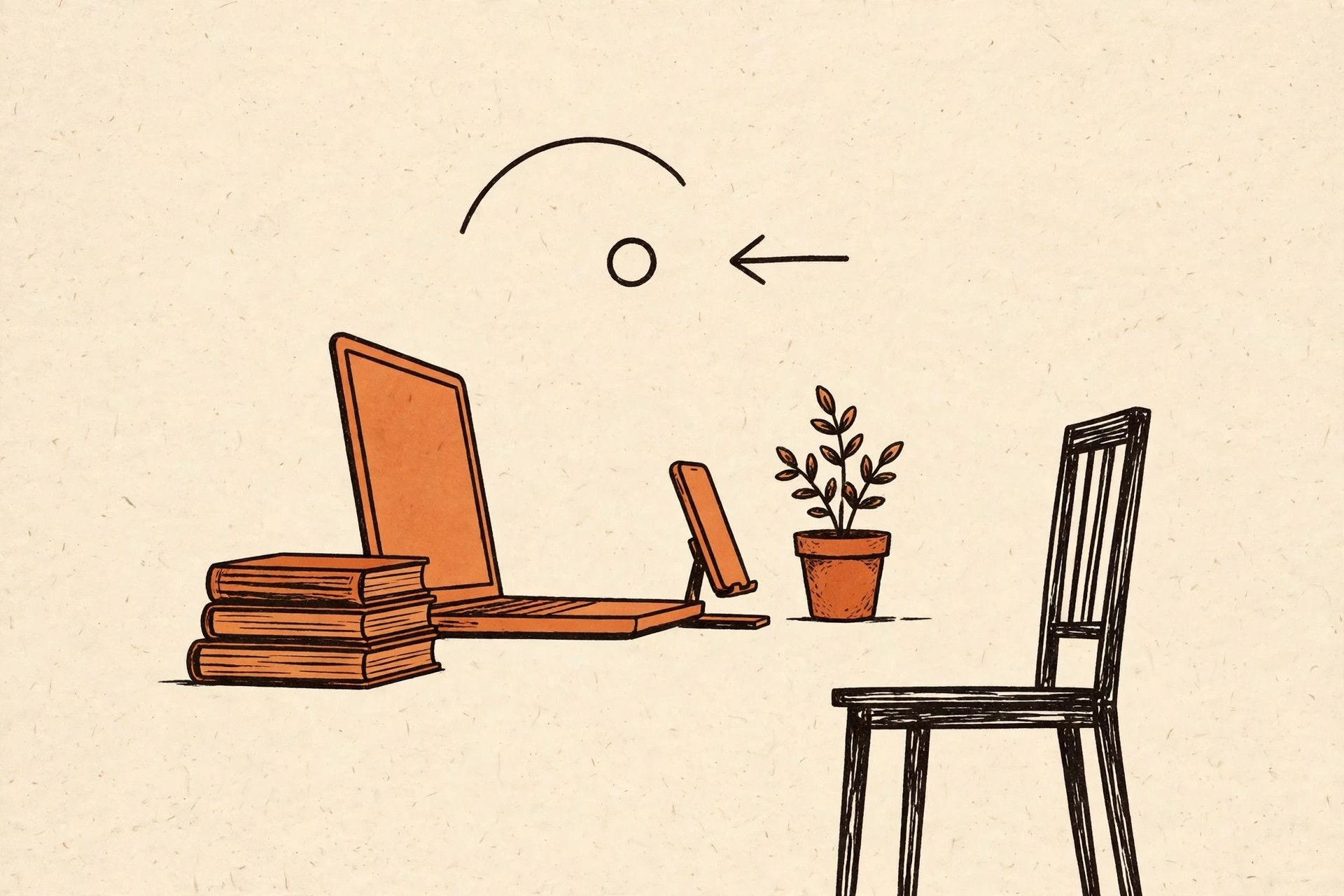
Then fix the cause, not just the symptom. The CDC's home-office guidance puts an external monitor about an arm's length away, with the top of the monitor at or below eye level, and says to use a book or a box to raise it if needed (checked November 2026). Do the same for the phone: hold it up, or prop it on a stand, instead of looking down at it in your lap. The stretches loosen the neck; the setup stops the phone from tightening it again. Pair the round with the desk stretches — that round covers the neck, shoulders, back, and hips the chair folds, and together the two rounds make a full desk-day reset in under 20 minutes.
Easier: two moves a day beats none — chin tucks and the upper trap stretch first, the rest when you have them. Harder: run the full round twice a day, morning and late afternoon.
At a glance
| Step | The short version |
|---|---|
| Chin tucks | 2 sets of 10, hold 3 seconds each, eyes level |
| Upper trapezius stretch | 2 rounds, hold 30 seconds each side, ear toward shoulder |
| Levator scapulae stretch | 2 rounds, hold 30 seconds each side, nose toward armpit |
| Slow neck turns | 5 each side, hold 5 seconds, slow and smooth |
| Daily round | All four moves, about 10 minutes, plus the screen at eye level |
Common mistakes
Pulling the head with your hand. A hard pull turns a stretch into a strain. Fix: let the head's own weight do the work — the hand rests lightly, or stays off entirely.
Rolling the head in circles. Full neck circles grind the joints and teach nothing. Fix: stretch in one direction at a time, hold it, and come back to the middle before changing direction.
Bouncing the stretch. Bouncing makes the muscle guard instead of lengthen. Fix: hold still for the full 30 seconds, at a gentle stretch, and breathe normally.
Stretching the neck and ignoring the screen. The stretches loosen the neck, and the low phone tightens it again by lunch. Fix: raise the monitor and the phone to eye level — the setup is half the program.
Can't do today?
Do the 2-minute version at your desk: 10 chin tucks and a 30-second upper trap stretch on each side, sitting tall, with the phone held up at eye level. That is the whole fallback, and it counts. The missed-day rule is simple: let it go — do today's session today, never double up to catch yesterday. What counts as enough: the full 10-minute round five days out of seven, with the 2-minute version on the other days, and the screen holding its height all week.
Questions people ask
How often should I do neck stretches?
Once a day, for about 10 minutes, is the round in this guide. The NHS neck-pain exercises suggest holding stretches for 20 to 30 seconds, doing 2 to 3 sets, and repeating them 2 to 3 times a day — so if your neck feels tight in the afternoon, repeat just the two side stretches once. Little and often beats one long session.
How long should I hold a neck stretch?
About 30 seconds, breathing normally. Mayo Clinic's stretching guidance says to hold each stretch for about 30 seconds, or around 60 seconds in a problem area, and never to bounce — bouncing can injure the muscle and add to tightness. If one side feels tighter, give it the full 60 seconds.
Can neck stretches help text neck?
They are general stretching, not treatment. The moves in this guide loosen the muscles that tighten when the head sits forward for hours, and the chin tuck retrains the head-over-shoulders position. The longer-term change is the setup: the CDC's home-office guidance puts the top of the monitor at or below eye level, about an arm's length away, so the head stops drifting forward to meet the screen.
Should neck stretches hurt?
No. A gentle pull is normal; sharp pain is not. If a stretch sends pain, numbness, or tingling down your arm, stop and talk to your clinician — the NHS lists weakness, numbness, or tingling in an arm as a reason to get checked. The health note at the top of this guide says the same.
What comes next
Keep the round, and let the phone stop winning. When the holds feel easy and the turns move evenly both ways, take the harder versions — 5-second chin tucks, 60-second holds on the tighter side, 10-second turns. The round stays at 10 minutes; the control is the upgrade. When the neck feels looser, the eyes want the same treatment: the 20-20-20 rule for eye strain takes the same 10-minute shape to the part of the body the screen works hardest, and hip and hamstring mobility for sitters takes it to the lower half the chair folds all day.
Sources
Every fact in this post was checked against the sources below in November 2026.
- Mayo Clinic — Stretching: Focus on flexibility (checked November 2026) — breathe normally and hold each stretch for about 30 seconds, around 60 seconds in problem areas; do not bounce; focus on major muscle groups including the neck and shoulders.
- NHS (University Hospitals Sussex) — Self-treatment of acute neck pain (checked November 2026) — chin tuck 10 times; hold stretches 20 to 30 seconds, 2 to 3 sets, 2 to 3 times a day; a stretch feeling is not harmful and will slowly improve.
- NHS (Robert Jones and Agnes Hunt Orthopaedic Hospital) — Neck pain (checked November 2026) — 2 out of 3 people experience neck pain or a stiff neck at some point; weakness, numbness, or tingling in an arm is a reason to get checked.
- MedlinePlus (U.S. National Library of Medicine) — Guide to Good Posture (checked November 2026) — good posture keeps the head above the shoulders with the spine's three natural curves held, not increased.
- CDC/NIOSH — Working from Home: How to Optimize Your Work Environment and Stay Healthy (2020, checked November 2026) — monitor at arm's length with the top at or below eye level, using a book or a box to raise it if needed.
- Treat Your Own Neck, 5th edition, by Robin McKenzie (2011), ASIN 0987650416 — the neck self-care handbook recommended in this post.
Subscribe for more free step-by-step how-to guides to help you get more things done to grow your business or project everyday.
Email required. Unsubscribe anytime.
Read our Privacy Policy.