
Self Improvement #004: How to Build a Morning Routine That Actually Sticks
The morning sets the day. Not because of some magic hour, but because the first thing you do teaches the rest of the day what kind of day it is. A routine that sticks is not the impressive one. It is the small one you can do on your worst morning.
Disclosure: This post contains one affiliate link. If you buy through it, Changenaire may earn a commission at no extra cost to you. As an Amazon Associate, Changenaire earns from qualifying purchases made through links on this page. We only link books we would hand to a friend.
One book worth your money
You don’t need it to start — nothing here replaces the practice itself. But if you want the case made properly, Meditation for Fidgety Skeptics by Dan Harris is the one: a practical guide for people who are sure they cannot meditate, written by a man who was sure he could not either — short exercises, no incense, no jargon. (Referral link — we may earn a commission.)
And if your anchor is the five quiet minutes, and you want the story of how one skeptic built the habit — 10% Happier by Dan Harris is the one.
Ten minutes is enough
A routine fails when it asks too much. An hour of journaling, exercise, reading, and cold water looks good on paper and dies by Thursday. Ten minutes does not die. Ten minutes is short enough to do when you are tired, late, or unmotivated — and those are the mornings that decide whether the routine survives.
Pick one thing that steadies you. Sitting still for five minutes. A short walk. Writing three lines. One thing, not five. The routine is not a performance. It is a promise you can keep.
One anchor, same order
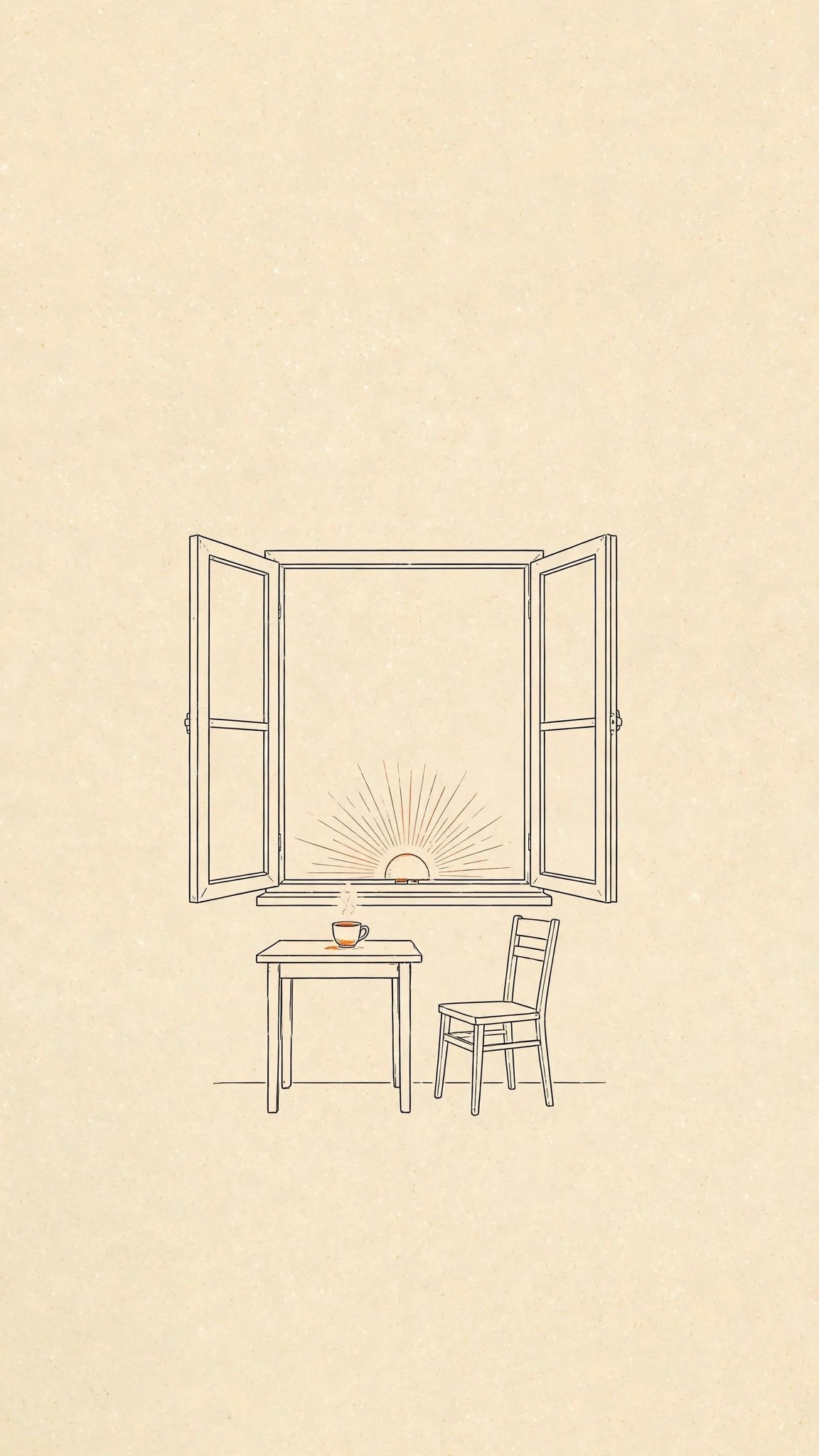
Do the same thing in the same order every day. Keep the order fixed, and the content can stay simple: when the steps are the same, you do not spend willpower deciding. You just start. Coffee, chair, five quiet minutes — or shoes, door, ten-minute walk. The sequence becomes the habit, and the habit carries you on the days your motivation does not show up.
Anchor it to something that already happens. After the coffee is made. After the shoes are on. After the alarm is off. The old habit pulls the new one along, and after a couple of months, for most people, you do not think about it at all. A 2010 habit-formation study put numbers on it: 18 to 254 days, 66 on average, before a new habit felt automatic.
What to do when you miss a day
You will miss a day. That is not a failure — it is a fact of a real life. The rule is simple — as James Clear puts it in Atomic Habits, never miss twice. One missed morning is a blip. Two in a row is the start of a new habit, and the new habit is not doing it.
Do not make up for it. Do not double the time the next morning to “catch up.” Just do the ten minutes, same as always, and move on. The routine is a practice, not a debt.
What not to buy
You do not need a special journal, a sunrise lamp, or a subscription. A chair, a cup, and ten minutes are the whole kit. The routine is the product — not the things around it. If a purchase makes the morning easier, fine. If it makes the morning more complicated, skip it.
What comes next
This is Self Improvement #004. The series continues the inner work: stillness, movement, time outdoors, and faith without the fine print. Next, we close the day — how to quiet a busy mind before bed, and why the day needs a closing time as much as the morning needs an opening one.
Ten minutes. One anchor. Same order. Start tomorrow morning — the world you’re going to change is waiting on the person you’re becoming.
Sources
- Lally et al. (2010), "How are habits formed: Modelling habit formation in the real world," European Journal of Social Psychology 40(6):998–1009 — 96 volunteers, twelve weeks: it took 18 to 254 days, 66 on average, for a new habit to feel automatic. Habits take far longer than "a few weeks" for most people.
- James Clear, Atomic Habits — the "never miss twice" rule, as popularized by Clear; it is practical advice, not a research finding.
Subscribe for more free step-by-step how-to guides to help you get more things done to grow your business or project everyday.
Email required. Unsubscribe anytime.
Read our Privacy Policy.