
Self Improvement #027: Strength Without a Gym: The Bodyweight Basics
Strength looks like it needs a gym — a membership, a rack, a row of machines. It does not. The weight you already carry is the equipment, and the floor you already stand on is the gym. Four moves, twice a week, in your living room. That is the whole program.
Health note: This piece is general information, not medical advice. It describes gentle techniques for healthy adults. Talk to a doctor before starting a new exercise or breathing routine — especially if you have a health condition, an injury, or pain that keeps coming back. If anything hurts, stop.
Disclosure: This post contains one affiliate link. If you buy through it, Changenaire may earn a commission at no extra cost to you. As an Amazon Associate, Changenaire earns from qualifying purchases made through links on this page. We only link books we would hand to a friend.
One book worth your money
You don’t need it to start — nothing here replaces the practice itself. But if you want the case made properly, Born to Run by Christopher McDougall is the one: McDougall pursues the question of why we run and finds people in Mexico who run for joy, not medals. It is a reminder that the body was built to move — and it starts with the body you already have. (Referral link — we may earn a commission.)
The four moves
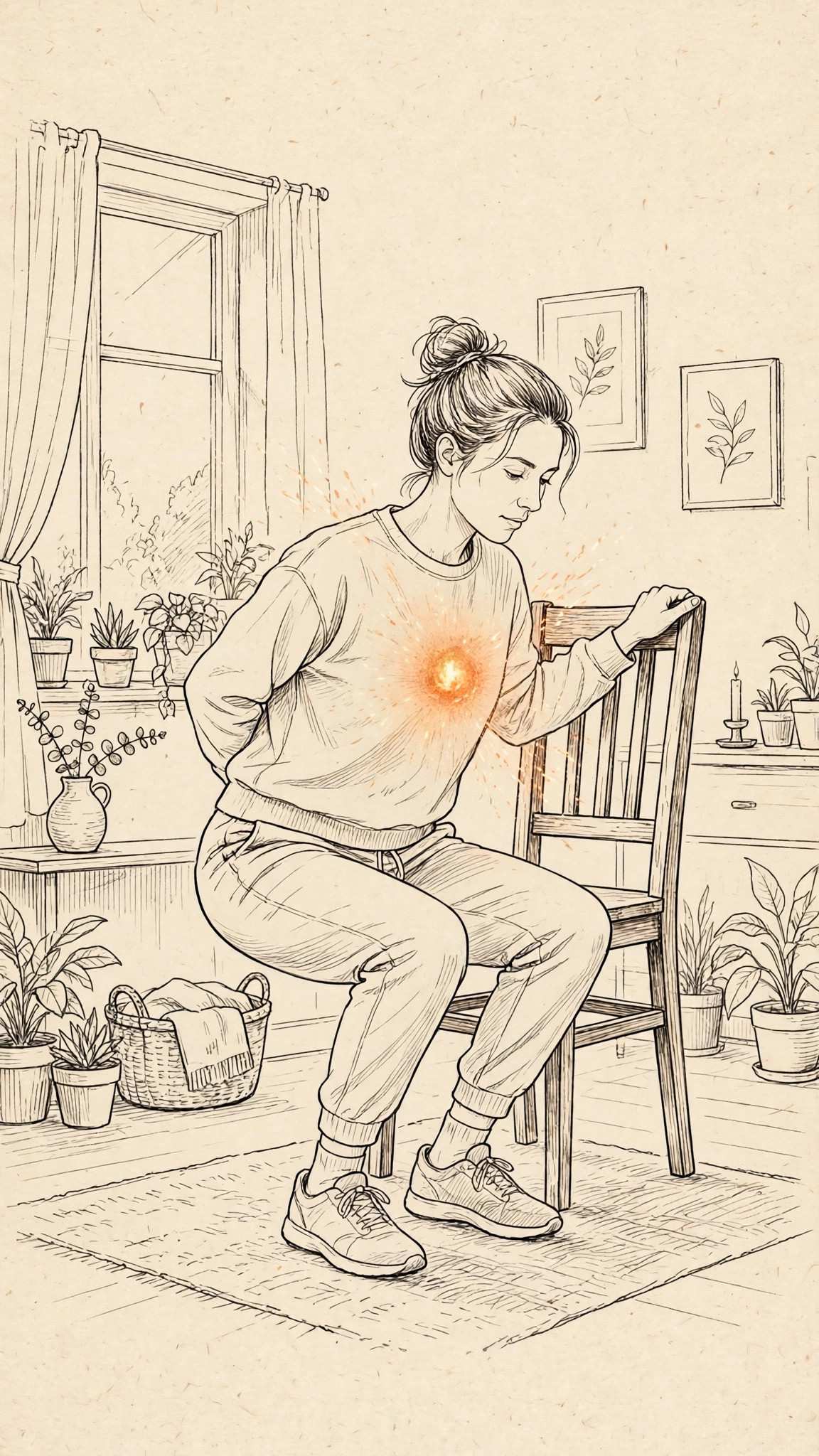
Start with the simplest version of each move. The NHS strength-exercise guide lists the same set: sit-to-stand from a solid chair, slow mini-squats holding the chair back, calf raises with a hand on the chair, and wall press-ups — hands flat on the wall at chest height, elbows by your side. Five repetitions each, slow, is a full session the first week. The slower the repetition, the better the work.
Twice a week, no more to start
The NHS guide says to aim for these exercises at least twice a week, and to build up slowly, adding repetitions over time. That is the whole schedule. Two days, not seven — because a schedule you keep beats a schedule you quit. Pick two days and put them on the calendar. Tuesday and Friday. Monday and Thursday. The days do not matter. Keeping them does.
Why it is worth doing
Strength is not only about muscle. Harvard Health explains that strength training builds more than muscles: it helps with balance, with the everyday work of standing up, climbing stairs, and carrying groceries, and with staying steady on your feet as you get older. The bodyweight basics are not a shortcut to a gym body. They are a way to keep the body you have working well — and they cost nothing.
What not to buy
No set of dumbbells, no resistance bands, no bench — not yet. Your body weight is the load, and the chair and the wall are the equipment. If a move hurts — sharp pain, not effort — stop, and ask a doctor or a physical therapist before you push through it. The goal is a stronger body, not a braver injury.
What comes next
This is Self Improvement #027. The series continues the inner work: stillness, movement, time outdoors, and faith without the fine print. Next, we move — how to walk more without changing your schedule, and why the small walks count.
Four moves. Twice a week. Your living room.
Sources
- NHS, “Strength exercises” (accessed November 2026) — gentle strength exercises that can be done at home: sit-to-stand, mini-squats, calf raises, wall press-ups; aim for at least twice a week and build up slowly.
- Harvard Health Publishing, “Strength training builds more than muscles” (accessed November 2026) — strength training helps with balance and the everyday work of standing, climbing, and carrying, as well as staying steady on your feet.
Subscribe for more free step-by-step how-to guides to help you get more things done to grow your business or project everyday.
Email required. Unsubscribe anytime.
Read our Privacy Policy.