
How to Take a Real Lunch Break: Move, Go Outside, Eat Away From the Desk — Wellness #021
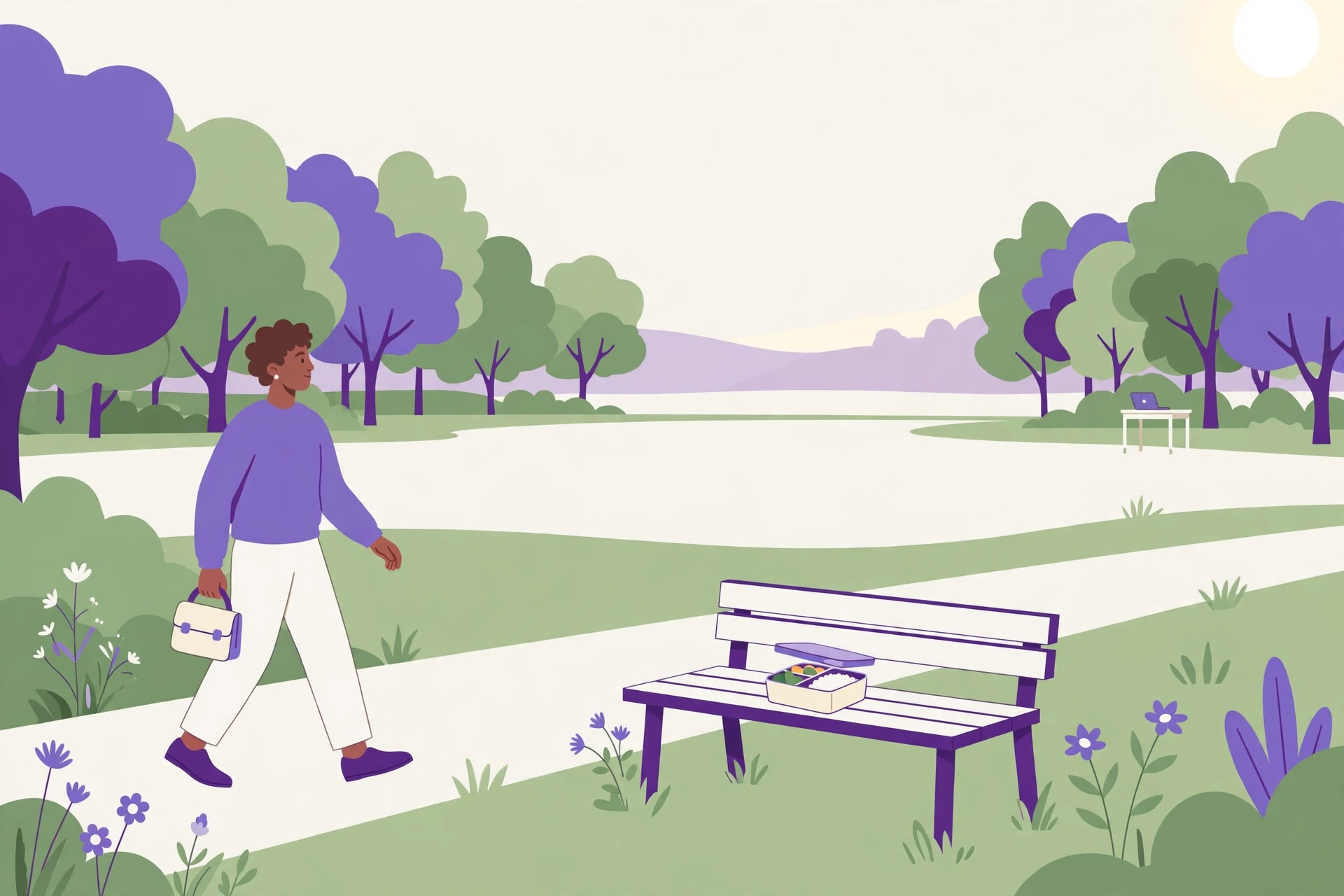
Lunch at the desk is not a break. The screen stays on. The emails keep coming. The food goes down without a thought. A real break has three parts. Move your body. Step outside. Eat away from the desk. Thirty minutes can reset the second half of your day. Built to last.
Disclosure: some links on this page are affiliate links. As an Amazon Associate, Changenaire earns from qualifying purchases made through links on this page, at no extra cost to you.
Key takeaways
- A real lunch break has three parts: move, go outside, eat away from the desk.
- Ten minutes of walking counts — adults need 150 minutes of moderate activity a week.
- Time outside every day may help your sleep, and daylight sets the body clock.
- Eat with the screen off so you taste the food and feel full.
- Put the break on the clock at the same time every day, and guard it like a meeting.
Health note: This guide is education, not medical advice. It describes a lunch habit for healthy adults. Talk to your doctor before changing a health routine — especially if you have a heart condition, a breathing problem, or a health issue that limits walking. If a change in this guide makes you feel worse, stop and talk to your doctor.
Who this is for: builders who eat over the keyboard, answer emails through lunch, and hit 3 p.m. feeling foggy and tired. Check first if walking hurts, leaves you short of breath, or brings chest pain: those are reasons to talk to a doctor, not to add a longer walk.
We used to treat lunch as lost time: a sandwich in one hand, the mouse in the other, and pride in never leaving the desk. The afternoons stayed foggy because the break never happened. The screen never switched off, the body never moved, and the food never got a thought. A real break is not a luxury. It is three small moves in thirty minutes. This guide is part of the Wellness hub. If the morning is the harder half of the day, the caffeine cutoff and morning light sets it right; if you want the five small habits that hold the whole day together, the wellness habits starter set stacks them on a normal workday.
Go deeper (affiliate link — we may earn a commission): the break needs nothing to buy — shoes, a door, and food are the whole kit. If you want the case for rest as a work tool, from the writer who studies how creative people really work, Rest: Why You Get More Done When You Work Less by Alex Soojung-Kim Pang is the book we would hand you. Skip it if you only want the break — it is all below, and it is enough.
Leave the desk: the break starts with distance
Stand up and walk away from the desk before you do anything else. The desk is the work cue. As long as you sit there, the work keeps pulling at you — one more email, one more tab, one more bite between clicks. Distance breaks the pull. Close the laptop, put the phone on silent, and leave the room. The break cannot start where the work lives.
Easier: eat in another room for the first week — the kitchen table, a bench, the car with the windows down. Harder: leave the building for lunch every day, phone left on the desk.
Move for ten minutes: a walk counts
Walk for ten minutes, at a pace that lifts your breath a little. Walk to the end of the street and back. Walk around the block. Walk to the shop and back. Ten minutes is enough to break the sitting, and it is short enough to fit inside any lunch hour. The walk is the first part of the break, not a workout — the point is to move, not to sweat.
The CDC, Adult Activity: An Overview puts it plainly: adults who sit less and do any amount of moderate or hard activity gain some health benefits, and adults need at least 150 minutes of moderate activity a week, such as 30 minutes a day, 5 days a week (checked November 2026). A ten-minute lunch walk, five days a week, is 50 of those 150 minutes — a third of the week, found inside lunch. Harvard Health Publishing, Exercising to Relax, adds the calm side of the same move: use deep breathing and slow movement when stress hits, and practice the routine in advance so it is ready when you need it (checked November 2026).
Easier: five minutes out and five minutes back, every workday. Harder: a twenty-minute walk, at the same time each day, with the phone left behind.
Go outside: daylight and fresh air
Step outside, even for a few minutes, and let the daylight hit your eyes. Inside light is weak light. Outside light is the signal your body clock runs on — the same light that sets your mornings also steadies your afternoons. Fresh air helps too: the change of air, sound, and space tells your brain the work has stopped for a while.
Mayo Clinic, Sleep tips: 6 steps to better sleep gives the outside habit in one line: spending time outside every day might be helpful for sleep, too (checked November 2026). Harvard Health Publishing, How the body's internal clocks influence heart health, names the light habit itself: get morning sunlight, because bright light helps set the body clock — the 24-hour cycle that governs when we sleep and wake up (checked November 2026). Lunch light is not morning light, but the same rule holds: daylight is the cue, and outside is where it lives.
Easier: eat the first five minutes of lunch outside, on a step or a bench. Harder: take the whole lunch outside, every workday, in all weather.
Eat away from the desk: taste the food
Eat with the screen off and the work out of sight. Put the food on a plate, sit down, and eat it like a meal. When the screen is on, the food goes down without a thought — and then the afternoon brings hunger again, because the meal never registered. A meal you taste is a meal that fills you.
Easier: one screen-free lunch a week to start, then add a day each week. Harder: every lunch screen-free, with the phone in another room for the full thirty minutes.
Set the time: put the break on the clock
Pick one lunch time and hold it every workday. Put it on the calendar like a meeting, with an alarm five minutes before. Tell the people you work with that you are out for thirty minutes. A break with no set time gets eaten by the next urgent thing. A break on the clock gets kept.
Easier: set the alarm and take the break when it rings, even if the work is not done. Harder: hold the same lunch time for a month, and let the work wait until you are back.
Try it today
Take one real break today, in plain steps. Step 1: pick a lunch time and set a phone alarm for it. Step 2: close the laptop and leave the desk when the alarm rings. Step 3: walk outside for ten minutes, at a pace that lifts your breath a little. Step 4: eat your lunch away from the desk, screen off, for the rest of the break. Step 5: come back when the thirty minutes are up, not before. That is the whole break, and it counts.
At a glance
| Part | The short version |
|---|---|
| Distance | Leave the desk — the break cannot start where the work lives |
| Move | Ten minutes of walking, five days a week, is 50 of 150 weekly minutes |
| Outside | A few minutes of daylight; time outside every day may help sleep |
| Eat | Screen off, food on a plate, eaten like a meal |
| Time | One lunch time every workday, on the clock like a meeting |
Common mistakes
Eating at the desk and calling it a break. The screen stays on, the work keeps pulling, and the food goes down unseen. Fix: leave the desk first — distance is the break.
Skipping the walk because ten minutes feels too small. Ten minutes feels small because it is small — and it still counts. Fix: walk five minutes out and five back; a third of the weekly 150 minutes hides inside lunch.
Taking the break at a new time every day. A break with no set time gets eaten by the next urgent thing. Fix: one lunch time, on the clock, every workday.
Judging the break after one day. One lunch outside will not change the afternoons. Fix: run the break for two weeks before judging it, and let a missed day go.
Can't do today?
Do the 2-minute version: stand up, step outside for two minutes of daylight, and eat the first five bites of lunch with the screen off. That is the whole fallback, and it counts. The missed-day rule is simple: let it go — one desk lunch does not break the habit, and tomorrow's lunch time pulls it back. What counts as enough: the break kept three days out of five, the walk most days, and the screen off while you eat.
Questions people ask
How long should a lunch break be?
Thirty minutes is enough for the full break: ten minutes of walking, time outside, and a meal eaten away from the desk. If thirty minutes is too much to start, take fifteen — five minutes out, five back, and five minutes to eat with the screen off. The three parts matter more than the clock.
Does a ten-minute walk really count as exercise?
Yes. The CDC says adults who sit less and do any amount of moderate or hard activity gain some health benefits, and adults need at least 150 minutes of moderate activity a week. A ten-minute lunch walk, five days a week, is 50 of those 150 minutes.
What if I cannot leave the building for lunch?
Take the break inside, but away from the desk: another room, a stairwell landing, a window seat. The distance from the desk is the point, not the fresh air. Step outside for two minutes if you can — even the doorstep counts — and eat the meal with the screen off.
Is eating at my desk really that bad?
The desk is the work cue: as long as you sit there, the work keeps pulling at you, and the food goes down without a thought. A meal you taste is a meal that fills you. Eat away from the desk, screen off, and the same lunch does more for your afternoon.
What comes next
Run the break for two weeks before judging it. The first week feels like lost time — the work waits, the inbox grows, and the walk feels slow. The second week starts to feel like the day has two halves, and the second half runs better. When the break holds on its own, the next step is the food itself: two more guides sit next to this one, eating for steady energy at a desk for the plate that holds the afternoon, and how much water you actually need for the glass that goes with it.
Sources
Every fact in this post was checked against the sources below in November 2026.
- CDC — Adult Activity: An Overview (checked November 2026) — adults need at least 150 minutes of moderate-intensity activity a week, such as 30 minutes a day, 5 days a week; adults who sit less and do any amount of moderate or hard activity gain some health benefits.
- Mayo Clinic — Sleep tips: 6 steps to better sleep (checked November 2026) — spending time outside every day might be helpful for sleep, too.
- Harvard Health Publishing — How the body's internal clocks influence heart health (checked November 2026) — get morning sunlight, because exposure to bright light in the morning helps reinforce the circadian clock, the 24-hour cycle that governs when we sleep and wake up.
- Harvard Health Publishing — Exercising to Relax (checked November 2026) — deep breathing and slow movement help when stress hits; practice the routine in advance, then use it when you need it most.
- Rest: Why You Get More Done When You Work Less (2016), by Alex Soojung-Kim Pang, ASIN B06XKQ32J7 — the book on rest as a work tool recommended in this post.
Subscribe for more free step-by-step how-to guides to help you get more things done to grow your business or project everyday.
Email required. Unsubscribe anytime.
Read our Privacy Policy.