
Eating for Steady Energy at a Desk: Fiber, Protein, Water — Wellness #022
You know the pattern. Lunch is sweet and fast. Energy jumps, then falls by 3 p.m. The desk drawer opens again. The fix is not more willpower. It is a better plate. Fiber, protein, and water slow the swing down. Build the plate once and the afternoons get easier. Built to last.
Disclosure: some links on this page are affiliate links. As an Amazon Associate, Changenaire earns from qualifying purchases made through links on this page, at no extra cost to you.
Key takeaways
- Steady energy at a desk comes from three things: fiber, protein, and water.
- Fiber: 25 grams a day for women and 38 grams for men up to age 50 — most adults eat only 10 to 15 grams.
- Protein: 0.8 grams per kilogram of body weight a day — add it to every meal, not just dinner.
- Water: about 11.5 cups a day for women and 15.5 cups for men, from all drinks and food — and more water as fiber goes up.
- Build the plate once: half vegetables and fruit, a quarter whole grains, a quarter protein, plus a glass of water.
Health note: This guide is education, not medical advice. It describes general eating habits for healthy adults. Talk to your doctor before changing how you eat — especially if you have diabetes, kidney disease, a gut problem, or take medicines that affect food or water. If a change in this guide makes you feel worse, stop and talk to your doctor.
Who this is for: builders who sit all day, snack from the desk drawer, and fade hard by mid-afternoon. Check first if you have a health issue that limits what you can eat or drink: those are reasons to talk to a doctor, not to add more fiber at once.
We used to treat the afternoon slump as a character flaw: more coffee, more willpower, a promise to eat better on Monday. The slump stayed because the plate never changed. A sweet lunch and no water is a fast rise and a fast fall. Fiber slows the food down, protein holds you longer, and water keeps both working. This guide is part of the Wellness hub. If the break itself is the missing piece, a real lunch break gives you thirty minutes to eat it in; if you want the glass that goes with the plate, how much water you actually need works out the number.
Go deeper (affiliate link — we may earn a commission): the plate needs nothing to buy — beans, bread, eggs, and water are the whole kit. If you want the food science behind steady energy, from the biochemist who made blood sugar plain English, Glucose Revolution by Jessie Inchauspé is the book we would hand you. Skip it if you only want the plate — it is all below, and it is enough.
Fiber first: the base of the plate
Start with fiber, because most of us get far too little of it. Fiber is the part of plant foods your body cannot break down — in beans, lentils, whole grains, vegetables, and fruit. It slows the meal down, so the energy from lunch lasts longer into the afternoon. Add it one food at a time: beans in the soup, whole-grain bread in place of white, an apple with the sandwich.
Harvard Health Publishing, Should I be eating more fiber? gives the gap in plain numbers: on average, American adults eat 10 to 15 grams of total fiber per day, while the USDA daily amount for adults up to age 50 is 25 grams for women and 38 grams for men (checked November 2026). Women and men over 50 should have 21 and 30 grams a day. The same guide says to add one more high-fiber food to your daily diet for a week, then see how your body feels — and to drink more water as the fiber goes up.
Easier: add one high-fiber food a day for a week — beans, lentils, oats, or an apple. Harder: build every lunch around a fiber base: beans, whole grains, and vegetables first, then the rest.
Protein at every meal: the anchor
Put protein in every meal, not just dinner. A lunch with no protein fades fast. An egg, yogurt, beans, chicken, fish, or tofu holds the meal together until dinner. You do not need a lot — you need some, at each meal, every day.
Harvard Health Publishing, How much protein do you need every day? gives the daily number: the recommended amount is 0.8 grams of protein per kilogram of body weight a day for adults (checked November 2026). For a person who weighs 70 kilograms, about 154 pounds, that is about 56 grams a day — roughly 20 grams at each of three meals. Beans count double here: they bring fiber and protein in the same bite.
Easier: add one protein food to lunch — an egg, a cup of yogurt, or a half cup of beans. Harder: put protein in all three meals, and keep the amount near 20 grams at lunch.
Water with the food: fiber needs it
Drink water with the meal, not just after it. Fiber needs water to do its work. A dry high-fiber lunch can leave you bloated and slow. Keep a glass on the desk and fill it at each meal. Water is part of the plate, not an afterthought.
The Mayo Clinic, Water: How much should you drink every day? gives the daily number: about 15.5 cups, or 3.7 liters, of fluids a day for men, and about 11.5 cups, or 2.7 liters, a day for women, from all drinks and food — about 20 percent of daily fluid comes from food (checked November 2026). Harvard Health Publishing, on fiber, adds the link between the two: increase your water as you increase fiber. Our companion piece, how much water you actually need, works out the same number for your own day.
Easier: one full glass of water with lunch, every day. Harder: a glass with every meal, plus one more in the afternoon.
The desk plate: build it once
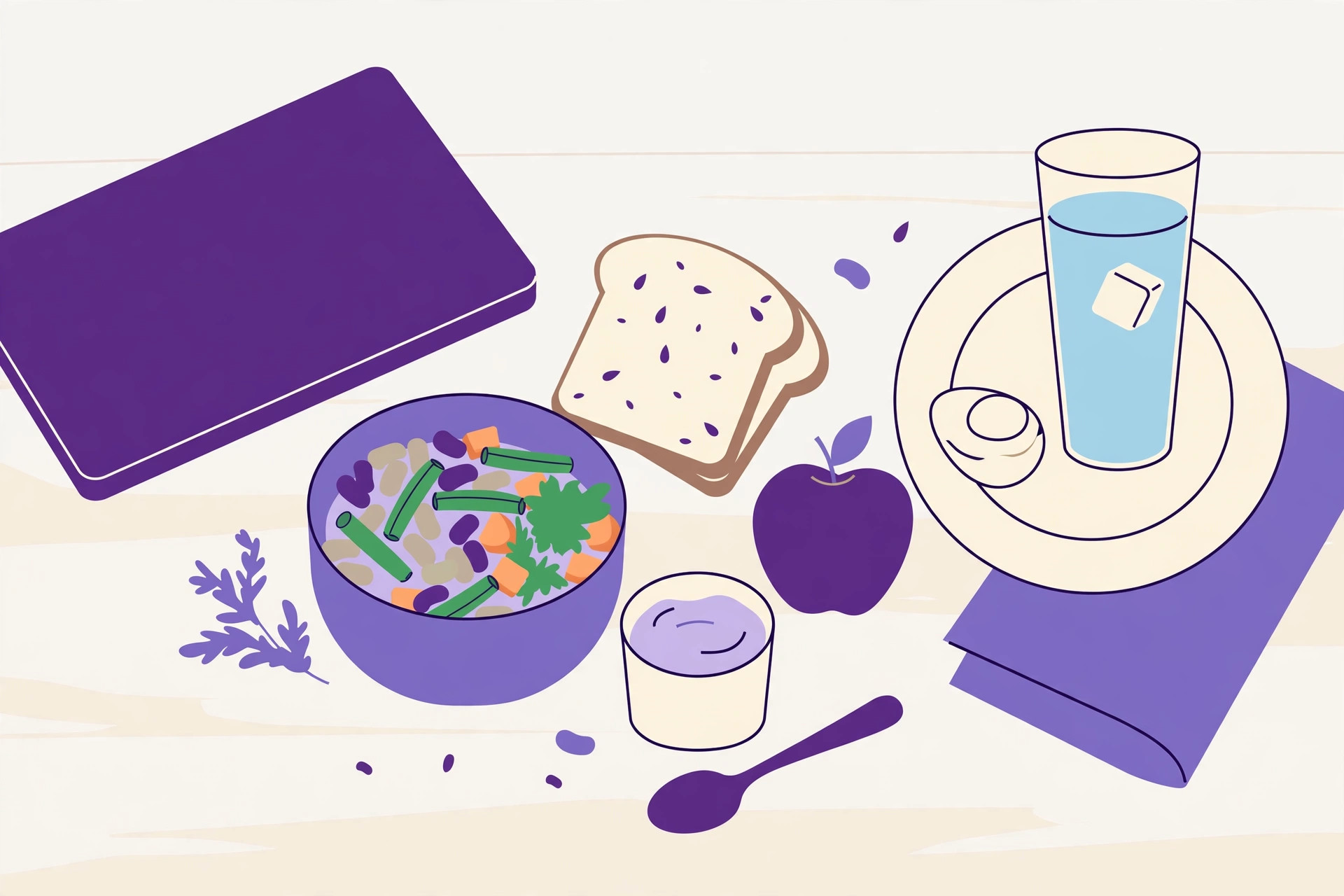
Build the plate the same way every day, so lunch takes no thought. Half the plate is vegetables and fruit. A quarter is whole grains — brown rice, whole-grain bread, oats. A quarter is protein — beans, eggs, chicken, fish, yogurt, or tofu. A glass of water sits next to it. The same shape works for a packed lunch, a bought lunch, or a lunch from home.
Easier: use the plate shape for lunch only, and eat what you like for dinner. Harder: use the plate shape for lunch and dinner, and keep the desk drawer free of sweets for a month.
Snacks that hold: what to keep at the desk
Keep snacks that hold you, not snacks that spike and drop you. Nuts, fruit, yogurt, whole-grain crackers, and cheese hold for hours. Sweets and crisps give fast energy and then leave you hungry again. Keep the good snacks where you can reach them, and keep the sweets out of the drawer.
Easier: swap one desk snack this week — fruit in place of sweets. Harder: stock the desk with a week's worth of nuts, fruit, and yogurt, and buy no sweets at all.
Try it today
Build one steady plate today, in plain steps. Step 1: fill half the plate with vegetables or fruit. Step 2: add a quarter plate of whole grains, like brown rice or whole-grain bread. Step 3: add a quarter plate of protein, like beans, an egg, or yogurt. Step 4: put a full glass of water next to the plate and drink it with the meal. Step 5: eat away from the desk, screen off. That is the whole plate, and it counts.
At a glance
| Part | The short version |
|---|---|
| Fiber | 25 grams a day for women, 38 grams for men up to age 50; most adults eat 10 to 15 |
| Protein | 0.8 grams per kilogram of body weight a day; about 20 grams at lunch |
| Water | About 11.5 cups a day for women, 15.5 cups for men, from all drinks and food |
| The plate | Half vegetables and fruit, a quarter whole grains, a quarter protein, plus water |
| Snacks | Nuts, fruit, yogurt, whole-grain crackers — sweets out of the drawer |
Common mistakes
Adding fiber fast and skipping the water. A big jump in fiber with no extra water can leave you bloated and slow. Fix: add one high-fiber food a week, and drink more water as the fiber goes up.
Saving all the protein for dinner. A lunch with no protein fades by mid-afternoon. Fix: put protein in every meal — an egg, yogurt, or beans at lunch.
Counting coffee as water. Coffee is a drink, but the glass of water with the meal is the habit. Fix: one full glass of water with lunch, every day, on top of the coffee.
Judging the plate after one day. One good lunch will not change the afternoons. Fix: run the plate for two weeks before judging it, and let a missed day go.
Can't do today?
Do the 2-minute version: add one high-fiber food and one protein food to today's lunch, and drink one full glass of water with it. That is the whole fallback, and it counts. The missed-day rule is simple: let it go — one sweet lunch does not break the plate, and tomorrow's lunch pulls it back. What counts as enough: the plate built three days out of five, water with every lunch, and protein at lunch most days.
Questions people ask
How much fiber do I need each day?
Harvard Health Publishing cites the USDA daily amount: 25 grams for women and 38 grams for men up to age 50, and 21 and 30 grams a day over 50. Most American adults eat only 10 to 15 grams a day. Add one high-fiber food a week, and drink more water as the fiber goes up.
How much protein do I need each day?
Harvard Health Publishing cites 0.8 grams of protein per kilogram of body weight a day. For a person who weighs 70 kilograms, about 154 pounds, that is about 56 grams a day — roughly 20 grams at each of three meals. Put protein in every meal, not just dinner.
How much water should I drink at work?
The Mayo Clinic cites about 15.5 cups of fluids a day for men and about 11.5 cups for women, from all drinks and food. One full glass with lunch is the habit to start with — and more water as your fiber goes up. Our companion piece on water works out the number for your own day.
What is a good desk lunch for steady energy?
Build the plate: half vegetables and fruit, a quarter whole grains, a quarter protein, plus a glass of water. Beans, brown rice, and vegetables; an egg sandwich on whole-grain bread with an apple; yogurt with oats and fruit. Eat it away from the desk, screen off.
What comes next
Run the plate for two weeks before judging it. The first week feels like effort — the shop takes longer, the plate looks plain, and the sweets call from the drawer. The second week starts to feel normal, and the 3 p.m. fade gets softer. When the plate holds on its own, the next step is the day around it: two more guides sit next to this one, a real lunch break for the thirty minutes to eat it in, and the wellness habits starter set for the five small habits that hold the day together.
Sources
Every fact in this post was checked against the sources below in November 2026.
- Harvard Health Publishing — Should I be eating more fiber? (checked November 2026) — on average, American adults eat 10 to 15 grams of total fiber per day; the USDA daily amount for adults up to age 50 is 25 grams for women and 38 grams for men; women and men over 50 should have 21 and 30 grams a day; add one more high-fiber food to your daily diet for a week; increase your water intake as you increase fiber.
- Harvard Health Publishing — How much protein do you need every day? (checked November 2026) — the recommended amount is 0.8 grams of protein per kilogram of body weight a day for adults.
- Mayo Clinic — Water: How much should you drink every day? (checked November 2026) — about 15.5 cups, or 3.7 liters, of fluids a day for men, and about 11.5 cups, or 2.7 liters, a day for women, from all drinks and food; about 20 percent of daily fluid intake usually comes from food.
- Glucose Revolution: The Life-Changing Power of Balancing Your Blood Sugar (2022), by Jessie Inchauspé, ASIN 1982179414 — the book on steady energy through food recommended in this post.
Subscribe for more free step-by-step how-to guides to help you get more things done to grow your business or project everyday.
Email required. Unsubscribe anytime.
Read our Privacy Policy.