

Profit First: Pay Yourself Before the Bills Eat Everything — Book Deep-Dive #005
Disclosure: some links on this page are affiliate links. If you buy through one, Changenaire may earn a commission at no extra cost to you. As an Amazon Associate, Changenaire earns from qualifying purchases made through links on this page.
Ask a small business owner how the year went and you'll hear the same story: sales were up, the calendar was full, everybody got paid — everybody except the owner. Mike Michalowicz built two multimillion-dollar companies, sold them, started a third, and lost everything. When he rebuilt, he stopped asking why his business couldn't make a profit and started asking a harder question: what if profit was never supposed to be the leftovers? Profit First (Amazon Associates link — we may earn a commission) is his answer — first published in 2014, with the updated edition most readers buy today out in 2017 — a cash system so simple it fits on a bank statement, and so stubborn it works even when willpower doesn't.
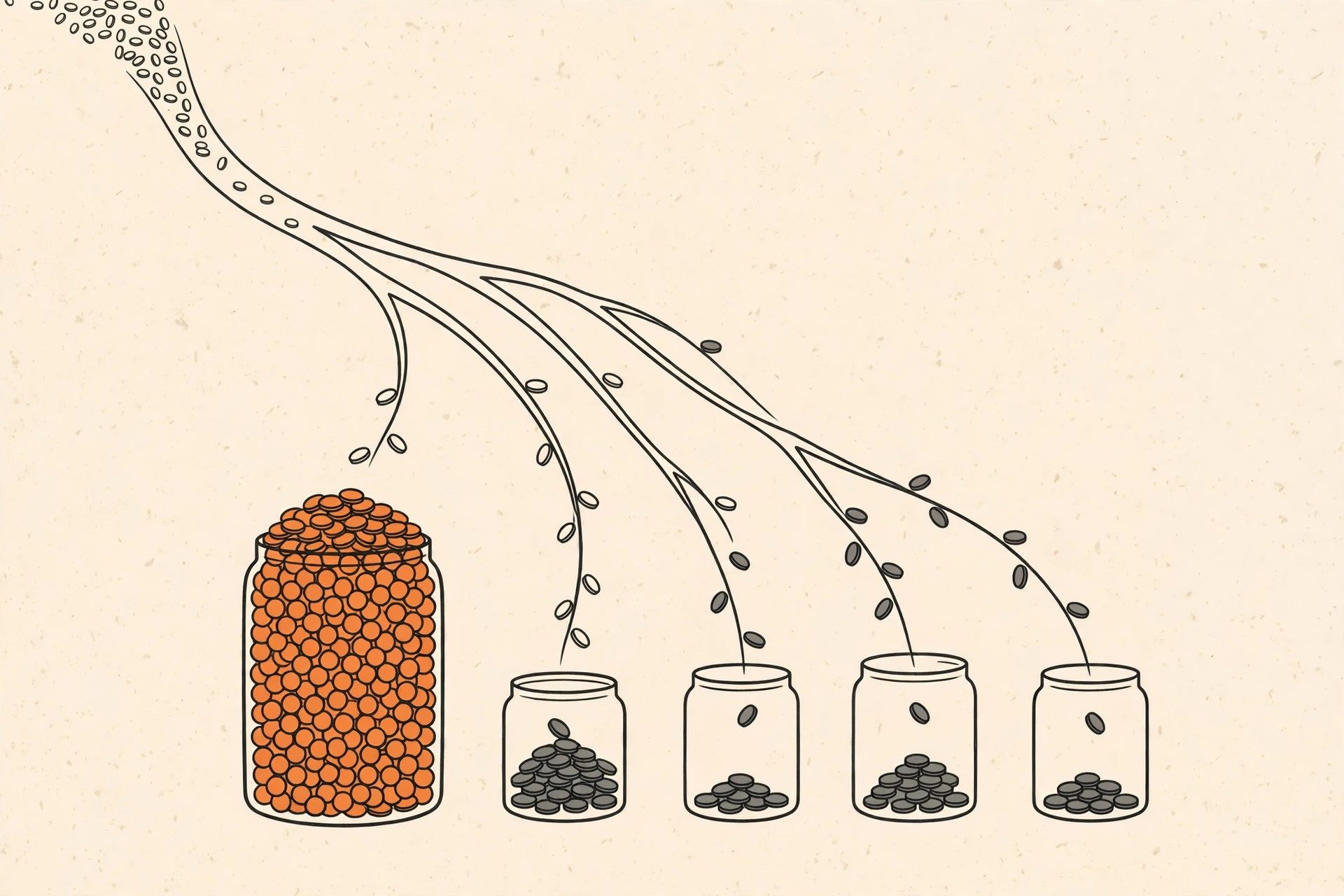
Here's the book in one line: stop treating profit as whatever survives the month. Take it first — a small, fixed slice of every dollar that comes in — and force the business to run on what's left. The old formula says sales minus expenses equals profit, and in that formula profit is always last in line, always the thing that gets squeezed. Michalowicz flips it: sales minus profit equals expenses. Profit moves to the front of the queue. Everything else — rent, tools, ads, that subscription you forgot about — has to fit in a smaller pot. And here's the part that stings: it can. Because the pot was never the problem. The problem was that the pot was always full.
We put this book fifth on the shelf for a reason. Zero to One (#004) asked whether you're building the right thing. Profit First asks whether the thing you're building actually pays you. A brilliant idea that never leaves its owner a dollar is a hobby with invoices. This is the book that makes sure the work pays. Atomic Habits (#001) made the case for tiny habits that compound. Profit First is one of those habits, with a bank account of its own.
Key takeaways
- Sales minus profit equals expenses: take profit first — a small, fixed slice of every dollar that comes in — and force the business to run on what's left.
- Expenses expand to fill the money you can see. The fix is walls between accounts, not more willpower.
- Five accounts, one job each: Income, Profit, Owner's Pay, Tax, and Operating Expenses — split twice a month, on the 10th and the 25th.
- Owner and worker are two jobs with two paychecks. Pay the salary and the profit separately, or neither gets paid properly.
- Start at 1%. The habit matters more than the percentage — a rhythm beats a resolution.
Expenses expand to eat whatever you can see
The engine under the whole book is an old idea with a new target: Parkinson's Law. Work expands to fill the time you give it. Michalowicz says cash does the same thing — expenses expand to fill the money you can see. Give a business one big account with everything in it, and it will spend everything in it. Not because the owner is reckless. Because the balance looks available, and every cost feels reasonable on its own. A slightly better tool here, a nicer chair there, a software plan that "pays for itself." None of them is the mistake. The mistake is the setup: one pot, one balance, no walls. The fix is not more discipline. It's less to look at. Hide the profit from yourself on purpose, in an account at a different bank, and the business stops spending money it can't see. The law still works — it just starts working for you.
He makes the same point with food. Serve dinner on a big plate and you eat more. Serve the same dinner on a small plate and you eat less and feel just as full. The accounts are the small plates.
Five accounts, each with one job
Every dollar that comes in lands in one place first: the Income account. Twice a month — on the 10th and the 25th — you split it by percentage into four more accounts, and each one has a single job it can't borrow from. Profit holds your reward. Owner's Pay holds your salary, because the work you do in the business is a real job and it deserves a real paycheck. Tax holds the government's share, so April stops being a panic. Operating Expenses holds whatever is left — and that is the only account you spend from, day to day.
That's the whole machine. No spreadsheet ballet, no finance degree, no app you have to open every morning. The discipline lives at the bank, in the walls between accounts, not in your head. And the percentages are starting points, not laws: for a business under $250,000 a year, the book suggests 5% to profit, 50% to owner's pay, 15% to tax, and 30% to operating expenses. Your numbers will differ — the point is that every dollar has a destination before it has a chance to wander.
You have two jobs in your business, and only one of them pays a salary
This is the distinction most owners miss, and the one that quietly breaks them. You are the owner and you are the worker, and those are two different jobs with two different paychecks. Owner's Pay is your salary for the work you do — the hours, the calls, the deliveries. Profit is your reward for owning the thing — the return on the risk you took. When the two get mixed into one pot, neither gets paid properly. Usually the salary disappears first, because the owner is the easiest person in the company to short. "I'll pay myself when things pick up." Things pick up. The owner still doesn't get paid. The system ends that negotiation by separating the money before anyone can raid it: the salary lands in its own account on a schedule, and the profit account is a different pile entirely. Every quarter, you take half the profit account as a distribution — a real reward, in your hands — and leave the rest as a cushion. That's the moment the system stops being theory. You can feel it.
A rhythm beats a resolution
Twice a month. The 10th and the 25th. Not "when I get around to it," not "at the end of the quarter when things calm down" — a date on the calendar, every time, rain or shine. That rhythm is the real product. A one-time budget is a wish; a twice-a-month transfer is a habit, and habits are what survive a bad week. Michalowicz even tells nervous owners to start at 1%: move one percent of every deposit into the profit account and nothing else changes. One percent is too small to hurt and too real to ignore. Once the habit exists, the percentage grows. The businesses that fail at this don't fail because the percentages were wrong. They fail because they waited for a calm month to start, and calm months don't exist.
Use it this week
Open one new account at your bank this week and call it Profit — just the one, not all five. Then, on the next deposit that lands, move 1% of it into that account before you pay anything else. That's it. One percent. Don't touch it for a month and watch what happens to the way you look at the main account. Next, write down what you actually pay yourself each month, honestly, and compare it to what the job would pay someone else — if the gap makes you wince, that's the owner's-pay problem, and it's now on paper where you can see it. Finally, mark the 10th and the 25th on your calendar as transfer days, and tell one person — a partner, a friend, your accountant — that you're doing it. A habit with a witness is harder to quietly drop.
Who should skip this book
If your business has no sales yet, this book won't create them — it manages cash, it doesn't conjure it, and you'd be better served by How-To #019 on getting your first ten customers. If you run a larger company with a finance team and accrual accounting, the five-account system will feel basic; the principle still holds, but you'll outgrow the mechanics fast. And if you're looking for a book about investing or getting rich, this isn't it — it's about a small business paying its owner, on time, every month. Everyone else? If you've ever finished a good month and wondered where the money went, this is the book that answers that question in plain numbers.
Questions people ask
Is 1% profit really enough to start?
Yes — because the point of the first percent isn't the money, it's the habit. A business that moves 1% every time builds the muscle; a business that plans to start at 10% “someday” never starts. Raise it a point at a time once the transfers feel normal.
Do I really need five separate accounts?
That's the system as written, and the separation is the point — money you can't see, you don't spend. But Michalowicz himself says to start with just the profit account if five at once feels like too much. One wall is better than none.
What if my business genuinely can't afford the allocations?
Then the allocations just told you something important: the business, as priced and run today, doesn't pay for itself. That's painful news, and it's the news you need. The usual answer is on the pricing side or the expenses side — which is exactly what How-To #018 on pricing is for.
Does Profit First replace my accountant?
No. It's a cash system, not an accounting system — it manages the money in the bank, while your accountant handles taxes, filings, and the books. Tell your accountant you're using it; a good one will help you set the percentages.
See it on Amazon → (Amazon Associates link — we may earn a commission)
Read this next: The Pumpkin Plan by Mike Michalowicz — the companion idea from the same author: grow by pouring your energy into your best customers, the way a farmer grows one giant pumpkin instead of a field of small ones. (Amazon Associates link — we may earn a commission)
From the Book Club shelf: browse all seventeen picks.
Sources
Figures in this guide are as of November 2026 unless noted.
- Penguin Random House — Profit First by Mike Michalowicz — the original edition was published by the author in 2014; the Portfolio/Penguin edition (ISBN 9780735214149) came out February 21, 2017; the book this guide summarizes.
- Brex — The Profit First Method, Explained — the five accounts, the twice-a-month allocation rhythm, and the target allocation percentages, including 5% profit / 50% owner's pay / 15% tax / 30% operating expenses for businesses under $250,000 a year.
- FrankX — Profit First Book Review & Key Insights — the flipped formula (Sales − Profit = Expenses), Parkinson's Law applied to cash, and the small-plates idea.
Subscribe for more free step-by-step how-to guides to help you get more things done to grow your business or project everyday.
Unsubscribe anytime.