

Atomic Habits: You Don't Rise to Your Goals, You Fall to Your Systems — Book Deep-Dive #001
Go deeper (affiliate link — we may earn a commission): Atomic Habits by James Clear — the book this deep-dive is about — the small-habits system the whole piece walks through.
James Clear's bestseller sits first on our Book Club shelf for a reason: it's the operating manual for building something before you have capital. Small moves, repeated daily, beat big plans abandoned by February.
Disclosure: some links on this page are affiliate links. As an Amazon Associate, Changenaire earns from qualifying purchases made through links on this page, at no extra cost to you.
One percent. That's the entire pitch. Get one percent better at something every day for a year, and the math says you finish roughly thirty-seven times better. Read that number for what it is: arithmetic, not a measured result — 1.01 multiplied by itself 365 times comes to about 37.8. Nobody's life compounds that smoothly; the figure illustrates how small gains stack, it is not a finding from a study. Clear's whole book argues that the people who change their lives aren't the ones with the biggest goals — they're the ones with the smallest repeatable moves.
We put this book first because it matches how we think about impact. Nobody becomes a Changenaire in a weekend. The people who move the needle on human lives do it the way this book describes: unglamorous, daily, on purpose. Motivation gets the headline. Systems do the work.
Key takeaways
- Get 1 percent better every day for a year and the arithmetic (1.01 to the power of 365) comes to roughly thirty-seven times better — an illustration of compounding, not a measured result — but results lag effort, and most people quit in the gap.
- Winners and losers share the same goals; what separates them is the machinery underneath — the system, not the goal.
- Every action is a vote for the identity you want: start with "I'm a reader," then collect evidence until the belief follows.
- Make it obvious, easy, and satisfying — start so small it is embarrassing (the two-minute rule); the runner who laces his shoes and walks back inside still cast a vote.
- Your room is stronger than your willpower: arrange the environment so discipline is never needed.
Forget the goal. Build the system.
Goals are where you want to land. Systems are what you do every day. Clear's line — the one worth the price of the book — is that winners and losers share the same goals; what separates them is the machinery running underneath. A goal says "I want a business that feeds my family." A system says "every morning at seven, I send one pitch email before I check my phone." One of those changes your Tuesday. The other just changes your mood.
One percent better compounds.
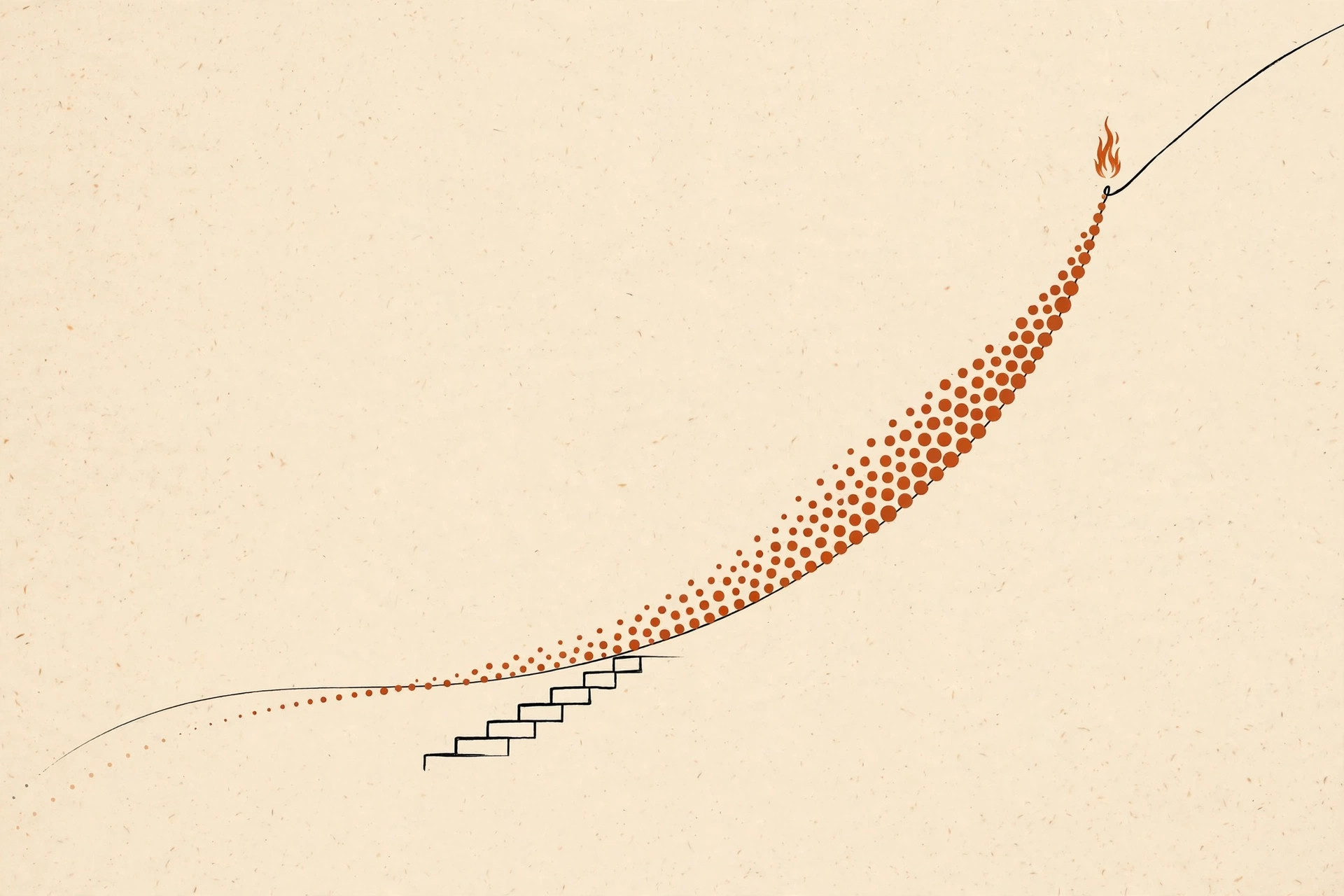
The curve that matters most in this book is the boring one: results lag effort. You do the work for weeks and see nothing, then the line bends upward all at once. Clear calls the flat stretch the plateau of latent potential. Plain version: the payoff arrives late. Most people quit in the gap between starting and seeing. The ones who don't aren't tougher — they just understood the gap was part of the deal.
Every action is a vote for who you become.
This is the idea we underline. Don't start with "I want to read more." Start with "I'm a reader." Then every book finished is a vote for that identity. A vote is small. Elections are won on them. You don't need to believe the new identity on day one — you collect evidence until the belief has no choice.
The four laws — and how to run them backward
Every habit runs through four steps: a cue that starts it, a craving that wants it, a response that does it, and a reward that teaches you to repeat it. Clear gives one law for each step. To build a good habit, run the laws forward. To break a bad one, run each law in reverse. The table is the whole system on one card.
| Step | Build a good habit | Break a bad habit |
|---|---|---|
| Cue | Make it obvious | Make it invisible |
| Craving | Make it attractive | Make it unattractive |
| Response | Make it easy | Make it difficult |
| Reward | Make it satisfying | Make it unsatisfying |
In plain terms: put the good thing where you will see it, pair it with something you already want, start so small it's embarrassing, and give yourself a visible win. Two minutes counts. Reading one page counts. The runner who laces his shoes and walks back inside still cast a vote. The version of you that needs heroic discipline every day is a version that will quit; the version that rearranged the room won't have to be heroic. And the same machinery runs backward: the phone in another room is a cue made invisible; the app deleted from the home screen is a bad habit made difficult.
Your room is stronger than your willpower.
Willpower is a terrible business partner — it shows up late and leaves early. So stop negotiating with it. Phone in another room. Running shoes by the door. The spreadsheet open before the browser is. People who look disciplined are usually just well-arranged. Arrange yourself.
List your habits before you change any of them.
Before you change a single habit, Clear asks you to see the ones you already have. The habit scorecard, from chapter 4, is a written list of everything you do in a normal day, each item marked as good, bad, or neutral for the person you want to become. No judgment at this stage — the point is awareness. You cannot fix a habit you have not noticed, and most habits run on autopilot precisely because nobody ever wrote them down. For most people the list itself does half the work: the afternoon scroll, the skipped lunch, the phone checked before the feet hit the floor. See them first. Change them second.
Pair the habit you resist with the one you want.
Temptation bundling, from chapter 8, pairs an action you need to do with an action you want to do. Only listen to a favorite show while walking. Only get the good coffee while the morning emails go out. Only watch the game while folding the laundry. The want pulls the need along — the craving for the treat becomes the cue for the work. The rule that keeps it honest: the treat comes only with the habit. No bundling, no show. Break that rule and the bundle stops working; keep it and the habit you resisted starts carrying its own reward.
Miss once, never twice.
A missed day is an accident. Two missed days is the start of a new habit — the habit of not showing up. That is the never-miss-twice rule from chapter 16, and it is the whole recovery plan in four words: get back on track at the next chance, not next Monday. The fix is speed, not guilt. Track the habit somewhere visible — the wall calendar with an X for every day you show up — because a streak you can see is a streak you protect, and one blank square is a prompt, not a verdict. Nobody keeps a perfect streak. The people who change are the ones who never let one miss become two.
Stay at the edge you can just manage.
The Goldilocks rule, from chapter 19, says motivation peaks when the task sits just past what you can already do: hard enough to hold your attention, easy enough to stay in reach. Too easy and you get bored; too hard and you get discouraged. The practical version is one notch at a time — a slightly heavier weight, a slightly longer run, a slightly harder client — so the work stays interesting without becoming punishing. And the rule carries an unglamorous twin: fall in love with boredom. Once the novelty wears off, mastery is doing the same small thing well, again, on a Tuesday, when nobody is watching. That is where the compounding actually happens.
The book, chapter by chapter
Twenty chapters in six parts: the basics first, one part for each of the four laws, then the advanced tactics. The book reads in order, but it also works as a reference — use this map to jump to the part you need.
| Part | Chapters | What it covers |
|---|---|---|
| The fundamentals | 1–3 | Small gains compound; identity first; the four steps of a habit. |
| The 1st law: make it obvious | 4–7 | Seeing your habits (the scorecard), starting, environment, self-control. |
| The 2nd law: make it attractive | 8–10 | Temptation bundling, the people around you, fixing the causes of bad habits. |
| The 3rd law: make it easy | 11–14 | Slow and steady, least effort, the two-minute rule, making good habits inevitable. |
| The 4th law: make it satisfying | 15–17 | Immediate rewards, sticking with it (never miss twice), accountability. |
| Advanced tactics | 18–20 | Talent and fit, the Goldilocks rule, the downside of habits on autopilot. |
An opening section tells Clear's own story — the injury that started his interest in habits — and a closing chapter pulls the whole system together. Read the fundamentals and the law you need most, and you have the working version of the book; read the rest when the first habits are holding.
Use it this week
Pick one habit. Shrink it to two minutes. Not "get in shape" — five push-ups. Not "fix the finances" — open the bank app and look. Bolt it onto something you already do: coffee finishes, one outreach email goes out. Mark the win somewhere visible — a wall calendar with an X for every day you show up. Tell one person what you're doing; saying it out loud is a vote, witnessed. And remove one friction tonight: if the bag is packed by the door, you're not deciding at 6 AM — you decided last night.
Who should skip this book
If you already run your life on systems — you track, you review, you iterate — you'll skim half of it and nod at the rest. If what you want is a pep talk, this isn't that; it's mechanics, and mechanics don't clap for you. And if a two-minute habit sounds beneath you, the book will annoy you before it helps you. No shame in any of that. The shelf has sixteen more.
Questions people ask
Do I need to read the whole book?
No. The first hundred pages carry most of the weight; the rest is application. But the stories are short and the chapters are shorter — a few evenings.
Is it just for personal habits, or does it work for business?
Business runs on the same machinery. A follow-up system, a daily sales action, a weekly review — those are habits wearing a suit.
What's the one idea to steal if I read nothing else?
The two-minute rule: scale any habit down until it takes less than two minutes to start. Starting is the whole battle; finishing takes care of itself more often than you'd think.
Hasn't everyone already heard this?
Heard, yes. Done, no. The book's value isn't novelty — it's that it finally makes the obvious feel doable.
See it on Amazon (Amazon Associates link — we may earn a commission)
Read this next: Tiny Habits by BJ Fogg — the Stanford behavior scientist whose research Clear builds on. Same science, different angle: design the behavior so willpower never has to show up. (Amazon Associates link — we may earn a commission)
From the Book Club shelf: browse all seventeen picks.
Sources
Figures in this guide are as of November 2026 unless noted.
- Penguin Random House — Atomic Habits by James Clear — published October 16, 2018 (Avery); the book this guide summarizes.
- James Clear — Atomic Habits (author's page) — the author's own page for the book, including the 1% better framing and the four laws.
- Wikipedia — Atomic Habits — publication details and a summary of the book's argument, including the 1% compounding claim and the four laws of behavior change.
Subscribe for more free step-by-step how-to guides to help you get more things done to grow your business or project everyday.
Email required. Unsubscribe anytime.
Read our Privacy Policy.