
A Wind-Down Routine That Helps You Sleep — Wellness #004
A wind-down routine is a fixed sequence of calm activities in the hour before bed that tells your body the workday is over. This one takes 60 minutes: screens off at 30 minutes before bed, lights low, a short worry dump on paper, and the same bedtime every night. It does not promise sleep on demand. It builds the conditions sleep needs, night after night, and the routine itself becomes the signal.
Disclosure: some links on this page are affiliate links. As an Amazon Associate, Changenaire earns from qualifying purchases made through links on this page, at no extra cost to you.
Key takeaways
- Adults 18 to 60 need 7 or more hours of sleep a night — set the wake time first, then count back to bedtime.
- Same bedtime and wake time every day, with weekends within about an hour of weeknights.
- Screens off at least 30 minutes before bed; the hour before bed is quiet time, lights low.
- Caffeine's effects can last up to 8 hours — cut it off in the early afternoon.
- Keep the bedroom quiet, cool, and dark; if you are awake after about 20 minutes, get up and do something relaxing.
Health note: This guide is education, not medical advice. It describes general techniques for healthy adults. Talk to your doctor before changing a health routine — especially if you have a health condition, and especially if trouble sleeping keeps coming back despite a steady routine. Ongoing sleep problems deserve a doctor's attention, not a longer routine. If a change in this guide makes you feel worse, stop and talk to your doctor.
Who this is for: builders whose brains keep working after the laptop closes — the ones who lie awake rehearsing tomorrow's calls. The routine is built for people with no time to spare: one hour, timed, with every step doing one job. Check first if you regularly cannot fall asleep, wake up gasping, or feel exhausted despite a full night in bed: those are reasons to talk to a doctor, not to add more steps to a routine.
We used to end the workday by closing the laptop and opening the phone, which is not ending anything — it is changing the screen. Sleep came when it felt like it, usually late, usually badly. The wind-down routine fixed the ending. One hour, same steps, same order, and the body learned what the hour meant: work is over, the lights are low, the phone is parked, and sleep is next. It took two weeks to feel automatic. It has held ever since. This guide is part of the Wellness hub. If the racing mind is the hardest part of the hour, box breathing to calm down is a short way to settle before the worry dump.
Go deeper (affiliate link — we may earn a commission): you need nothing to buy for this routine — the whole hour is below, free, and it is enough to start. If you want the science of what sleep does and why the routine works, from the neuroscientist who runs a sleep laboratory, Why We Sleep by Matthew Walker is the book we would hand you. Skip it if you only want the routine — it is all below, and it is enough.
Set the anchor: same wake time every day
Pick one wake time and keep it 7 days a week. The wake time sets the bedtime, not the other way around: if you wake at 6:30 a.m. and need 7 or more hours, bedtime is 11:30 p.m. or earlier, and the routine below runs from 10:30 p.m. Weekends stay within about an hour of weeknights — sleeping in two hours on Saturday resets the clock the week just set, and Monday pays for it. The anchor is the one step that matters most. If you keep nothing else in this guide, keep the wake time.
The guidance is consistent on this point. NHLBI, Healthy Sleep Habits says to go to bed and wake up at the same time every day, and to keep the same sleep schedule on weeknights and weekends, limiting the difference to no more than about an hour, because staying up late and sleeping in late on weekends can disrupt the body clock's sleep-wake rhythm (checked November 2026). CDC, About Sleep recommends 7 or more hours a night for adults 18 to 60, 7 to 9 hours for adults 61 to 64, and 7 to 8 hours for adults 65 and older (checked November 2026). Set the wake time, count back 7 hours, and the bedtime is decided.
Easier: fix the wake time first and let the bedtime follow on its own for a week. Harder: fix both times, and keep them inside the same 30-minute window every day including weekends.
Cut caffeine 8 hours before bed
Set the last coffee, tea, or caffeinated drink 8 hours before bedtime, and hold the line. For an 11:30 p.m. bedtime, the cutoff is 3:30 p.m. — no coffee, no caffeinated tea, no energy drinks, and watch the chocolate and the caffeine-containing medicines too. The afternoon coffee feels harmless because the lift fades by dinner. The caffeine does not fade with it. It keeps working, quietly, into the night, and the sleep you lose does not announce itself as a caffeine problem. It announces itself as a 2 a.m. ceiling.
The 8-hour rule comes from the NHLBI guidance linked above: nicotine and caffeine are stimulants that can interfere with sleep, and the effects of caffeine can last up to 8 hours, so a cup of coffee in the late afternoon can make it hard to fall asleep at night. The CDC guidance linked above says the same thing in shorter form: avoid caffeine in the afternoon and evening. If you drink coffee all day today, move the cutoff earlier by an hour every few days instead of stopping at once — the headaches of a sudden stop are real, and they are avoidable.
Easier: move the cutoff to noon for the first week, then to 8 hours before bed. Harder: cut caffeine after breakfast entirely, and switch the afternoon drink to water or herbal tea.
The last hour: quiet time, lights low
Use the hour before bed for quiet time. Dim the lights — one low lamp instead of the overheads — and keep the hour free of intense exercise and bright artificial light. Reading fits here. Gentle stretching fits here. A warm bath fits here. Work email, the news, and the group chat do not fit here; they are the workday, and the hour is for ending it. The hour is not a ritual with rules. It is a transition: the same dim, quiet shape every night, so the body learns what comes next.
NHLBI, Healthy Sleep Habits says to use the hour before bed for quiet time, and to avoid intense exercise and bright artificial light, such as from a TV or computer screen (checked November 2026). It also says to avoid heavy or large meals within a few hours of bedtime, and to keep the bedroom quiet, cool, and dark. Our companion piece, Self Improvement #005: How to Quiet a Busy Mind Before Bed, covers the quiet hour in reflective form; this guide is the timed version, with the clock on it.
Easier: 30 minutes of quiet time instead of 60, with the lights dimmed for the last 15. Harder: 90 minutes, with the last 30 spent reading in the bedroom itself.
Screens off 30 minutes before bed
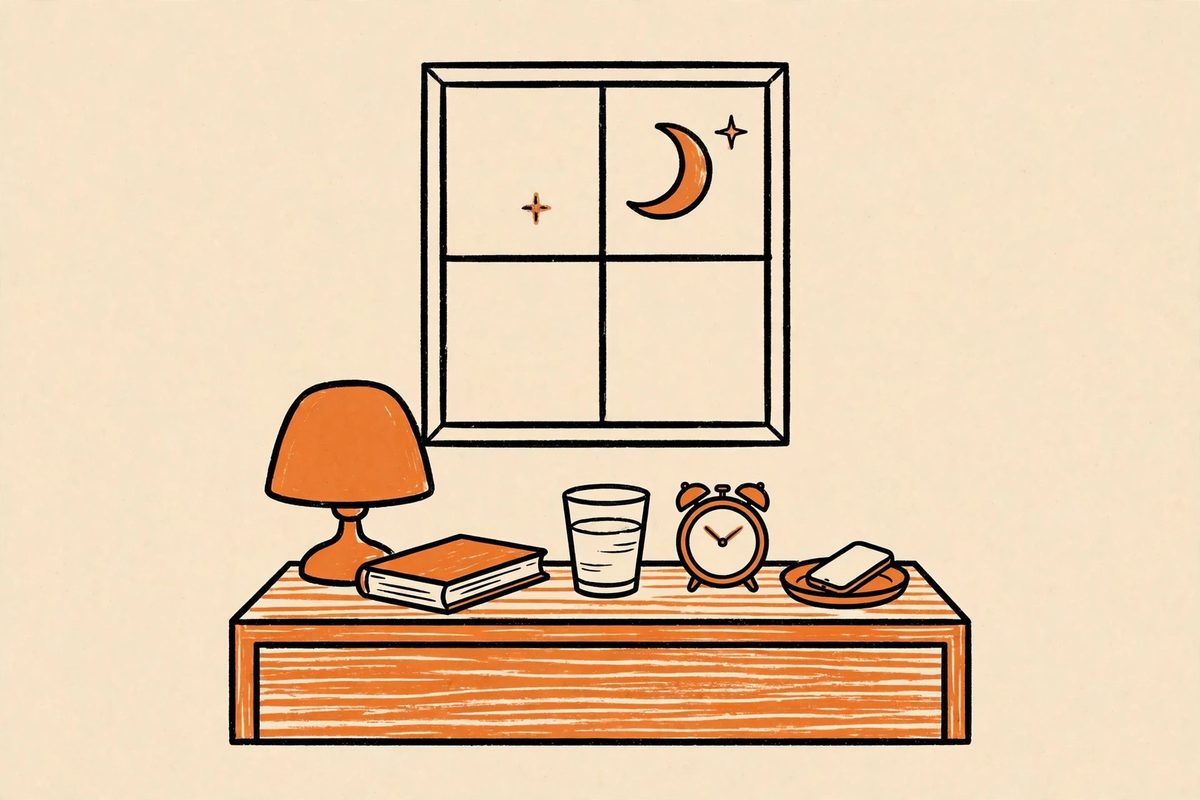
Turn off phones, tablets, TVs, and laptops at least 30 minutes before bedtime — not dimmed, not on night mode, off. Charge the phone outside the bedroom if you can. If the phone must stay in the room, put it face-down in a dish across the room, on silent, where reaching it takes getting up. The 30 minutes are the hardest part of the routine for most people, because the phone is where the day's loose ends live. They will still be there in the morning. They are always still there in the morning.
The CDC guidance linked above lists turning off electronic devices at least 30 minutes before bedtime among its habits for better sleep, alongside a consistent schedule and a quiet, cool bedroom (checked November 2026). The number is a floor, not a ceiling: 30 minutes is the minimum that helps, and the full quiet hour in step three is better. If the phone is the alarm clock, buy a small alarm clock — the cheapest upgrade in this whole guide, and the one that removes the excuse.
Easier: screens off 15 minutes before bed for the first week, then 30. Harder: screens off for the full quiet hour, and the phone charging in another room every night.
The 5-minute worry dump: paper, pen, tomorrow's top 3
Sit down with paper and a pen — not the phone, not the laptop — and spend 5 minutes writing. First, tomorrow's top 3 tasks, in order. Then, anything looping in your head: the awkward email, the unpaid invoice, the thing you forgot to say. Write it in short lines, not essays. When the 5 minutes end, put the pen down and leave the paper on the desk. The paper holds it now, not you. The point is not solving anything. The point is moving the loops out of the head and onto a surface that will still be there in the morning.
Managing worries is part of the standard sleep guidance. Mayo Clinic, Sleep tips: 6 steps to better sleep lists managing worries as its sixth step, and suggests writing down what is on your mind and setting it aside for tomorrow (checked November 2026). Our companion piece, Self Improvement #014: How to Fall Asleep When Your Mind Won't Stop, covers the racing mind in reflective form. The worry dump is the working version: 5 minutes, timed, on paper.
Easier: 2 minutes, top 3 only, no looping thoughts. Harder: 5 minutes plus one line of gratitude — one good thing from the day, written down before the pen goes down.
The bedroom: quiet, cool, and dark
Keep the bedroom quiet, cool, and dark. Close the curtains or the blinds. Turn off the lights, including the small ones — the charger light, the power strip light, the TV standby light. If noise leaks in, a fan or a white-noise app on a speaker (not the phone in the bed) covers it. A dim night light is fine if you need one for safety. Set the room once, as part of the routine, and check it nightly: curtains, lights, temperature, phone parked. The room does half the routine's work, and it never forgets.
The CDC and NHLBI guidance linked above agree on the room: quiet, cool, and dark, with a dim night light fine if needed. No specific temperature is prescribed in either source, and this guide does not invent one — cool means cool to you, with bedding you can push off if the night warms up. If the room runs hot, cool it before the quiet hour starts, not at bedtime, so the room is ready when you are.
Easier: curtains and lights only; the rest can wait for the weekend. Harder: blackout curtains, no electronics in the bedroom at all, and the same bedding year-round.
If you're still awake: the 20-minute rule and the morning habit
If you have not fallen asleep within about 20 minutes, leave the bedroom and do something relaxing — read in dim light, sit quietly, stretch gently — then return to bed when you feel sleepy. Do not lie awake forcing sleep. Forcing teaches the bed to mean wakefulness, and the bed should mean sleep. If the wakefulness keeps coming back night after night, talk to your doctor: the routine builds the conditions for sleep, and it is not a treatment for a sleep problem.
The morning closes the loop. Get daylight early — outside if you can, by a bright window if you cannot — and keep the same wake time, even after a bad night. Our companion piece, Self Improvement #009: Why Morning Sunlight Is the Free Reset Your Body Needs, covers the morning light in reflective form. The 20-minute rule comes from Mayo Clinic's sleep tips (checked November 2026): if you do not fall asleep within about 20 minutes of going to bed, leave the bedroom and do something relaxing, then return when you are sleepy.
Easier: give it 30 minutes before getting up, and keep the relaxing activity to reading only. Harder: get up at 20 minutes sharp, and keep the wake time exact the next morning no matter how the night went.
At a glance
| Step | The short version |
|---|---|
| Wake time anchor | Same wake time 7 days a week, weekends within about an hour |
| Caffeine cutoff | Last caffeine 8 hours before bed — 3:30 p.m. for an 11:30 p.m. bedtime |
| Quiet hour | Last hour before bed: dim lights, no intense exercise, no bright screens |
| Screens off | All screens off at least 30 minutes before bed; phone parked |
| Worry dump | 5 minutes on paper: tomorrow's top 3, then the looping thoughts |
| Bedroom | Quiet, cool, and dark; dim night light fine if needed |
| Still awake | 20-minute rule: get up, do something relaxing, return when sleepy |
Common mistakes
Keeping a different weekend schedule. Sleeping in two hours on Saturday resets the clock the week just set, and Monday pays for it. Fix: keep weekends within about an hour of weeknights, wake time included.
A "quick check" of the phone in bed. One check becomes twenty minutes of bright light and loose ends, and the quiet hour is gone. Fix: park the phone across the room or outside the bedroom, face-down, on silent.
A late heavy meal or a nightcap. A full stomach and alcohol both fragment the night, even when they feel relaxing at the time. Fix: finish heavy meals a few hours before bed, and keep alcohol out of the wind-down hour.
Lying awake forcing sleep. Forcing teaches the bed to mean wakefulness, and the harder you try, the longer it takes. Fix: use the 20-minute rule — get up, do something relaxing, and return when sleepy.
Can't do today?
Do the 10-minute version: screens off 30 minutes before bed, the 5-minute worry dump on paper, and the same wake time tomorrow morning. That is the whole fallback, and it counts. The missed-day rule is simple: let it go — one bad night does not break the routine, and the wake time tomorrow is what pulls it back. What counts as enough: the full hour five nights out of seven, with the 10-minute version on the other nights, and the wake time held every day.
Questions people ask
How much sleep do adults need?
The CDC recommends 7 or more hours a night for adults 18 to 60, 7 to 9 hours for adults 61 to 64, and 7 to 8 hours for adults 65 and older. Set the wake time first, then count back to find the bedtime that gives you 7 hours.
What time should I stop drinking coffee?
Work back 8 hours from bedtime: the NHLBI notes that the effects of caffeine can last up to 8 hours, so a coffee in the late afternoon can make it hard to fall asleep at night. For an 11 p.m. bedtime, the cutoff is 3 p.m. — and it covers tea, energy drinks, and chocolate too.
What if I can't fall asleep?
If you have not fallen asleep within about 20 minutes, leave the bedroom and do something relaxing, then return when you feel sleepy. Lying awake forcing sleep teaches the bed to mean wakefulness. If trouble sleeping keeps coming back, talk to your doctor.
Do naps ruin the routine?
Short, early naps are fine for most people, but the NHLBI says adults should nap for no more than 20 minutes, and if you have trouble falling asleep at night, limit naps or take them earlier in the afternoon. A long late nap is the one that steals the night.
What comes next
Run the routine for two weeks before judging it. The first week feels like effort; the second week starts to feel like the evening. The wake time is the anchor — protect it first, and let the rest of the routine grow around it. When the hour feels automatic, the next step is the morning: daylight, movement, and the same wake time, every day, without negotiation. Two more guides sit next to this one: yoga for absolute beginners for a slow evening session, and how to get 7,000 steps on a workday for the daytime movement that helps the night.
Sources
Every fact in this post was checked against the sources below in November 2026.
- CDC — About Sleep (checked November 2026) — adults 18 to 60 need 7 or more hours a night, adults 61 to 64 need 7 to 9 hours, adults 65 and older need 7 to 8 hours; turn off electronic devices at least 30 minutes before bedtime; keep the bedroom quiet and cool; avoid caffeine in the afternoon and evening; avoid large meals and alcohol before bedtime.
- NHLBI (National Heart, Lung, and Blood Institute, NIH) — Healthy Sleep Habits (checked November 2026) — go to bed and wake up at the same time every day, keep weeknights and weekends within about an hour, use the hour before bed for quiet time, avoid intense exercise and bright artificial light, caffeine's effects can last up to 8 hours, adults should nap for no more than 20 minutes, avoid heavy or large meals within a few hours of bedtime, keep the bedroom quiet, cool, and dark.
- Mayo Clinic — Sleep tips: 6 steps to better sleep (checked November 2026) — the recommended amount of sleep for a healthy adult is at least 7 hours; go to bed and get up at the same time every day including weekends; if you do not fall asleep within about 20 minutes, leave the bedroom and do something relaxing; manage worries by writing them down and setting them aside.
- Why We Sleep: Unlocking the Power of Sleep and Dreams (2017), by Matthew Walker, ASIN 1501144324 — the sleep book recommended in this post.
Subscribe for more free step-by-step how-to guides to help you get more things done to grow your business or project everyday.
Email required. Unsubscribe anytime.
Read our Privacy Policy.