
Box Breathing: Calm Down in 4 Minutes — Wellness #006
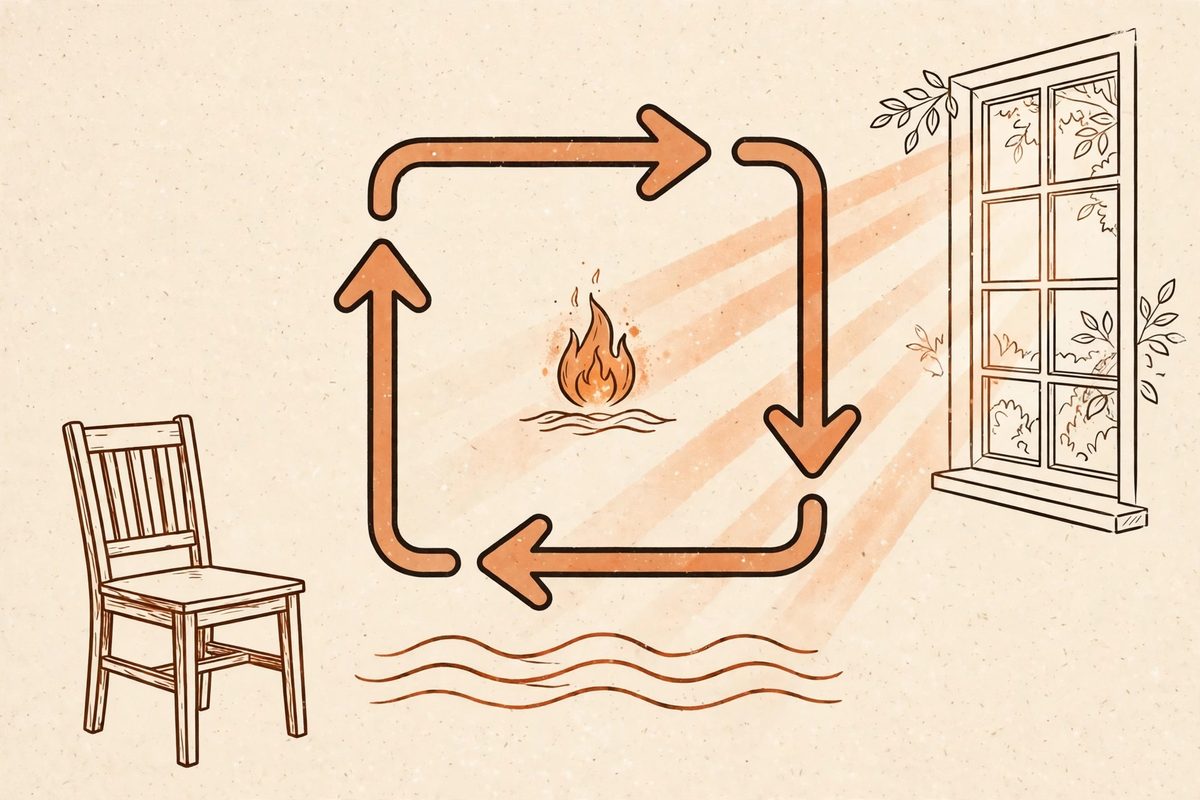
Box breathing means breathing in for 4 counts, holding for 4, breathing out for 4, and holding empty for 4, then repeating. Four minutes of it — about 14 or 15 rounds — is the workday routine in this guide, and the 4-7-8 pattern is the slower cousin for winding down. No app, no equipment, no floor space. Just a chair, a timer, and four numbers you already know.
Disclosure: some links on this page are affiliate links. As an Amazon Associate, Changenaire earns from qualifying purchases made through links on this page, at no extra cost to you.
Key takeaways
- Box breathing is 4 counts in, 4 hold, 4 out, 4 hold — one round takes about 16 seconds.
- The 4-7-8 pattern is slower: in for 4, hold for 7, out for 8, four rounds to start.
- The workday protocol is a 4-minute timer: 30 seconds to settle, about 3 minutes of box breathing, 30 seconds of normal breathing.
- Stop if you feel dizzy, and check with your doctor before breath-holding if you have a heart or lung condition or high blood pressure.
Health note: This guide is education, not medical advice. It describes general techniques for healthy adults. Talk to your doctor before trying breath-holding techniques if you have a heart or lung condition, high blood pressure, or if you feel dizzy or unwell. If you feel dizzy, stop and breathe normally.
Who this is for: anyone who works at a desk and wants a short, quiet way to settle down between tasks — before a hard call, after a tense email, or at the end of a long day. No experience with breathing exercises or meditation is needed, and nothing here needs equipment or floor space.
What if the fastest way to calm down at work is also the quietest? No app to open, no walk around the block, no ten-minute meditation with a voice telling you to picture a beach. Just counting, in a square, for four minutes, in the chair you are already sitting in. We like tools that ask nothing of us. This one asks for four numbers and a timer. That is the whole price of admission, and it is why the habit survives busy weeks when fancier routines do not. This guide is part of the Wellness hub. The slower pattern below also works as part of a wind-down routine that helps you sleep in the last hour before bed.
Go deeper (affiliate link — we may earn a commission): breathing costs nothing, and both patterns in this guide are complete above — no book, no app, nothing to buy. If you want to know why slow breathing affects the body the way it does, Breath: The New Science of a Lost Art is the readable tour: the history of breathing practices, the science of nose versus mouth breathing, and the experiments behind the claims. Skip it if you only want the two patterns — they are all below, and they are enough.
Box breathing, step by step: 4-4-4-4
Sit upright in your chair, feet flat on the floor, shoulders down and away from your ears. Breathe in through your nose for 4 counts. Hold for 4 counts. Breathe out through your mouth for 4 counts. Hold empty for 4 counts. That is one round, about 16 seconds, and then you start again. Mayo Clinic describes square breathing — also called box breathing — in exactly these counts (checked November 2026): in while you count to 4, hold while you count to 4, out while you count to 4, then hold as you count to 4.
Count at a walking pace, about one count per second. Keep the breath gentle, not maximum: fill the belly on the way in — diaphragmatic breathing, which is just the plain name for breathing that lets the belly expand — and let the shoulders stay down the whole time. If 4 counts feels long on the first try, start at 3 on each side and build to 4 over a few days. If two minutes is all you have, Self Improvement #003: How to Use Your Breath to Calm Down in Two Minutes is the shorter version of this same idea, in reflective form.
Easier: count to 3 on each side instead of 4. Harder: no harder version yet — do more slow rounds instead of longer holds.
The 4-7-8 pattern: in for 4, hold for 7, out for 8
The second pattern is slower, and the exhale does the work. Breathe in through your nose for 4 counts. Hold for 7 counts. Breathe out through your mouth for 8 counts, with a soft whoosh, as if you were fogging a mirror. One round takes 19 seconds. Do 4 rounds to start, sitting down, and breathe normally for a few seconds between rounds if you need to. Four rounds is about 75 seconds of pattern plus the pauses — call it two minutes, and do not rush it.
Both patterns belong to the same family: slow, deep breathing. The National Center for Complementary and Integrative Health (NCCIH) notes preliminary evidence from a 2019 review of 3 studies, with 880 participants in total, suggesting that diaphragmatic breathing exercises may help to reduce stress (checked November 2026). Preliminary is the honest word — promising, not proven — and it is why this guide presents the patterns as techniques to try, not promises. NCCIH, Stress. Stop if you feel dizzy or lightheaded, and never practice breath-holding while driving.
Easier: halve it — in for 2, hold for 3 or 4, out for 4 — until the full counts feel easy. Harder: no harder version yet — do more slow rounds, never force the hold.
The 4-minute workday protocol
Set a timer for 4 minutes and put the phone face-down. The first 30 seconds: settle. Feet flat, shoulders down, two normal breaths, eyes open or closed — your call. The next 3 minutes: box breathing, about 12 rounds, counting steadily. The last 30 seconds: breathe normally and sit still. Then get up and go back to work. The timer matters. Without it, four minutes becomes forty seconds, and forty seconds becomes "I will do it later."
Run it once to three times a day: before a hard call, after lunch, at the end of the day. The NHS breathing exercise for stress runs at least 5 minutes and gives the most benefit when done regularly as part of a daily routine (page last reviewed 12 June 2026, checked November 2026) — treat 4 minutes as the workday floor, and stretch to 5 or more when you have it. NHS, Breathing exercises for stress.
For the longer version of quiet at work, Self Improvement #030: The Quiet Hour: Why Silence Is a Skill makes the case for a full hour of it. This protocol is the version for days when an hour is a fantasy and four minutes is real.
Easier: one minute of box breathing — four rounds — still counts as a session. Harder: stretch the timer to 5 minutes and keep the same counts.
Which pattern, when
Box breathing is for staying sharp: before a call, a presentation, or a hard conversation. The even counts give the mind a job, and a mind with a job stops rehearsing the worst version of the meeting. The 4-7-8 pattern is for winding down: the end of the day, the drive home, the hour before bed. The long exhale is the slow part, and slow is the point. For any in-between moment, slow breathing with no holds at all — in through the nose, out through the mouth, gentle and regular — does the job without any counting.
Harvard Health lists breath focus — long, slow, deep breaths, also called abdominal or belly breathing — among its six relaxation techniques, and notes that even a few minutes can help (checked November 2026). Harvard Health, Six relaxation techniques to reduce stress. If the breathing habit sticks, Self Improvement #001: How to Start Meditating When Your Brain Won’t Shut Up is the natural next step: sitting with the breath for longer, on purpose.
Easier: learn box breathing only and ignore 4-7-8 for the first week. Harder: no harder version yet — do more slow rounds of the pattern that suits the moment.
At a glance
| Step | The short version |
|---|---|
| Box breathing | In 4, hold 4, out 4, hold 4 — about 16 seconds a round |
| 4-7-8 breathing | In 4, hold 7, out 8 — 4 rounds to start |
| Workday protocol | 4-minute timer: settle 30s, box breathe 3 min, breathe normally 30s |
| Box breathing, when | Before calls, presentations, hard conversations |
| 4-7-8, when | Winding down at the end of the day |
Common mistakes
Breathing too hard. Maximum breaths make you dizzy and teach nothing. Fix: breathe gently, at a comfortable depth, and let the belly do the moving.
Forcing the 7-count hold in 4-7-8. A forced hold is strain, not calm. Fix: halve the pattern until the full counts feel easy, and breathe normally between rounds.
Only breathing when stressed. A technique you only reach for in a crisis is a technique you have never practiced. Fix: run the 4-minute protocol daily, at the same time, so it is ready when you need it.
Practicing breath-holding while driving or standing. Dizziness plus a moving car is a bad combination. Fix: sit down, every time, and stop if you feel dizzy.
Can't do today?
Do the 2-minute version at your desk: six rounds of box breathing — about 96 seconds — or three slow breaths if even that feels like too much. That is the whole fallback, and it counts. The missed-day rule is simple: let it go — do today's session today, never double up to catch yesterday. What counts as enough: one 4-minute session a day, most days, with the 2-minute version covering the days that refuse to cooperate.
Questions people ask
How many rounds of box breathing should I do?
For the 4-minute protocol, about 14 or 15 rounds — one round takes 16 seconds. If you are starting out, four rounds (about a minute) is a fine first session; build to the full four minutes over a week.
Is box breathing safe for everyone?
Box breathing is gentle, and most healthy adults can do it without trouble. Stop if you feel dizzy or unwell, and talk to your doctor before trying breath-holding techniques if you have a heart or lung condition or high blood pressure.
Box breathing vs 4-7-8: which one should I use?
Use box breathing when you need to stay sharp — before a call, a presentation, or a hard conversation. Use 4-7-8 when you are winding down at the end of the day. Neither is better than the other; they suit different moments, so try both and keep the one you actually use.
Can I do box breathing every day?
Yes — once to three times a day is a sensible rhythm for most people. The NHS notes that breathing exercises give the most benefit when done regularly as part of a daily routine, so a short daily session beats an occasional long one.
What comes next
Keep the timer, keep the chair, and keep the counts. Four minutes a day is a small promise, and small promises are the ones that survive. When the pattern feels automatic, the work is not adding more — it is showing up for the same four minutes tomorrow. If you want more of the same quiet, yoga for absolute beginners builds a full session around the breath, and desk stretches for people who sit all day gives the four minutes a chair-based partner between tasks.
Sources
Every fact in this post was checked against the sources below in November 2026.
- Mayo Clinic — 5 ways to reduce stress now (checked November 2026) — square (box) breathing: breathe in while counting to 4, hold while counting to 4, breathe out while counting to 4, then hold while counting to 4.
- National Center for Complementary and Integrative Health (NCCIH) — Stress (checked November 2026) — preliminary evidence from a 2019 review of 3 studies with 880 participants suggesting diaphragmatic breathing exercises may help reduce stress.
- NHS — Breathing exercises for stress (page last reviewed 12 June 2026, checked November 2026) — breathe in through the nose and out through the mouth, count steadily from 1 to 5 if it helps, repeat for at least 5 minutes, and practice regularly as part of a daily routine.
- Harvard Health Publishing — Six relaxation techniques to reduce stress (checked November 2026) — breath focus as long, slow, deep breaths, and that even a few minutes can help.
- Breath: The New Science of a Lost Art (2020), ASIN 0735213615 — the breathing book recommended in this post.
Subscribe for more free step-by-step how-to guides to help you get more things done to grow your business or project everyday.
Email required. Unsubscribe anytime.
Read our Privacy Policy.